
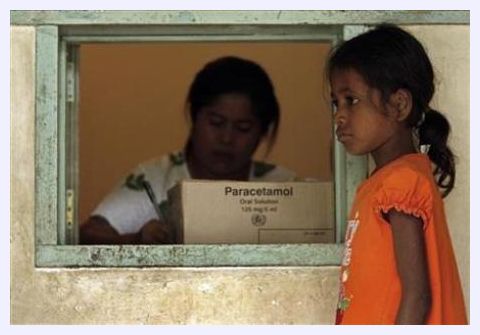
© Reuters/BeawihartaA child waits to receive immunisation against tuberculosis with the vaccine, BCG, in Dili, East Timor, May 7, 2007.
But more research is needed to clarify this and the benefits of paracetamol use for fever control still outweigh the potential of later allergy development, said Julian Crane, a professor at Otago University in Wellington and author of the report.
"The problem is that paracetamol is given quite liberally to young children," he told Reuters.
"There's a lot of evidence suggesting that something is going on here. It's not completely clear-cut, that's the problem."
The report, which has appeared in Clinical and Experimental Allergy journal, is based on the New Zealand Asthma and Allergy Cohort Study, which investigated use of paracetamol for 505 infants in Christchurch and 914 five and six-year-olds in Christchurch to see if they developed signs of asthma or allergic sensitivity.
"The major finding is that children who used paracetamol before the age of 15 months (90 percent) were more than three times as likely to become sensitized to allergens and twice as likely to develop symptoms of asthma at six years old than children not using paracetamol," Crane said in a statement.
"However, at present we don't know why this might be so. We need clinical trials to see whether these associations are causal or not, and to clarify the use of this common medication."
The research found that by six years of age, 95 percent of the study sample was using paracetamol and there was a significant increased risk for asthma and wheezing.
But the findings depended on how much paracetamol was being used, with the risk greater for those with severe asthma symptoms.
Crane said there were few other options for fever control in young children, noting that aspirin has dropped out of favor over about the last 30 years due to links between aspirin use and the potentially fatal illness Reye's syndrome in children.
"That timing fits quite well with the rise in the prevalence of allergies, but that may just be coincidence," Crane said.
He said that in the absence of other options and studies establishing a firm causal link, paracetamol should still be used for now.
"If I had a child with a fever, I'd give them paracetamol," he added.



The mainstream view is that fever is a symptom of infection by a pathogen.
An alternate theory is that the immune system, upon sensing an infection, raises the body temperature. The purpose is to slow down reproduction of a bacterium or replication of a virus, so that the T-cells can devour them, without being inundated.
If a fever is less than 103 F, does it pose any danger to the body? If not, then why reduce it?
Haven't we all heard the expression that someone's fever "broke," and that he's feeling better now? Doesn't it make sense to monitor temperature, and, if the fever doesn't spike too high, let it run its course?
Modern medicine focuses on symptomatic relief. Is this a mistake?