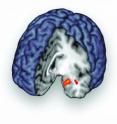
© University of MichiganThis is a brain image showing in orange/red one area of the brain where the natural painkiller (opioid) system was highly active in research volunteers who are experiencing social rejection. This region, called the amygdala, was one of several where the U-M team recorded the first images of this system responding to social pain, not just physical pain. Studying this response, and the variation between people, could aid understanding of depression and anxiety.
"Sticks and stones may break my bones, but words will never hurt me," goes the playground rhyme that's supposed to help children endure taunts from classmates. But a new study suggests that there's more going on inside our brains when someone snubs us -- and that the brain may have its own way of easing social pain. The findings, recently published in
Molecular Psychiatry by a University of Michigan Medical School team, show that the brain's natural painkiller system responds to social rejection -- not just physical injury.
What's more, people who score high on a personality trait called resilience -- the ability to adjust to environmental change -- had the highest amount of natural painkiller activation.
The team, based at U-M's Molecular and Behavioral Neuroscience Institute, used an innovative approach to make its findings. They combined advanced brain scanning that can track chemical release in the brain with a model of social rejection based on online dating. The work was funded by the U-M Depression Center, the Michigan Institute for Clinical and Health Research, the Brain & Behavior Research Foundation, the Phil F Jenkins Foundation, and the National Institutes of Health.
They focused on the mu-opioid receptor system in the brain -- the same system that the team has studied for years in relation to response to physical pain. Over more than a decade, U-M work has shown that when a person feels physical pain, their brains release chemicals called opioids into the space between neurons, dampening pain signals.


















Comment: The one underlying problem that often gets ignored is the very food we eat! See 'Carbohydrates rot the brain': Neurologist slams grains as 'silent brain killers' - and says we should be eating a high-fat diet and The Ketogenic Diet - An Overview for more information.