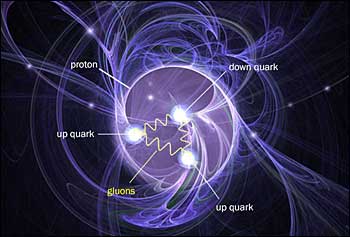
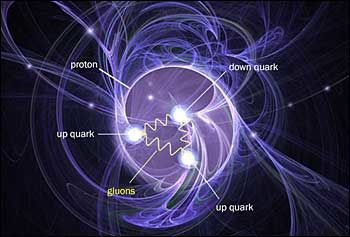
© phys.orgThe three valence quarks that make up each proton account for about one percent of its mass; the rest comes from interactions among the quarks and gluons.
By looking for ripples in the fabric of space-time, scientists could soon detect
"strange stars" - objects made of stuff radically different from the particles that make up ordinary matter, researchers say.
The protons and neutrons that make up the nuclei of atoms are made of more basic particles known as
quarks. There are six types, or "flavors," of quarks: up, down, top, bottom, charm and strange. Each proton or neutron is made of three quarks: Each proton is composed of two up quarks and one down quark, and each neutron is made of two down quarks and one up quark.
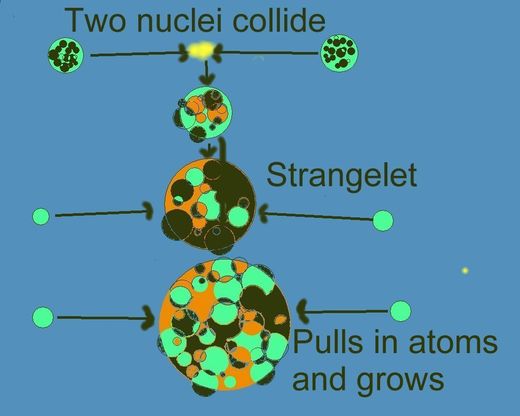
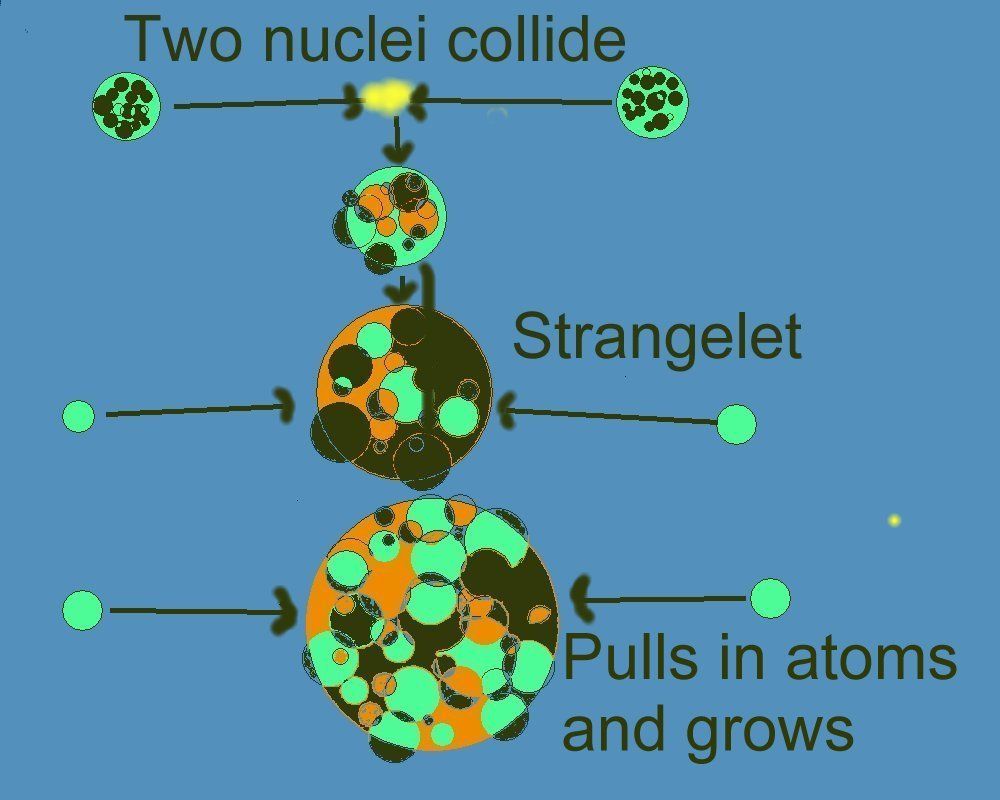
© cerntruth.wordpress.comStrangelet atom reaction.
In theory, matter can be made with other flavors of quarks as well. Since the 1970s, scientists have suggested that particles of
"strange matter" known as strangelets - made of equal numbers of up, down and strange quarks - could exist. In principle, strange matter should be heavier and more stable than normal matter, and
might even be capable of converting ordinary matter it comes in contact with into strange matter. However, lab experiments have not yet created any strange matter, so its existence remains uncertain.
One place strange matter could naturally be created is inside neutron stars, the remnants of stars that died in catastrophic explosions known as
supernovas. Neutron stars are typically small, with diameters of about 12 miles (19 kilometers) or so, but are so dense that they weigh as much as the sun. A chunk of a neutron star the size of a sugar cube can weigh as much as 100 million tons.
Under the extraordinary force of this extreme weight, some of the up and down quarks that make up neutron stars could get converted into strange quarks, leading to strange stars made of strange matter, researchers say.
















Comment: What is NASA doing other than making self-calming statements like 'one-in-a-thousand-years' and 'there is no threat'? The NASA "gorilla" consumes 16 billion American tax dollars every year. And yet they're doing nothing to inform the public, or protect them, against what is probably humanity's biggest existential threat.