
© RooM the Agency/Alamy Stock Photo
The ancient Greek physician first described "clubbing" in a patient with empyema (where pus fills the space between the lungs and the membrane around it) in the fifth century BC. Clubbing is where the nail looks like an upside-down spoon, and it is still recognised as a sign of disease.
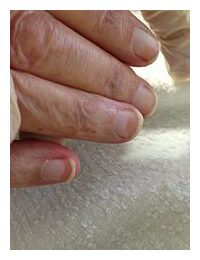
© Hojasmuertas/Wikimedia commons, CC BY-SATypical ground glass appearance of Terry’s nails.
Another nail change that can signal disease is Lindsay's nails. This is where one or more nails are half white and half reddish brown. Around 50% of people with chronic kidney disease have nails like this. But it can also be a sign of cirrhosis of the liver and Behcet's disease, a rare condition that causes inflammation of the blood vessels.
Terry's nails, where one or more fingernails have a ground-glass appearance, can also be a sign of cirrhosis of the liver, but they are also associated with type 2 diabetes, kidney failure and HIV.
And sounding a bit more medical and a bit less like a high street nail bar is Muehrcke's nails, which is where one or more horizontal lines run across the fingernails. This nail pattern indicates a decrease in the most abundant protein in the blood: albumin. These nail markings can be an indicator of kidney disease.
But sometimes changes in nail colour and pattern are not sinister and are merely signs of ageing. Neapolitan nails, so called because of their three distinct colour zones, are often seen in people over the age of 70 and are nothing to worry about.
Palms
Nails aren't the only part of the hand that can reveal ill health, though. The palms can tell a story too.
If you find your palms are becoming sweaty in the absence of nervousness, hot temperatures or exercise, it could be down to faulty nerve signals causing the sweat glands to become active. This can be benign, in which case it is called primary hyperhidrosis. But unexplained sweaty palms - and face, neck and armpits - can be a sign of thyroid problems.
Hyperthyroidism is where the thyroid gland in the neck produces too much thyroxine. Excess of this hormone causes bodily processes to speed up and can be the cause of sweaty palms. Thankfully, this condition is easily treated with the right drugs.
A more concerning palm change is the appearance of small areas of red or purple discolouration on the palms of the hands and fingers. This can be a sign of bacterial endocarditis (inflammation of the inside lining of the heart), which has a high mortality rate.
These discolourations come in two forms: Osler's nodes and Janeway lesions. Osler's nodes are typically painful red 1mm-10mm coloured nodules on the fingers appearing for hours to days, whereas Janeway lesions are irregular shaped with varying sizes and typically seen on the palms and are not painful, lasting few days up to a few weeks.
Both these palm patterns are very serious and urgent medical attention should be sought.
Pins and needles
If you experience pins and needles in your hand that you can't shake off, it might be a sign that you have carpal tunnel syndrome. This is where a major nerve (the median nerve) in the wrist is being compressed, causing numbness, tingling or pain.
It usually gets better without treatment, but a wrist splint can help to relieve pressure on the nerve. People who are overweight or pregnant are at greater risk of carpal tunnel syndrome.
Pins and needles in the hand can also be a sign of diabetes. Raised blood sugar in diabetes causes nerve damage that manifests as tingling or numbness in the extremities, such as the hands. This condition is called "diabetic neuropathy".
Everyone experiences pins and needles at some point, but if you get it a lot or it lasts a long time, you should see your doctor.
Finger length
The length of your fingers can give you some indication of your risk of developing certain diseases in later life.
The length of the index versus ring finger varies in men and women. In women, they are fairly equal in length, but in men, the ring finger is typically longer than the index finger. This is believed to be due to exposure to hormones in the womb.
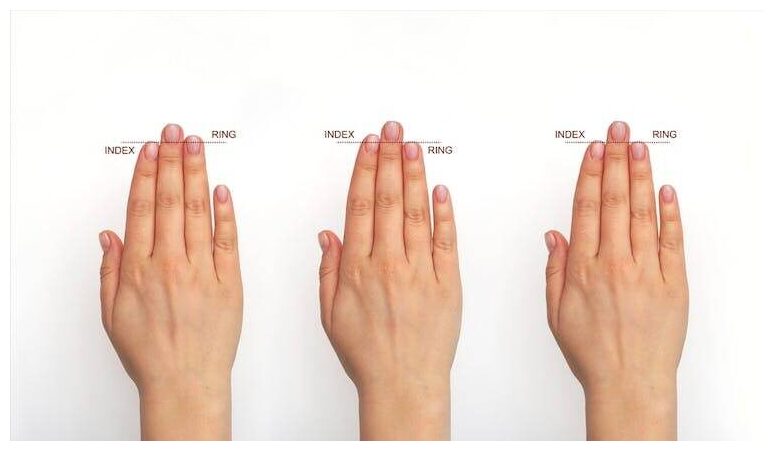
© logika600/ShutterstockYour finger length can reveal how much testosterone you were exposed to in the womb.
There is nothing you can do to change your finger length, but you can help stave off osteoarthritis by keeping a healthy weight, staying active and controlling your blood sugar levels. In fact, if you stick to that advice, you can stave off most illness.



Reader Comments
I have capable, strong hands, and I like them.
But actually, if I can do something for myself, I do. I was talking to a waiter the other day about capabilities, and he says he knows too many people who have no real, physical skills. Couldn't even paint a wall if they tried. I am the opposite. If at all possible, I do things myself. I know what tools are for, and how to use them. I married a do-it-yourself man, and just learned. Saves a lot of money, too.
The only interesting thing I know about hands is you have no muscles in your fingers. Fingers do not have muscles (other than arrector pili). The muscles which move the finger joints are in the palm and forearm. Fingers contain only tiny arrector pili muscles which are completely unrelated to motion. These muscles have nothing to do with the movement of fingers.
It is almost painless but can be a bit annoying...
Dupuytren's contracture (also called Dupuytren's disease) is an abnormal thickening of fascia, a layer of tissue under the skin, in the palm of your hand at the base of your fingers. This thickened area may develop into a hard lump or thick band. Over time, it can cause one or more fingers to curl (contract), or pull sideways or in toward your palm. The ring and little fingers are most commonly affected. In many cases, it affects both hands. Rarely, feet may also be affected. What causes Dupuytren's contracture? Dupuytren's contracture is believed to run in families (be hereditary). The exact cause is not known.
My dad had it, and i do to, been treated ones where they injected a fluid into the strains to soften them up, then they "break" the strains loose, under anesthetic, helped for half a decade, now the strains are growing back again, doctor said it's chronic, so it will come back eventually.
"Rh negative bloodline can signify the presence of antigens and the status of being immunogenic." [Link]
You are darn near 'Unicorn' status!!