
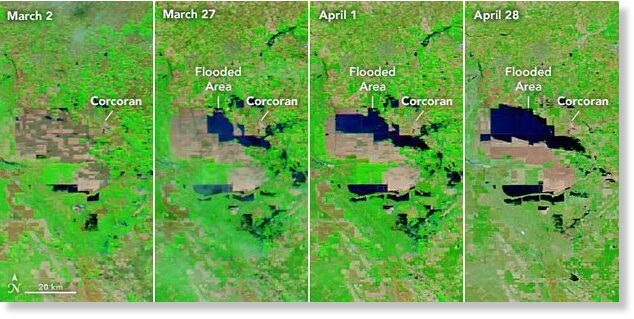
© NasaNasa satellite images show the progression of flooding in the Tulare Lake basin.
Taken between the start of February and the end of April and colored artificially to help distinguish the water from vegetation and bare ground, the images highlight the scale of the transformation across the region still grappling with the aftermath of this winter's heavy rains and snow.
This isn't the first time the "ghost lake" has caused widespread flooding, but the onslaught of weather whiplash wreaked havoc on residents, agricultural workers and farms - and it's far from finished.
Tucked against the Sierra Nevada's white-capped peaks, the region will have to reckon with surges of snowmelt filling its waterways as the weather warms. On Thursday, the snowpack in the southern Sierra was 436% of normal for this time of year, according to California's department of water resources (DWR).
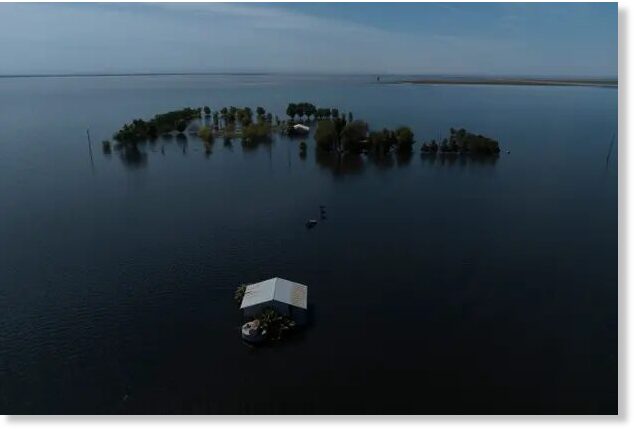
© Jae C Hong/APThousands of cows were lost to flooding in the Tulare Lake basin during California’s extremely wet winter.
The snowpack will lead to sustained high flows across the San Joaquin and Tulare basins over several months, Nemeth said.
Widespread damage has already been done. The rapidly rising waters forced evacuations across the region in early spring, as communities rushed to higher ground. In Tulare county - one of the world's largest milk-producing regions - thousands of cows were lost to the floods, while roughly 75,000 had to be trailered to safety. Growers were washed out of key crops and workers lost out on jobs across the waterlogged valley.
Decades have passed since Tulare - once the largest body of fresh water in the west - served as a vibrant wetland sprawling across nearly 800 sq miles. Carved up with canals and cleared for the cropland and livestock pastures in the late 19th and early 20th centuries, the basin now spans across multiple counties and is home to roughly 4 million Californians.
About half a dozen towns remain at risk from flooding, including Corcoran, where city officials are rushing to raise a sinking levee before the waters rise further. Stretching across 14.5 miles, the levee protects against flood waters up to 188ft. In March, Tulare Lake levels crept close, rising to 178ft.
"The Corcoran community only has a small window of time and dry conditions before the Sierra Nevada Mountain Range snowmelt runoff converges with existing floodwaters in the Tulare Lake, and against the Corcoran Levee," emergency officials warned in a press release in April, noting that requests for state and federal funding had been made.
Snowmelt is "projected to increase the Tulare Lake water to a dangerously high level that significantly intensifies the risk of overflow and erosion on the Corcoran Levee", they added.
Nasa's satellite images show areas where water managers have already redirected flows, filling ponds that will allow the water to seep underground and feed depleted aquifers. The DWR has initiated emergency work to pump high river flows away from the floodplain and into these recharge basins. Over the next four months, the plan could capture more than 55,000 acre-feet of water, according to the agency. (One acre-foot represents the amount of water needed to cover a football field a foot deep.)
But along with bolstering the levees and other protections, some have advocated for a more permanent return of the lake, stewarded as an environmental resource.
Others are also pushing for more water to be diverted into the historic lakebed ahead of the snowmelt, arguing that flooding the basin will alleviate overflows upstream and protect those who call the area home.
"This year will result in record high amounts of water entering the Central Valley between Fresno and Bakersfield," resident Martin Chavez wrote in both English and Spanish on an online petition signed by hundreds. "Communities on the front line will first face the danger of this statewide issue, as the water is directed downstream out of stressed reservoirs."



Reader Comments
I hope this is a salient reminder that mother nature is a bitch and can't be controlled. I think about these things every time I hike through ancient riverbeds which are one really wet season from being rivers again, and maybe a decade's worth of wet seasons from becoming permanent for a few decades or centuries.
Water meadows stretching dozens of miles along the river where declared "building land". Especially after the fall of the Eastern Bloc, real estate speculators and construction companies made millions.
After some catastrophic floods between 2000 and 2010, thousands lost their houses, insurances, or both.
Our ancestors were a bit smarter in this regard - usually.
Hardly ever did they such foolish things.
As said that changed somehow 30 years ago. Even a wet meadow in my parent's village, where never anyone built for centuries, was suddenly declared "building ground". And sure enough, after less than 10 years, the new building developed huge vertical cracks ...
The decline is visible in almost every aspekt ...