

Christian Kanstrup Holm
But now the numbers are out, and according to two Danish professors, Christian Kanstrup Holm, a virologist and Professor at the University of Aarhus, and Morten Petersen, Professor of Biology at the University of Copenhagen, in an article in the Danish newspaper Berlingske Tidende on July 8th, excess mortality in 2020 and 2021 was in fact the same in both countries.
In Denmark, harsh restrictions were justified by the need to prevent the breakdown of the healthcare system and the public has generally accepted this justification. The professors' conclusion however is that this justification does not hold: despite very few restrictions in Sweden, the Swedish healthcare system was never even close to breaking down.
In 2020 the Swedish certainly saw excess mortality while mortality in Denmark remained approximately the same as in previous years (see chart below). But in 2021 the situation is reversed, according to the data. The two professors also point out that in 2020 there was in fact no excess mortality in Sweden among those below the age of 75, which simply confirms how COVID-19 primarily attacks the oldest.
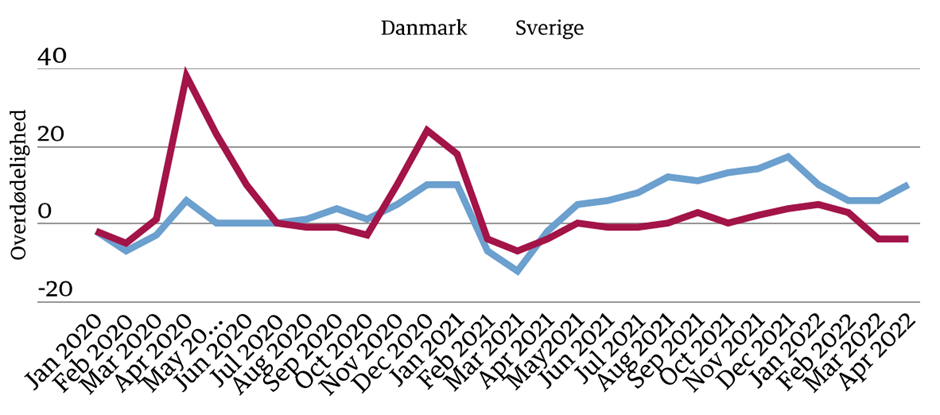
Excess mortality in Sweden (red) and Denmark (blue)
"It often happens," the authors say, "that individuals, groups or even whole populations get caught in false dichotomies. Those are commonly based on powerful anecdotes and lead to a general acceptance of the validity of one or more claims, which do not stand up to scrutiny." While some false beliefs may be harmless, "they can also persist for a long time, even if they have serious negative consequences, both for individuals and whole populations".
They urge the authorities to make sure that in the future all consequences, including negative effects of restrictions on public health, psychological well-being, education and the economy be considered. For this to happen "it is crucial to have the courage to debate and analyse".



________
Rospotrebnadzor does not intend to introduce COVID restrictions due to the increase in incidence in the Russian FederationThere is an update from 08:28 → The share of new "omicron" variants in the COVID-19 structure in Russia has approached 39%
Moscow. July 13 INTERFAX.RU - The introduction of restrictions in Russia in connection with the increase in the number of new COVID-19 cases is not required because the infection caused by the BA.4 / BA.5 sub-variants is milder than the disease is provoked by the initial "alpha" and "delta" strains of coronavirus, Rospotrebnadzor said.
"The disease caused by the BA.4/BA.5 sub-variants is milder than that caused by the alpha or delta strains. The introduction of any anti-epidemic restrictions due to the increase in the number of detected COVID-19 cases is not required," reporters at the ministry were told after the results of a teleconference between Rospotrebnadzor head Anna Popova and the heads of territorial units and departments of the department.
Rospotrebnadzor noted that a significant change in the number of severe cases and hospitalizations due to the spread of the new Omicron subvariants, which are more easily transmitted from person to person, is unlikely.
At the same time, the ministry stressed that due to the increase in BA.4 and BA.5 cases, "citizens are not advised to neglect basic precautions."
"People in sensitive categories, including those diagnosed with chronic diseases, should wear masks in public places, and use antiseptics," the ministry reported.
In addition, Rospotrebnadzor reminded that the recommendation to undergo repeat vaccinations against COVID-19 every six months remains .
Earlier, Moscow's operations headquarters announced an increase in the incidence of COVID-19 in the capital, linked to the spread of new "omicron" subvariants of strains BA.4 and BA.5. Moscow authorities also recommended that citizens wear masks indoors. Later, authorities in St. Petersburg and the Kaluga region issued recommendations to wear masks in public places.
Rospotrebnadzor reported the appearance of sub-variants of the "omicron" strain BA.4 and BA.5 in Russia in mid-June. Both variants, according to experts, are characterized by the fact that they spread more easily between people and are harder for the immune system to track.
On July 6, the director general of the World Health Organization (WHO), Tedros Adhanom Ghebreyesus, reported a 30 percent increase in coronavirus cases worldwide over the past two weeks. He explained that in Europe and America, the increase in incidence is related to the spread of the BA.4 and BA.5 subvariants.
On July 8, the head of the Yekaterinburg Research Institute of Viral Infections FBSI SRC VB "Vector" Rospotrebnadzor, MD, PhD, Alexander Semenov, said that a new increase in the incidence of coronavirus in Russia is possible with the emergence of new subvariants of the virus and a decline in herd immunity. At the same time, he noted that the situation with COVID-19 is under the control of Rospotrebnadzor and there is no need for any restrictions.
[Link]