
© Reuters / Sarah MeysonnierTesla on the road
David Colombo, who is based in Germany, shared the feat on Twitter saying the fault does not fall on the Elon Musk-founded company, but on owners of the Teslas.
The flaw is said to have been found in third-party software that allowed Colombo to unlock doors and windows, start the cars without keys and disable security systems.
He also tweeted the vulnerability lets him use the internal Tesla cameras to spy on the driver.
© David ColomboDavid Colombo was able to exploit a flaw in third-party software installed in Tesla cars and take control of them
'I'm in contact with the Tesla Product Security Team as well as the third party maintainer to coordinate disclosure and get the affected owners notified as well as a mitigation/patch for the vulnerability rolled out.'
The issue with the software is how it stores the Tesla owner's information that is needed to link the cars to the program.
© David Colombo/Twitter
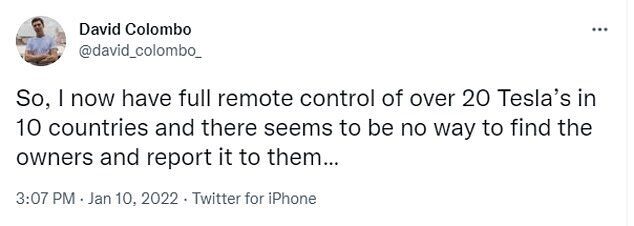
However, he is unable to 'intervene with someone driving (other than starting music at max volume or flashing lights).'
Although Colombo has not provided details of the software, Twitter users are making their own guesses.
Tyler Corsair tweeted: 'These owners utilized an open-source project called Teslamate and then configured it incorrectly (partially the dev's fault for setting bad default configurations) so that anyone could access it remotely.'
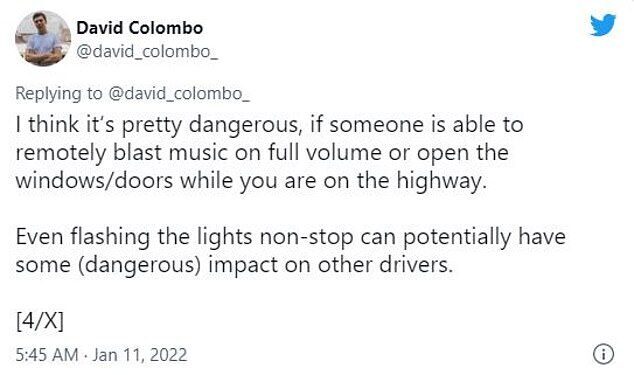
© David Colombo/TwitterThe flaw is said to have been found in third-party software that allowed Colombo to unlock doors and windows, start the cars without keys and disable security systems
Corsair posted several updates from similar third-party software companies, stating they had seen Tesla accounts disconnect from the service - all of which was due to Colombo infiltrating the systems.
These include TezLab, TeslaFi, TeslaTip and keemut.
Corsair tweeted: 'This seems to not be impacting all installations (seems less likely if authenticated within the last few months) which is great! Many third-party services have been impacted by this in different ways. For most, just reconnecting your Tesla Account will resolve the issue.
He continued to explain in another tweet that Colombo's warning is not as dramatic as it may seem.
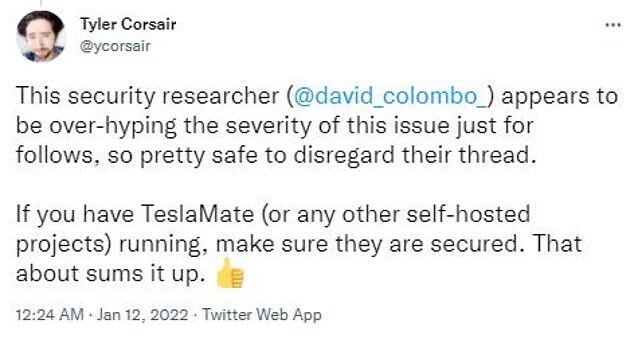
© Tyler Corsair/Twitter
Colombo told DailyMail.com in response to Corsair's tweet: 'I don't think I'm trying to make this look worse at it is.
'But I fully understand that there's a lot of hype and speculation around this due to the limited details I'm able to provide to the public at this point in the disclosure.'
He continued to explain that if it was not an issue than the Tesla Security team would not be investigating it.
'If my reports to the involved parties would not have some kind of severity then the Tesla Security Team would probably not investigate this issue, the third-party maintainer would probably not release patches in connection to this and tech / cyber security reporters with access to my writeup probably would not have reported on this issue in the way they do,' Colombo said in a direct message.







Danny Casolaro is a good start if you appreciate information like this. I "PROMIS".