
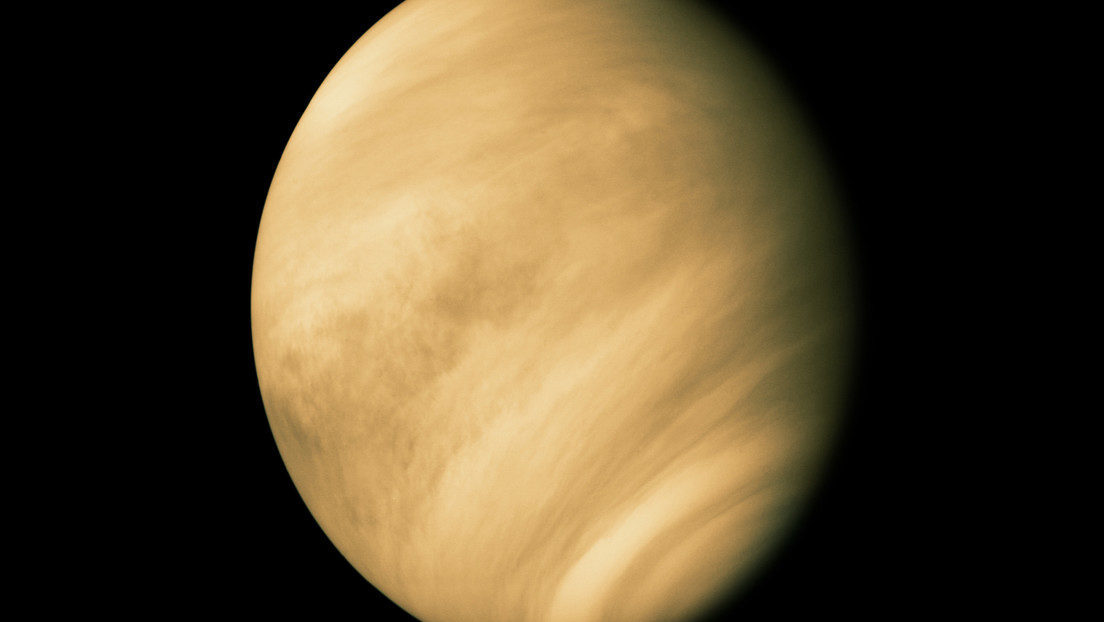
© Michael Benson / AFPVenus
This overturns a previous theory that these 'volcanic structures' - first spotted through satellite observations of the planet - were long extinct.
Researchers from the University of Maryland and the Institute of Geophysics, Zurich, created 3D models to investigate whether the coronae could be geologically active.
They found that rather than coronae being formed from geological activity more than 500 million years ago, they come from currently active processes. The ring-like structures are formed when hot material from deep inside the planet rises through the mantle and erupts through the crust.
This discovery 'significantly changes' the way in which scientists will view the second planet from the Sun in future, according to the team behind the research.
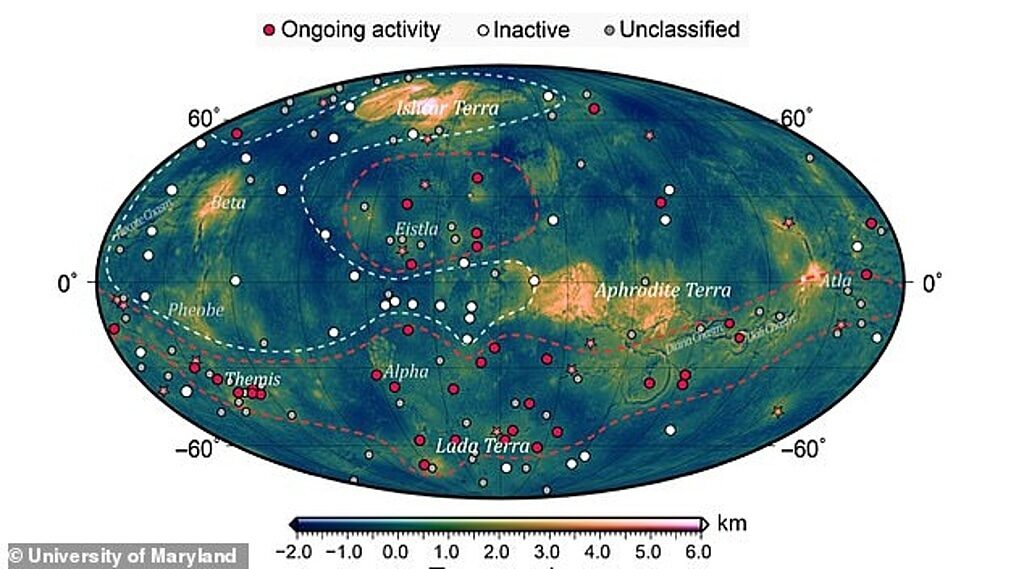
© University of MarylandResearchers say there are currently 37 'coronae' on Venus created and being shaped by current geological processes. It was previously thought the most recent activity that led to these 'ring-like features' happened 500 million years ago
Laurent Montési, a professor of geology at the University of Maryland, said it was the first time they'd been able to point to a specific structure on Venus and say 'look, this is not an ancient volcano but one active today'.
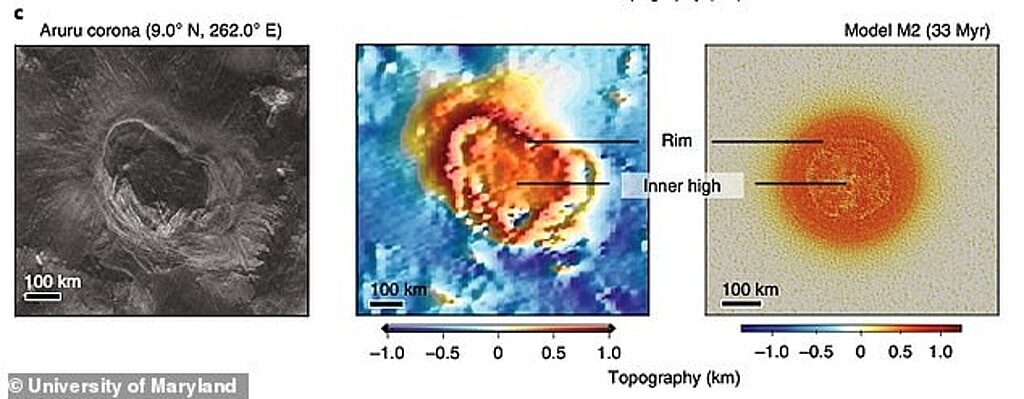
© University of MarilandThe team studied different images of coronae taken from orbiting satellites and compared them to 3D computer models they created themselves
With 65 per cent of the planet consisting of a mosaic of volcanic lava plains, scientists have known for some time Venus has a younger surface than the other 'non-Earth' rocky planets Mars and Mercury.
Evidence of a warm interior and geologic activity dots the surface of the planet in the form of ring-like structures known as coronae.
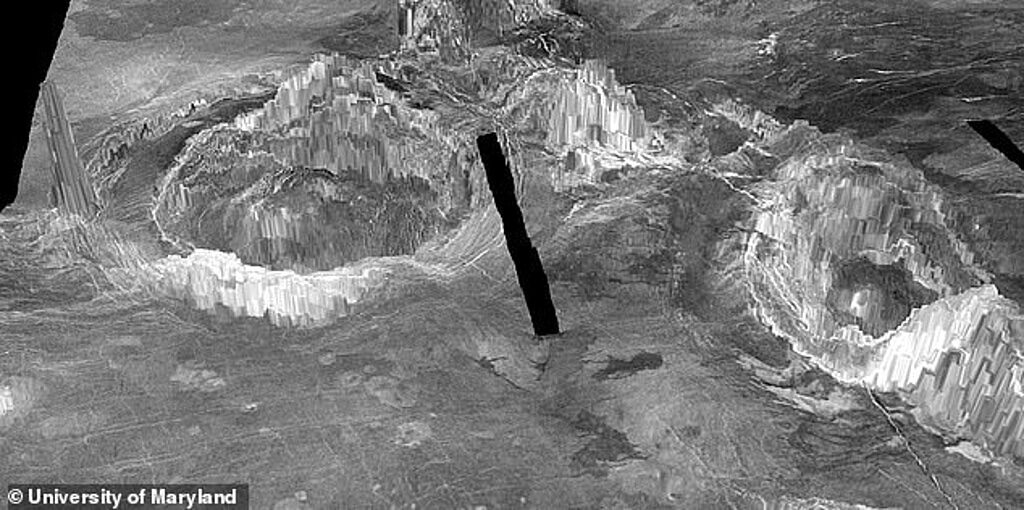
© University of MarylandThe 3D rendition above shows two coronae observed on the surface of Venus. The ring-like structures are formed when hot material from deep inside the planet rises through the mantle and erupts through the crust. The black line is a gap in data rather than showing anything
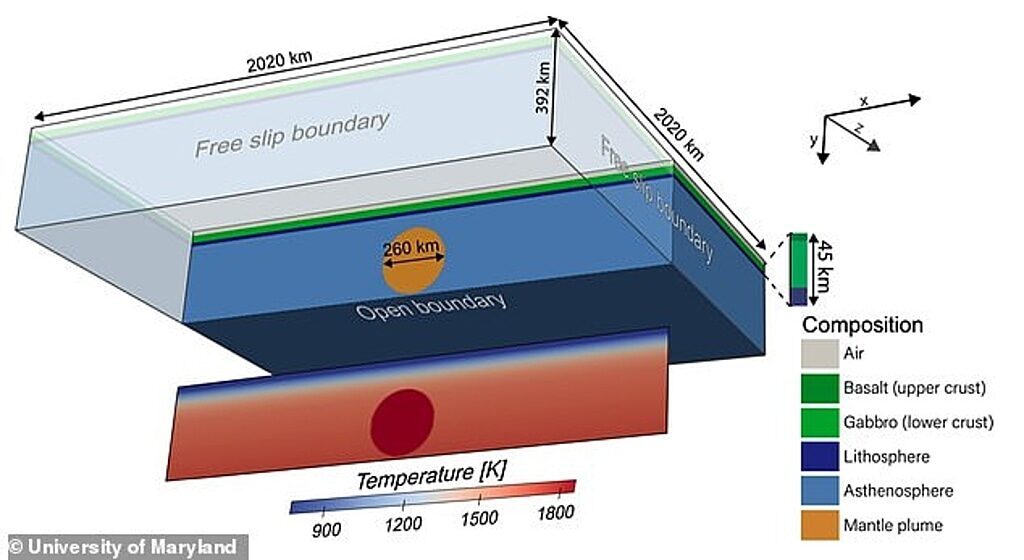
© University of MarylandThis is a 2D cross-section through the centre of the model of Venus created by the researchers to determine how 'tectonic' and other activity might occur. It shows in weak areas of lithosphere plumes are able to break through and form circular 'coronae' on the surface
It was previously thought the coronae on Venus were signs of ancient activity from 500 million years ago rather than anything happening more recently.
But now, with numerical models of thermo-mechanic activity to create high-resolution 3D simulations of coronae formation, the US and Swiss team were able to show that volcanoes are still active and still changing the planet's surface.
Montési said: 'The improved degree of realism in these models over previous studies makes it possible to identify several stages in corona evolution and define diagnostic geological features present only at currently active coronae.
'We are able to tell that at least 37 coronae have been very recently active.'
The active coronae on Venus are clustered in a handful of locations, rather than being spread evenly over the planet, according to the team behind the study. This suggests there are some areas where the planet is most active than in others - providing clues to the workings of the interior of Venus.
'Our study presents new evidence for recent tectonic and magmatic activity on the surface of Venus, complementing other indications of such activity,' they said.
'The global arrangement of active coronae suggests a large-scale organization of tectono-magmatic activity on the planet.'
These results may help identify target areas where geologic instruments should be placed on future missions to Venus.
This could include Europe's EnVision that is scheduled to launch on Venus in 2032.
They say that areas with a thin lithosphere allow plumes from deep inside the planet to penetrate through and form a coronae.
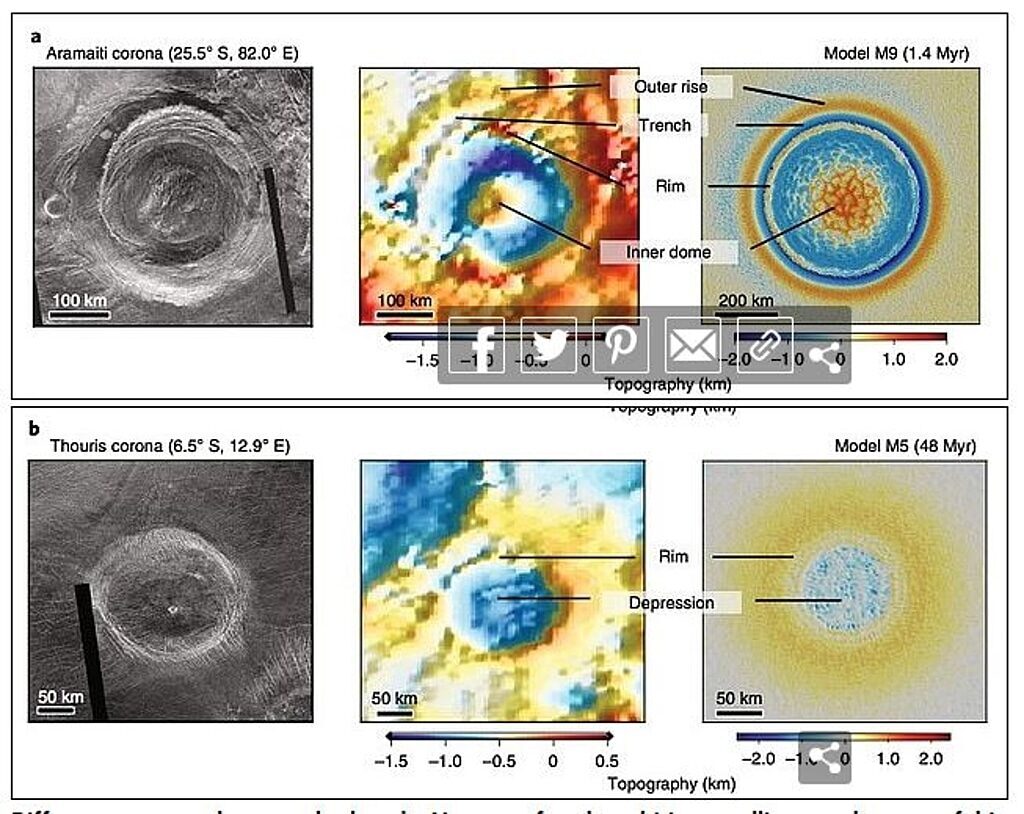
Different coronae photographed on the Venus surface by orbiting satellites used as part of this study into how they may have formed including Aramaiti (top) and Thouris corona (bottom)
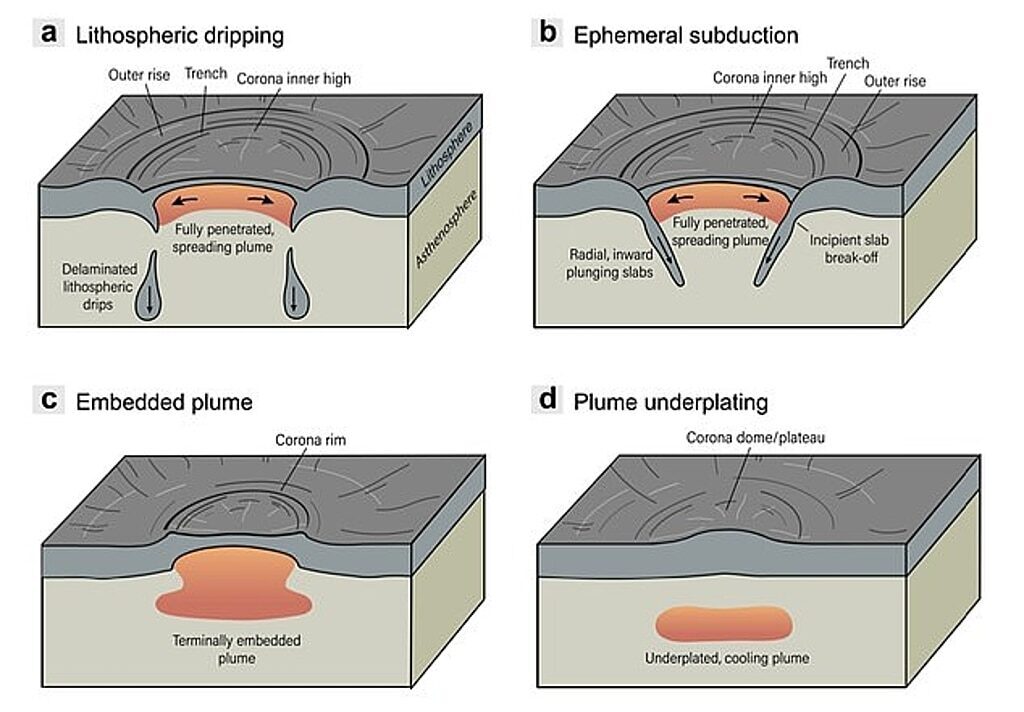
These sketches of the four different processes predicted to exist inside Venus for creating different types of coronae on the surface
They say this is due to limitations in their own data and a lack of high-resolution topography data from the surface of Venus itself.
'Improvements on numerical techniques and resolution are needed to allow for better comparisons with different types of datasets' including information gravity, heat emissions, lava flows, and actual images of the surface, they said.
'Furthermore, any future mission that would collect more and higher-resolution topographic and geo-dynamic data of the planet would help further determine the activity of coronae and other geological/volcanic features.'
This would substantially contribute new understanding of the interior dynamics of Venus and the evolution of terrestrial planets in general.
The study was published in the journal Nature Geoscience.



Comment: See also: The Seven Destructive Earth Passes of Comet Venus