
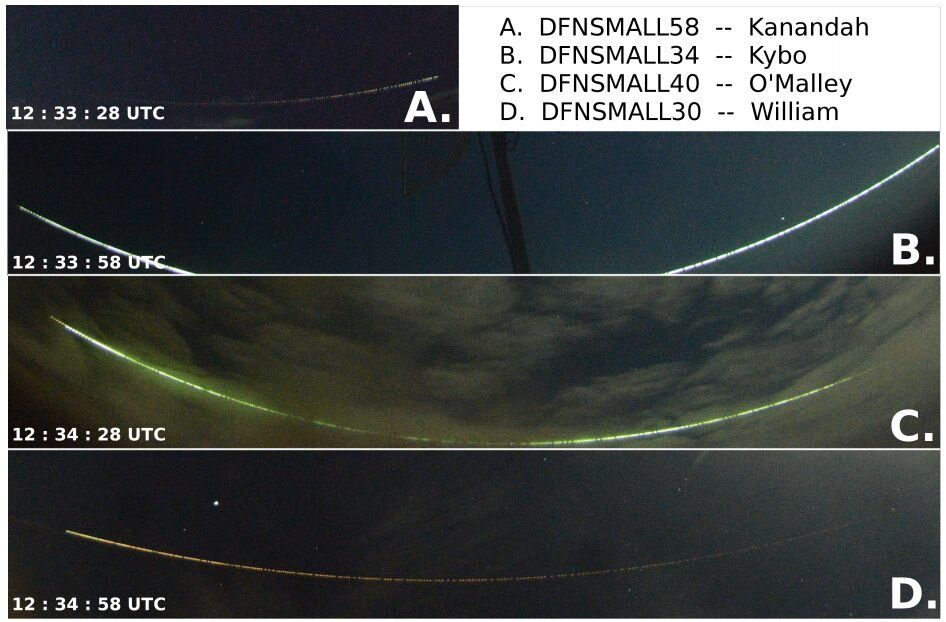
© arXiv:1912.01895 [astro-ph.EP]Long exposure images of event DN170707_01. The event lasted over 90 seconds and spanned four 30 second exposures (A, B, C, D). The fireball was first observed at 85 km altitude, reached as low as 58 km, and then was visible until 86 km before escaping the Earth’s atmosphere. The initial velocity was 16.1 km s−1 , and the exit velocity after passing through the atmosphere was about 14.6 km s−1 . The images are all oriented so that the fireball travels from left to right (west to east).
Back in 2017, a meteor tore through the atmosphere over Australia. It was notable for its duration — it lasted for approximately a minute and a half. In this new effort, the researchers have found that the object was a meteor for just a short period of time — it never struck the Earth. Instead, the object headed back out into space. Such meteors are known as grazing fireballs because they only graze the Earth's atmosphere rather than plunge through it. This is possible due to the angle at which it approaches. Like a rock that skips off the surface of a lake rather than plunging in, a meteoroid can skip off the atmosphere if its angle is very small.
The researchers with this new effort used data from Australia's Desert Fireball Network — a group of space enthusiasts who capture video of space objects that appear overhead. The network is the largest in the world and, as its name implies, is focused on learning more about space objects that make their way to Earth.
The researchers report that the 2017 grazing fireball traveled across the sky at approximately 35,000 miles per hour and lit up the sky for approximately 808 miles — and slowed by approximately 0.9 miles per hour during its time in our atmosphere. It also reached a minimum height of just 58.5 kilometers. They also estimated that the space rock had a diameter of approximately 12 inches and weighed approximately 60 kilograms. They noted that the scorching endured by the rock was enough to force some pieces of it to break off during its fiery trip. The researchers say that the space rock will likely remain in its orbit around the sun for approximately 200,000 years before being ejected from the solar system.



Comment: See also: Astronomers suspect 2016 meteor fireball event in Australia was caused by asteroid that had been 'captured' by Earth's gravity