
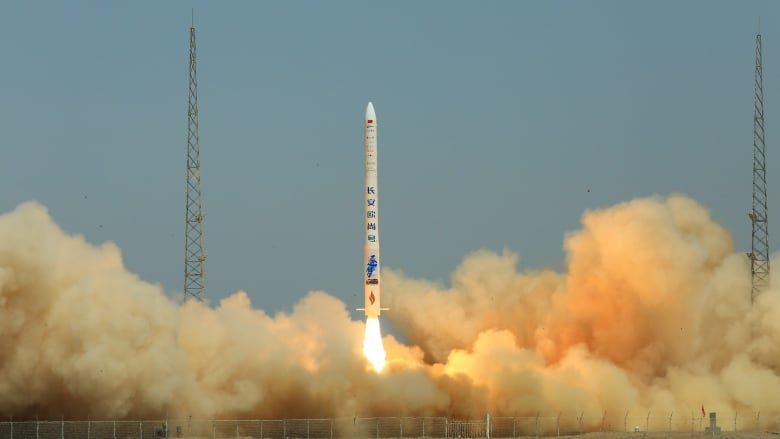
© Chinatopix via Associated PressA carrier rocket developed by a Chinese private company successfully launches to send two satellites into orbit from the Jiuquan Satellite Launch Center in northwest China, Thursday, July 25, 2019. The SQX-1 Y1, developed by a Beijing-based private rocket developer i-Space, is a four-stage small commercial carrier rocket.
Named SQX-1 Y-1, the self-developed carrier rocket carried two satellites and several experimental payloads.
It is thus far the largest and most powerful rocket built by a private Chinese space company, the Beijing-based start-up said.
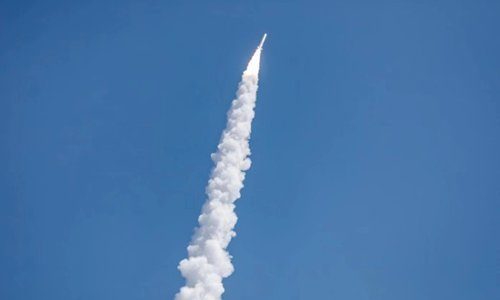
Fueled by solid propellant, the iSpace rocket made its breakthrough "from zero to one" for China's private commercial space sector by realizing successful orbital launch while carrying several satellites, and utilizing space advertising and video transmission.
© Chen Xiao
Prior to the iSpace launch, two domestic private rocket firms - LandSpace and OneSpace - failed in their orbital launches in October 2018 and March this year, respectively.




Comment: Just a few days ago India launched an unmanned mission to the far side of the moon following delays due to a "technical snag".
See also: