
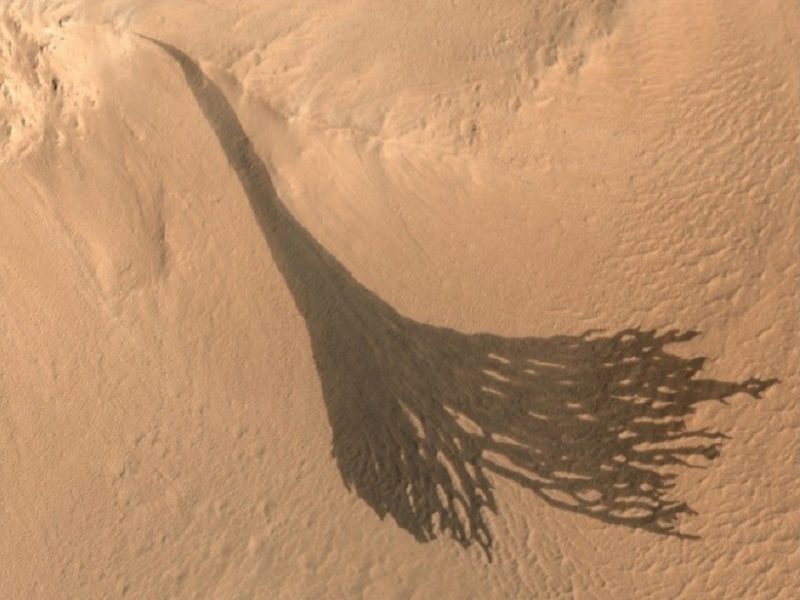
Luckily, improvements in high-resolution sensors and imaging capabilities - as well as improved understanding of Mars' seasonal cycles - is bringing us closer to an answer. Using a terrestrial analog from Bolivia, a research team from Sweden recently conducted a study that explored the mechanisms for streak formation and suggest that wet mechanisms appear to account for more, which could have serious implications for future missions to Mars.
The study, titled "Are Slope Streaks Indicative of Global Scale Aqueous Processes on Contemporary Mars?", recently appeared in the Reviews of Geophysics, a publication maintained by the American Geological Union (AGU). The study was conducted by Anshuman Bhardwaj and his colleagues, all of whom hail from the Luleå University of Technology in Sweden.

© Bhardwaj et al. (2019)Four of the most commonly observed morphologies of slope streaks.
"What we know from observations is the following: Slope streaks range from about a few meters to several kilometers long. They usually have a starting point upslope with gradual widening towards the downslope termini, thus indicating the possible involvement of some flow or mass movement. They are capable of following very gentle slopes and are reportedly able to climb even a few meters of obstacles in their flow paths. Slope streaks can appear anytime of the year in the equatorial and subequatorial regions of Mars. They appear to be singular events formed within a short temporal span, and their recurrence, or lengthening, is extremely rarely observed. They gradually fade over decadal timescales."
Despite the progress that has been made in studying these features, the scientific community remains divided into two camps when it comes to what causes Martian slope streaks. Those who belong to the "wet" mechanism school of thought believe that liquid water could be responsible for their creation, possibly as a result of groundwater springs, melting surface ice, or the formation of brines (salt solutions).
In contrast, those who fall into the "dry" mechanism school theorize that dust avalanches are responsible. These, in turn, could be caused by air fall deposits, subsurface melting, or localized disturbances - ranging by rockfalls, meteorite impacts, or tectonic activity ("Marsquakes"). Both of these explanations have limitations when it comes to explaining observed slope streaks.

© Bhardwaj et al. (2019)The cyan curves show the geographic distribution of slope streaks on Mars.
What's more, slope streaks have been found to climb over obstacles in many instances, which is not consistent with liquid-driven displacement. Similarly, the dry mechanism explanation also suffers from a number of inconsistencies and challenges when considered on its own.
For starters, if slope streaks were caused by the displacement of dry mass, scientists would have observed disturbances alongside them, not to mention a buildup of debris at their lowest point downslope. In the majority of cases, neither of these have been observed. At the same time, dry mechanisms cannot explain why some streak formations extend for kilometers.
To shed further light on this, the team investigated an "wet analog" site in Salar de Uyuni, an Andean region in southwest Bolivia. This region, which is the largest salt flat in the world, experiences similar atmospheric and surface conditions as the equatorial region of Mars. This results in seasonal brine flows where chloride and sulphate salts become liquefied and create slope streaks.
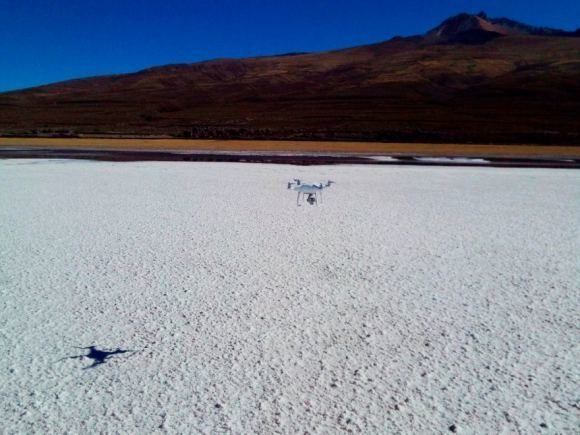
© Anshuman BhardwajDrone-based mapping of the Martian brine analogue environment in Salar de Uyuni, Bolivia.
After conducting drone-based observations of the region, the team determined that these streaks are a sufficient analog for a wet mechanism on Mars. They also recommend further studies, which could provide important clues about Martian brines and other surface features that have been linked to the transient occurrence of liquid water on Mars. As they conclude:
"While available remote sensing data has vastly improved, as well as our knowledge of Martian mineralogy, climate, and atmosphere, we still need further investigations to advance our understanding. In this regard, targeting slope streak regions during future robotic or manned Mars missions would be advantageous."
Essentially, salt water or liquid flows could explain many of Mars' slope streaks, but certain inconsistencies demand further research. Over time, we may learn that other mechanisms are involved, which could range from subsurface features to specific seasonal changes.
The subject of what causes these streaks and other transient surface features is important for many reasons, not the least of which has to do with planetary protection. In Sept. 2016, the Curiosity Rover encountered dark streaks while driving along the sloping terrain of Mount Sharp, which required that it alter its path to avoid contact and possible contamination of the site.
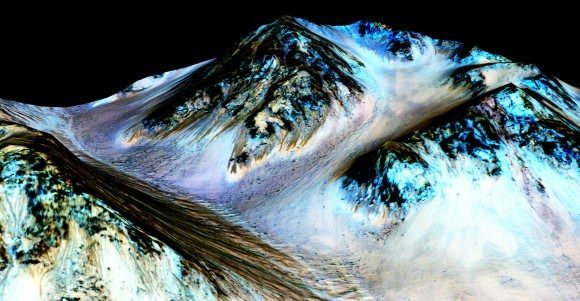
© NASA/JPL/University of ArizonaA dark, narrow, 100 meter-long streak called lowing downhill on Mars.
Before we can send astronauts to the surface Mars, or contemplate creating a permanent human presence there, we need to know where to step and what to avoid!
Further Reading: EOS, Review of Geophysics



Comment: It seems that the scientists are yet to find an adequate explanation. It's likely there are clues to be found in the other discoveries relating to Mars and its environment, see:
- Scientist Discovers Plate Tectonics On Mars
- Canyons flowing from Mars' craters likely caused by catastrophic flood events
- Massive subsurface ice sheets offer potential water source for future explorers of Mars
- NASA's astronomers perplexed over mysterious deep hole on Mars
- Stunning side-by-side video of Mars shows how the planet-wide dust storm has transformed the surface of the red planet
- Life on Mars? Study suggests mud and clay probably have microbe fossils - NASA discovers best evidence yet
And check out SOTT radio's: