
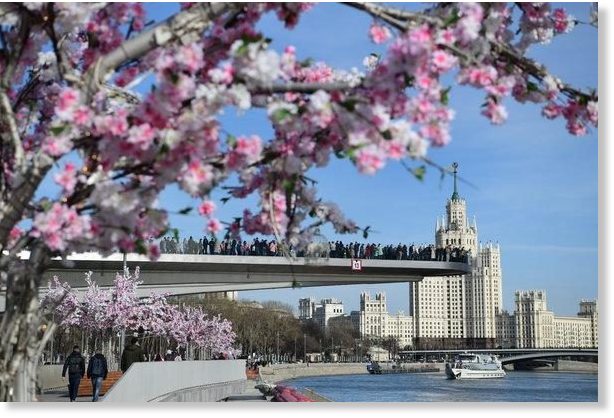
© James HillThe floating bridge in Zaryadye Park extends over the Moscow River. The park, which opened in 2017, is one of the most ambitious and expensive architectural projects carried out in Russia for several decades.
But Mr. Kudryavtsev, a partner at Citymakers, the Moscow-based urban planning team that worked on the project with the architects, was soon proudly pointing out how the numerous buildings on the 35-acre site have been tucked under curving, plant and tree-filled slopes. Each of these, he explained, represents an aspect of Russia's varied regional landscapes: tundra, the steppe, the wetlands, birch forests.
He led the way through birch trees and meadow grasses, past an undulating glass canopy that covers a concert hall, with views toward the Kremlin, down to a spectacular, boomerang-shape bridge that hovers, seemingly unsupported, over the Moscow River. Children shrieked excitedly and posed for photographs, while adults gazed across the river at the Kotelnicheskaya Embankment Building, one of seven Stalin-era skyscrapers.
The park, which opened in September, is framed by the Kremlin, Red Square, St. Basil's Cathedral and the Moscow River, and unusually for Russia, it is entirely open to the city on all sides.
"The park is conceived as a way of getting lost in the middle of the city," Elizabeth Diller of Diller Scofidio & Renfro said in a telephone interview. "Most parks in Russia are very formal; how you enter, where you walk, where the plants live, not sitting on the grass. In our scenario, we envisioned a park where anyone could walk in any direction, and people could gather."
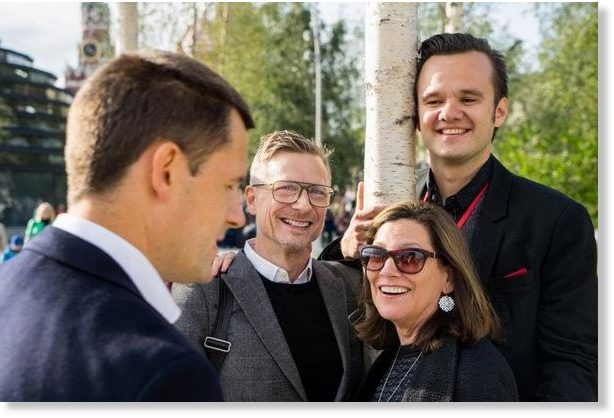
© Alina RogozhinaFrom left: Sergey Kuznetsov, Moscow’s chief architect; Charles Renfro of the architectural Diller Scofidio & Renfro; Mary Margaret Jones of the landscape architects Hargreaves Associates and Petr Kudryatsev of Citymakers, an urban planning consultancy.Credit
Developers began to compete for the site with designs for apartment, hotel and shopping complexes. A Norman Foster project was approved in 2007, then canceled after Sergei S. Sobyanin was appointed mayor of Moscow in 2010 and made green space a priority for the city, said Sergey Kuznetsov, Moscow's chief architect. Over tea and thick cranberry juice in a glamorous Soviet space-travel-themed restaurant at the park - the waitresses wore navy boilersuits and saltshakers came in the shape of white-helmeted cosmonauts - Mr. Kuznetsov explained that after he was appointed to oversee urban planning in City Hall in 2011, he found that an architectural competition for the site had led to nothing.
"It didn't have the right technical brief, and we collected about 100 ideas, but it was total rubbish," he said bluntly.
Around the same time, Mr. Kudryavtsev, with his Citymakers partner Andrey Grinev, began advocating a purely green space, and lobbying governmental bodies. They formed a Friends of Zaryadye group, inspired by Friends of the High Line, which had successfully campaigned for the restitution of a disused elevated rail track on Manhattan's West Side led by Diller Scofidio & Renfro.
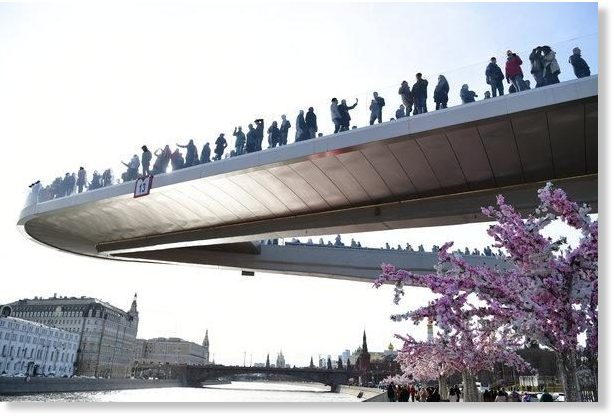
© James HillA Friends of Zaryadye group, inspired by Friends of the High Line in New York, campaigned for the park to be built on the site of what was once Europe’s largest hotel.
Mr. Kudryavtsev asked Ms. Diller if her office would team up with Citymakers, and the architects invited the landscape architects Hargreaves Associates to join the project.
"We were a little skeptical," Ms. Diller said. "It was during the Snowden period, there was a coolness in relations between Russia and the United States, and honestly, no one thought we had a chance," she said, referring to Edward J. Snowden, a former National Security Agency contractor who received temporary asylum in Russia.
The team made the shortlist of six finalists, and then it won.
There had "absolutely" been pressure to choose Russian architects, Mr. Kuznetzov said. "After we announced the winners, the mayor's office was deluged with letters criticizing the project and calling me an enemy of Russia," he said, adding that more than 60 percent of Moscow had been built by foreign architects.
"It's a very Russian tradition to resist influences from abroad," he said, but the success of the park had silenced the criticism. "It has become a standard, a new image of what can be done."
The park cost around 14 billion rubles, he said, or roughly $283 million at the time; the ruble has since devalued.
Kirill Martynov, the political editor of the newspaper Novaya Gazeta, told the Echo of Moscow radio station that the park's cost were hard to justify at a time when many Muscovites faced financial hardship. "People's incomes have been falling for four years in a row, and here, just imagine, some kind of exotic lichens have been brought to Moscow," he said, according to a report on the Radio Free Europe website.
The central principle of the design, which Charles Renfro described as "urbanity gives up to nature," was an unusual one for Russia. "When you look at landscape in Russian fairy tales and literature, you see that nature is outside of the city and something 'other,' " said Mary Margaret Jones, a senior principal at Hargreaves Associates.
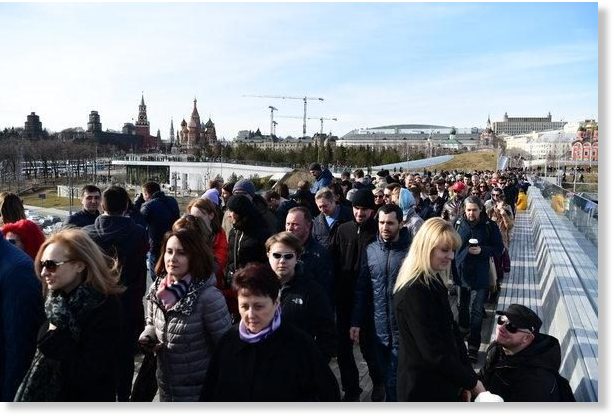
© James HillZaryadye Park has been visited by over 9.5 million people since it opened in September 2017.
Zaryadye Park has been a huge success, visited to date by over 9.5 million people. Were the architects at all worried about effectively promoting a government often seen as problematic in its policies and approach?
"I can't say we didn't think about that," Ms. Diller said. "However, national governments are failing us all, period."
She added: "As architects, we can have an impact. Cities actually have the most opportunity to change the lives of citizens. I think one has to think beyond the regimes."
Charly Wilder contributed reporting.





Comment: One wonders if the hopelessly biased, propagandistic and Russophobic NY Times would have even published this article if it weren't for the fact that the architects were American. Still, if Americans and Russians can work together to beautify anything in a world turning uglier by the day - then why the heck not?