
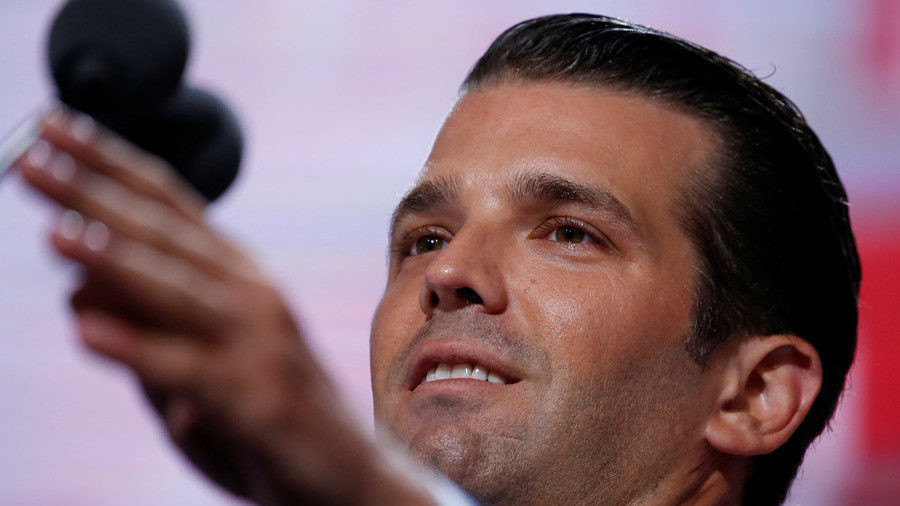
© Carlo Allegri / Reuters
Trump made the remarks at the premiere of Dinesh D'Souza's new film, 'Death of a Nation: Plantation Politics and the Making of the Democratic Party,' which argues Adolf Hitler was a progressive liberal.
"I've been hearing the left talking about these things ― fascism, Nazism on the right, and when you look at the actual history of how these things evolved, and when you actually look at that [Nazi] platform versus the platform of the modern left, you say, wait a minute, those two are really heavily aligned and frankly contrary to the right," Trump Jr. told One America News Network.
The eldest of Trump's children went on to say people can't repeat what they learn in history class because academia has been "strongly influenced" by the left.
"You see the Nazi platform from the early 1930s and what was actually put out there, and you look at it, compared to the DNC platform of today, you're saying, 'Man, those things are awfully similar.' To a point where it's actually scary! It's the exact opposite of what you've been told," he said.
Donald Trump Jr's comments generated a fierce backlash from Democrats on social media, many of whom were quick to highlight similarities between his father's supporters and campaign, and Nazis.
He responded to the outcry by tweeting a promotional clip from the film in which D'Souza points to elements of the Nazi platform, including "state controlled health care, state control of education, media and the press, moneylenders and profiteers punished by death, seizure of land without compensation," which he says sounds like it was written by Elizabeth Warren and Bernie Sanders.
President Donald Trump pardoned D'Souza in May, after he had pled guilty to violating campaign finance laws. D'Souza has claimed President Barack Obama may have 'staged' the Charlottesville white supremacist rally in which activist Heather Heyer was killed, and has referred to the former president as being a 'grown-up Trayvon,' referencing Trayvon Martin, the unarmed black teenager who was killed in 2012.



Fascists opposed both international socialism and free market capitalism, arguing that their views represented a third position. They claimed to provide a realistic economic alternative that was neither laissez-faire capitalism nor communism. They favored corporatism and class collaboration, believing that the existence of inequality and social hierarchy was beneficial (contrary to the views of socialists), while also arguing that the state had a role in mediating relations between classes (contrary to the views of liberal capitalists).
An important aspect of fascist economies was economic dirigism, meaning an economy where the government often subsidizes favorable companies and exerts strong directive influence over investment, as opposed to having a merely regulatory role. In general, fascist economies were based on private property and private initiative, but these were contingent upon service to the state. Fascist governments encouraged the pursuit of private profit and offered many benefits to large businesses, but they demanded in return that all economic activity should serve the national interest.
Historian Gaetano Salvemini argued in 1936 that fascism makes taxpayers responsible to private enterprise because "the State pays for the blunders of private enterprise... Profit is private and individual. Loss is public and social". Stanley Payne argues that fascist movements defended the principle of private property because they held it to be "inherent to the freedom and spontaneity of the individual personality", but that they also aimed to eliminate the autonomy or in some cases the existence of large-scale capitalism. Jurgen Kuczynski characterizes a fascist economy as a type of "monopoly capitalism", which preserves the "fundamental traits of capitalist production", such as the fact that production is carried out for the market by privately owned firms which employ workers for a certain wage. He argues that fascism is "nothing but a particular form of government within capitalist society", which instead does feature a major role for the state as was also the case in some early capitalist societies of previous centuries.
[Link]
Today we do not call it fascism but CORPORATE WELFARE.
Corporate welfare is a term that analogizes corporate subsidies to welfare payments for the poor. The term is often used to describe a government's bestowal of money grants, tax breaks, or other special favorable treatment for corporations. It highlights how wealthy corporations are less in need of such treatment than the poor.
"Socialism for the rich, capitalism for the poor".
Believed to have been first popularised by Michael Harrington's 1962 book The Other America in which Harrington cited Charles Abrams, a noted authority on housing.Variations on this adage have been used in criticisms of the United States' economic policy by Joe Biden, Martin Luther King, Jr.,Gore Vidal, Joseph P. Kennedy II, Robert F. Kennedy, Jr., Dean Baker, Noam Chomsky, Robert Reich, John Pilger and Bernie Sanders.
"Privatizing profits and socializing losses".
"Privatizing profits and socializing losses" refers to the idea that corporations want to reserve financial gains for themselves and pass along losses to the rest of society, potentially through lobbying the government for assistance. This practice was criticized in the Wall Street bailout of 2008.
[Link]