
© iStock/Ninety1fotoA developing form of computer memory has the potential to store information more quickly and more cheaply, while using less energy, than what’s used today by the semiconductor industry, NYU Physics Professor Andrew Kent concludes in an analysis that appeared in the journal Nature Nanotechnology.
In an analysis that appears in the journal Nature Nanotechnology, Kent and his colleague Daniel Worledge of the IBM Watson Research Center discuss a new type of memory, spin-transfer-torque magnetic random access memory (STT-MRAM).
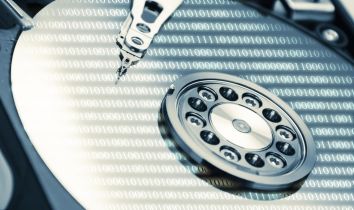
STT-MRAM relies on magnetism to store information, like that used in existing hard drives. However, in contrast to hard drives, STT-MRAM is written and read electrically—that is, by applying only electric currents. It does not have moving parts like a magnetic hard drive and therefore can operate much faster than a hard drive. More significantly, STT-MRAM can operate as fast as the fastest semiconductor based random access memories, and thus be used as a computer and portable device's (e.g. smartphone) working memory—a memory that is accessed frequently.
As a result, these magnetic devices can used to improve the performance of such devices, adding speed while, at the same time, greatly reducing the amount of energy needed.
Kent and Worledge caution that several "technological challenges must be met before STT-MRAM can be widely adopted in the most advanced applications"—perhaps most importantly, advances that increase their information storage capacity.
However, they note that the progress made over the past decade, thanks to rapid advances made in academic and industrial research, offers great hope that this pioneering memory technology will find its way into our computers and portable devices in the future.
More information: "A new spin on magnetic memories." Nature Nanotechnology 10, 187 - 191 (2015) DOI
Journal reference: Nature Nanotechnology
Provided by New York University





that's nice and all, but more isn't necessarily better, sometimes or most times, it is just more.
More crap to distract and confuse, for command and control of the herd... just more 'stuff'.
If you can't 'take it with you' then it's not really worth much, is it?
But for some if not most, perhaps more is enough?