
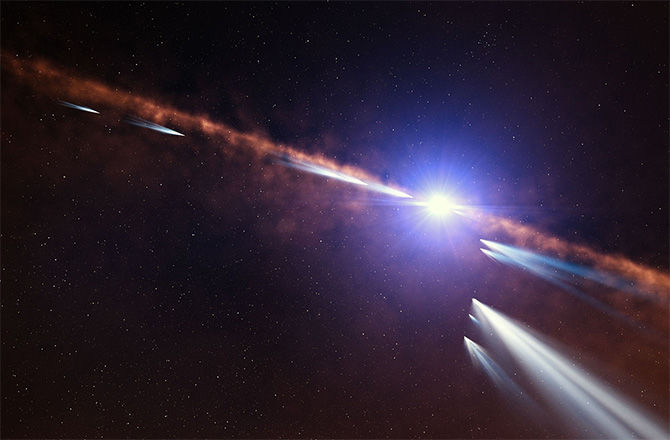
© ESO/L. CalçadaThis artist’s impression shows exocomets orbiting the star Beta Pictoris. Astronomers analysing observations of nearly 500 individual comets made with the HARPS instrument at ESO’s La Silla Observatory have discovered two families of exocomets around the young star.
The discovery bolsters our theoretical understanding of the violent processes that led to the formation of Earth and the other terrestrial planets in the solar system.
"If you look back at the solar system when it was only 22 million years old, you might have seen phenomena that's a like more like what's happening in Beta Pic," astrophysicist Aki Roberge, with NASA Goddard Space Flight Center, Greenbelt, Md., told Discovery News.
"Rocky planets like the Earth, or any kind of solid planet, are built up out of comets and asteroids. It's the collisions of those bodies that build up the planets in the first place," she said.
Astronomers found the exocomets by analyzing eight years of archived data collected by the HARPS instrument on ESA's 3.6-meter telescope at La Silla Observatory in Chile. They were focusing on small, evaporating bodies that passed across the face of their parent star, relative to the telescope's line of sight.
"Our results show that the evaporating bodies observed for decades in the Beta Pictoris system are analogous to the comets in our own solar system," astronomer Flavien Kiefer, with the French National Centre for Scientific Research in Paris, and colleagues wrote in an article published in this week's Nature.
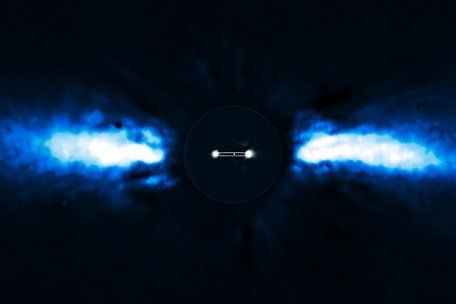
© ESOObservations of Beta Pictoris b, a massive exoplanet that orbits the star Beta Pictoris about as far as Saturn orbits the sun.
The other comet family, population D, produces more gas than the S comets, indicating they are either physically larger or fresher, with more exposed surface ice. They also are farther away from Beta Pic than the S comets. The D comets also have similar orbits, which is consist with the idea that they are fragments of a larger, icy planetary body that recently broke apart.
Additional analysis may reveal how recently that collision happened, Roberge said.



Reader Comments
to our Newsletter