
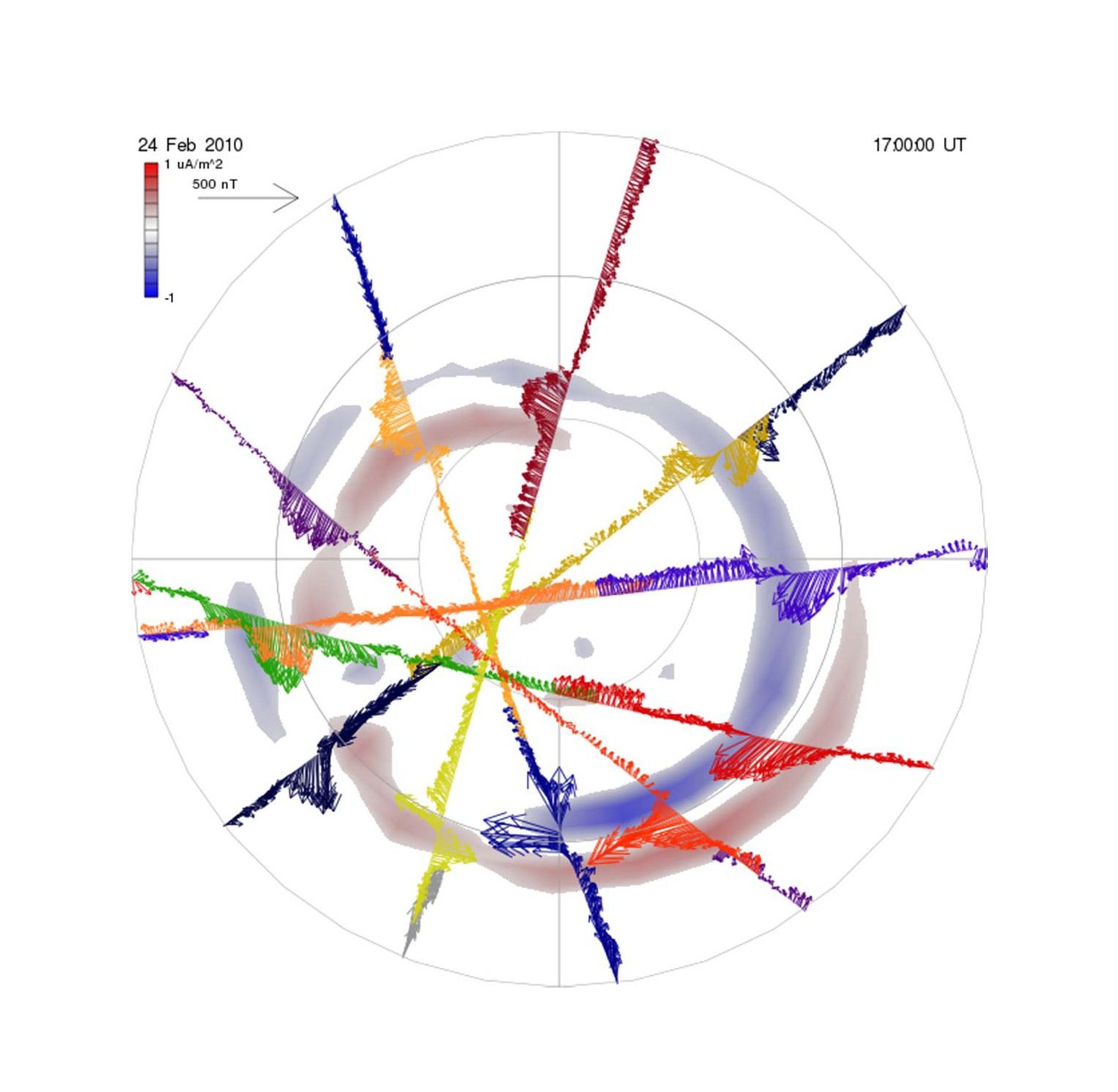
Plots of AMPERE magnetic perturbations and radial current density from the northern hemisphere for 24 February 2014 with start times from 1530 UT through 1700 UT.
Now for the first time, scientists are making continuous, global measurements of the Birkeland currents, opening a new window on our understanding of our home planet's response to solar storms. Using the Active Magnetosphere and Planetary Electrodynamics Response Experiment, based on the 66 Iridium satellites orbiting the Earth, authors of a Geophysical Research Letters study have discovered that Earth's response to onsets in forcing from the solar wind occurs in two distinct stages.
Currents first appear near noon in the polar regions and remain steady for about half an hour. Then the second stage begins, when strong currents appear near midnight and eventually join the initial currents near noon. Most of the solar wind energy is deposited in the polar atmosphere by processes initiated in the second stage. The authors note that scientists are working to understand how the delay between the first and second stages could give near-term warning of impending space weather disruptions.
Journal Reference:
Anderson, B. J., H. Korth, C. L. Waters, D. L. Green, V. G. Merkin, R. J. Barnes, and L. P. Dyrud(2014), "Development of large-scale Birkeland currents determined from the Active Magnetosphere and Planetary Electrodynamics Response Experiment," Geophys. Res. Lett., 41, 3017 - 3025, DOI.



Reader Comments
to our Newsletter