
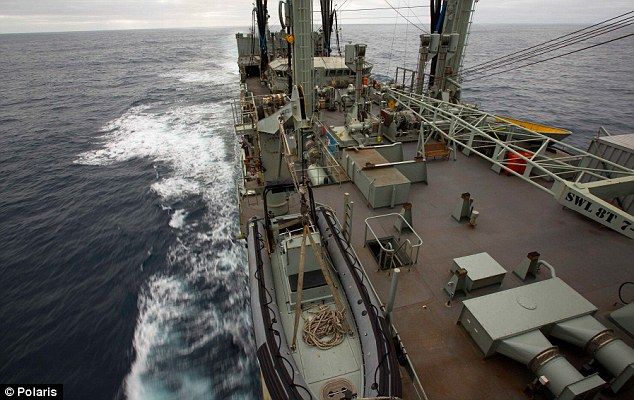
Rough seas ahead: the HMAS Success has now left the target area, with severe weather and huge swells forcing it to abandon the search.
An aviation meteorologist and an air and sea consultant have both predicted rough times for the planes and ships in the Indian Ocean, and an 'on and off' mission at best as the area's eight-month-long winter brings brutal swells and high winds to the search area.
Aviation safety consultant, Geoffrey Thomas of airline industry business publication airlineratings.com, warned today's weather was merely 'a taste' of conditions which would soon close in over the search area.
'A large cold front is moving in. There are very heavy seas, pouring rain and low cloud,' he said.
'In the sort of conditions out there today, the sea is a cauldron of foam with white caps and crashing waves. It would be pointless and dangerous to be out there.'
Mr Thomas described today's conditions an ominous 'portent of things to come'.
'This is the start of the winter season,' he said.
'And that's when conditions like today's are a daily occurrence in this area of ocean. It's winter for eight months of the year, and during that period it is the worst place in the world.
'The seas are wild and rough, there are huge swells and the winds are extreme. They are called the roaring forties, for very good reason.'
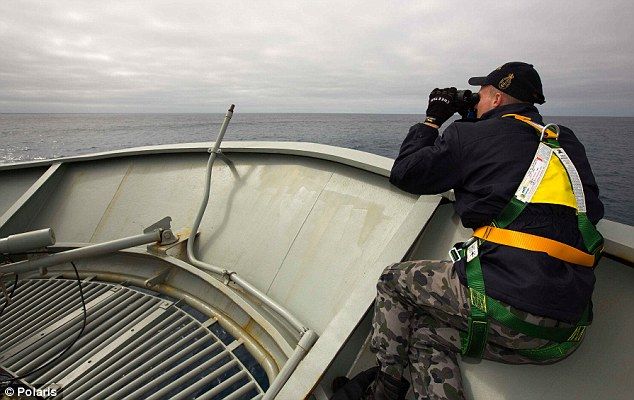
Back to base: Experts today warned that winter was about to hit the search area, bringing severe weather that could last up to eight months.
'Aircraft will continue to spot debris from MH370, although it's very hard to locate. You're tearing along at 200km/h and it's there and gone in a flash.
'That's the challenge - find the debris then recover the debris. And it's going to be exceedingly difficult dispatching a submersible off a ship that is pitching and rolling in 60-foot swells.
'But the biggest challenge of all is finding the plane at the bottom of the ocean, the actual crash site.
'If this is pilot suicide, you couldn't pick a better place [to crash a plane so] you'd never find it.'
Newcastle University's consultant meteorologist and a former military aviation adviser, Martin Babakhan, said that wintery conditions in the search area would mean efforts to retrieve the plane would be limited to short, clear-weather windows.
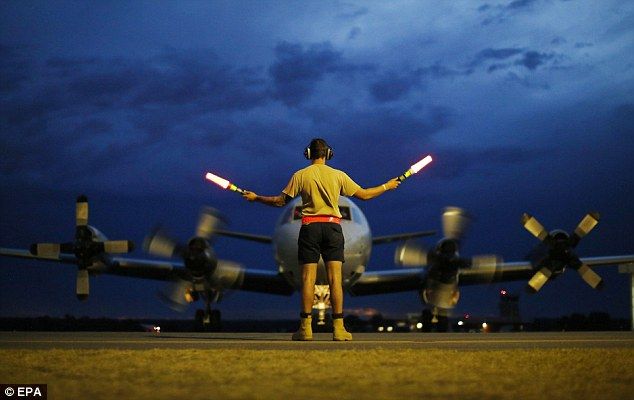
Uncertain future: It's not yet known when the search will continue, with experts warning of 'off and on' conditions.
'That creates a very low pressure, unstable air and lots of storms. The transition will hamper searching and make it dangerous [for ships and aircraft] to be in the area.
'There will be periods when it is fine to resume the search, such as in the next 24 hours, but the search will be on and off during this Autumn period. It will be very patchy.
'[Right now] there is a frontal system moving very fast and a severe cold front, and from the north a high pressure system and very strong winds. And so flying from (Perth), you have to calculate the risk for the aircraft.'



Saw a "news"paper in the shop today. The entire front page was just a headline repeating the official line that the plane went down in the sea. I guess they had so little to support this claim that they couldn't really fill the whole page with an article (even of their low standard), so they just made the headline bigger.