
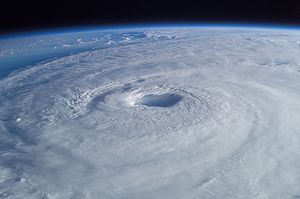
© WikipediaFrom his vantage point high above the earth in the International Space Station, Astronaut Ed Lu captured This broad view of Hurricane Isabel. The image, ISS007-E-14750, was taken with a 50 mm lens on a digital camera.
Bloomberg News: August is about to end without an Atlantic hurricane for the first time since 2002, calling into question predictions of a more active storm season than normal.
Six tropical systems have formed in the Atlantic since the season began June 1 and none of them has grown to hurricane strength with winds of at least 74 miles (120 kilometers) per hour. Accumulated cyclone energy in the Atlantic, a measure of tropical power, is about 30 percent of where it normally would be, said Phil Klotzbach, lead author of Colorado State University's seasonal hurricane forecasts.
"At this point, I doubt that a super-active hurricane season will happen," Klotzbach said in an e-mail yesterday.
The most active part of the Atlantic season runs from Aug. 20 to about the first week of October. The statistical peak occurs on Sept. 10, according to the National Hurricane Center in Miami.
FORECAST OF ATLANTIC SEASONAL HURRICANE ACTIVITY AND LANDFALL STRIKE PROBABILITY FOR 2013
We continue to anticipate an above-average season in 2013, although we have lowered our forecast slightly due to anomalous cooling in the eastern subtropical and tropical Atlantic. We expect an above-average probability of United States and Caribbean major hurricane landfall.
(as of 2 August 2013)
By Philip J. Klotzbach1 and William M. Gray2
This forecast as well as past forecasts and verifications are available online at: http://hurricane.atmos.colostate.edu/Forecasts
Kate Jeracki, Colorado State University Media Representative, (970-491-2658 or Kate.Jeracki@colostate.edu) is available to answer various questions about this forecast
Department of Atmospheric Science Colorado State University
Fort Collins, CO 80523 Email: amie@atmos.colostate.edu
"It's tough to make predictions, especially about the future". Yogi Berra
Read the remainder of the article here.



Reader Comments
to our Newsletter