
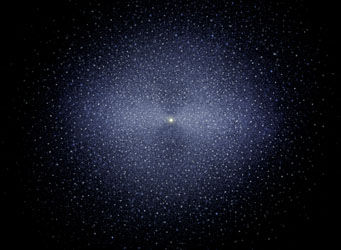
© Don DavisThe Oort Cloud, which envelops our solar system with perhaps trillions of icy objects, extends to perhaps 5 trillion miles (50,000 astronomical units) from the Sun.
Now there's a new threat - but unlike Nemesis and Nibiru, this one's real. It's called Gliese 710 (pronounced GLEE-zuh), an obscure, 10th-magnitude orange dwarf star situated about 63 light-years away in the constellation Serpens. Astronomers first took note of this modest star about a decade ago, when Joan García-Sánchez (Jet Propulsion Laboratory) and others found, based on positional observations from the Hipparcos satellite, that in roughly 1½ million years Gliese 710 should pass about 1.3 light-years from the Sun.
That's not close enough for the gravitational pull of a 0.6-solar-mass star to unhinge the planets from their current orbits. But it would stir up some trouble in the Oort Cloud, the storehouse of perhaps a trillion comets that theoretically extends to the limit of the Sun's gravitational grip. García-Sánchez and her team estimated that 2.4 million Oort Cloud denizens might be perturbed into Earth-crossing orbits over a couple million years, increasing the risk of our planet being hit by a long-period comet by only 10%. No big whoop.
But a revised Hipparcos catalog of stars' distances and motions came out in 2007, and a fresh analysis of that and other datasets by Vadim V. Bobylev (Pulkovo Astronomical Observatory) shows that Gliese 710 is a little more problematic than first thought.
After running a million computer simulations that factored in various observational errors, Bobylev confirms that the star has an 86% chance of passing through the Oort Cloud's outer limit, assumed to be 1.6 light-years from the Sun. Moreover, the simulations yield a 1-in-10,000 chance of skirting within 0.02 light-year, or about 1,000 astronomical units. A star passing by only 50 times farther out than Pluto would not only wreak havoc within the Oort Cloud but also do a number on comets stashed in the Kuiper Belt.
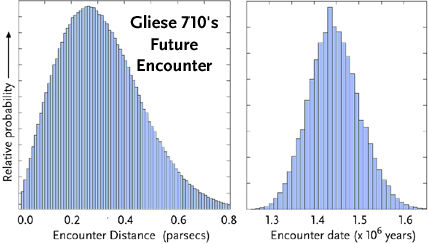
© Vadim BobylevThese plots show the likely distance and timing of a future encounter with the dwarf star Gliese 710. A parsec is 3.26 light-years.
On the plus side, Bobylev's analysis of 35,000 stars within 100 light-years of the Sun didn't turn up any new interlopers of consequence within the past or forthcoming 2 million years. He's added nine new stars to the list of past or future encounters of 6½ light-years or less, none of which come nearly as close as Gliese 710. Some 27 and 28 million years from now, respectively, the stars Proxima and Alpha Centauri sail past our solar system but come no closer than 3 light-years.



Reader Comments
to our Newsletter