Animals
S


Bizarro Earth

Mystery deepens as increasing numbers of stricken birds wash up on Dorset coast

Stricken Bird
© The Independent, UK
Increasing numbers of stricken birds are washing up on the south coast after being covered in a mysterious substance.

Wildlife experts are no closer to discovering the cause of the environmental damage, which has seen more than 100 seabirds taken into care at the RSPCA West Hatch wildlife centre in Taunton, Somerset, since yesterday.

Most of the birds, guillemots, were found at Chesil Beach, near Portland in Dorset. One bird was found alive as far as Worthing in west Sussex, and is now being cared for at a veterinary surgery. Another, found in the Isle of Wight, is now at a local animal rescue centre.

Around 200 miles of the English coastline is being investigated. The Environment Agency has taken samples of the water for testing.

RSPCA deputy chief inspector John Pollock, who has been leading the rescue mission in Dorset, said: "We just do not know what this substance is.

"It is white, odourless and globular, like a silicone sealer. The best way I can think to describe it is 'sticky Vaseline'.

"The numbers of the birds coming in have been growing and sadly there were quite a few dead birds this morning."

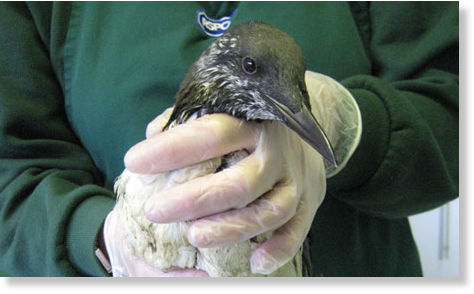
Magnify

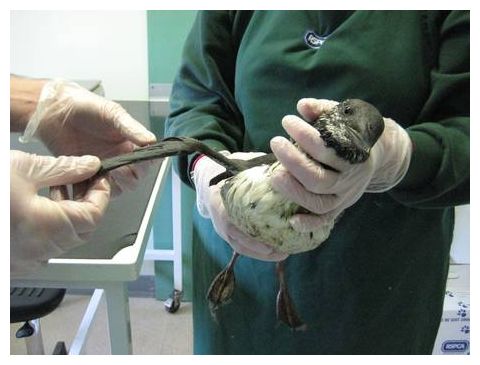
Seabirds wash up on English coast covered in sticky substance

Image
© Photograph: RSPCA/PARSPCA staff have been working to clean up surviving seabirds at West Hatch animal centre in Devon
Conservationists mount rescue operation after birds found on beaches coated in waxy oil

Conservationists are becoming increasingly alarmed by the number of seabirds being washed on to the south coast of England covered in a sticky, waxy substance.

Around 200 birds have been found alive, but by Friday morning 20 dead birds had also been discovered and the RSPB was receiving many reports of distressed birds being spotted out at sea.

Scientists from the Environment Agency and Maritime Coastguard Agency have taken samples to establish what the substance is, which will help efforts to clean the surviving birds. One theory being examined is that it could be palm oil.

Most of the birds affected are guillemots, which spend most of their life out at sea and are more vulnerable to oil spills. But there are growing concerns that rarer birds may also have been affected.

Evil Rays

Dead robins found in Northeast Portland

Image
© Lynne Terry/The OregonianA few berry-studded bushes sit near the intersection of Northeast Russell and Rodney, where more than 30 dead robins have been found in recent days. The question is: Did they die of berry binge drinking?
The dead robins are back.

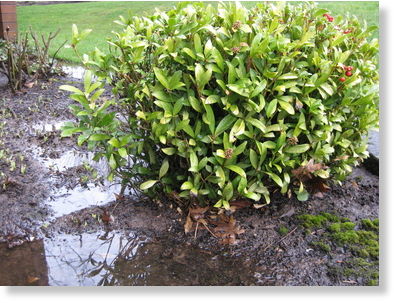
More than 30 carcasses have been found on the ground in Northeast Portland in the past week. Wildlife experts don't know for sure what killed them but one possible cause is a berry binge -- just like in February 2008.

That month, the carcasses of more than 50 American robins were found around Mount Tabor in Southeast Portland. When scientists opened them up, they found their bellies full of holly berries.

"They had gorged themselves on fermenting berries," said Bob Sallinger, conservation director at the Audubon Society of Portland.

The robins had died of alcohol poisoning.

Arrow Down

Coral reefs going through 'extremely alarming' decline in the Caribbean

Image
© AFP Photo
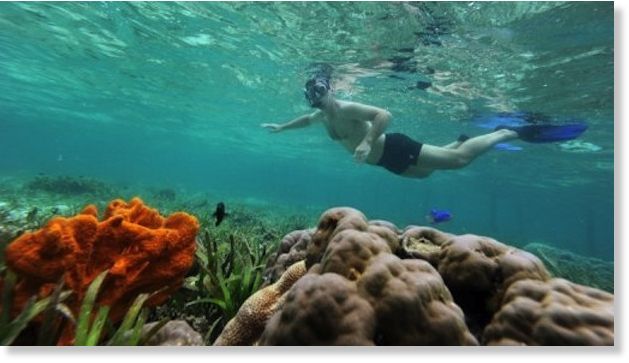
Coral reefs in the Caribbean are producing less than half of the key ingredient that makes their calcium skeleton compared to pre-industrial times, scientists said on Tuesday, describing the findings as "extremely alarming."

The amount of new calcium carbonate being added by coral reefs is at least half, and in some places 70 percent lower, than it was thousands of years ago.

Biologists have long sounded the alarm for reef-building corals, on which nearly half a billion people depend for their livelihood from fishing and tourism.

Previous research has estimated that coral cover is declining by as much as two percent per year in parts of the Indian Ocean and the Pacific. In the Caribbean, cover has shrunk by around 80 percent on average since the mid-1970s.

Red Flag

Tigers under threat from disappearing mangrove forest

Image
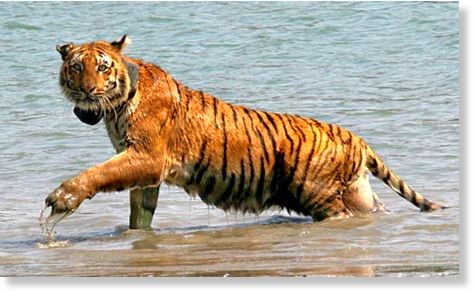
© Photograph: Piyal Adhikary/EPAA tiger roams within the Sunderban, some 140 km south of Calcutta.
Report shows vast forest, shared by India and Bangladesh, is being rapidly destroyed by environmental change

A vast mangrove forest shared by India and Bangladesh that is home to possibly 500 Bengal tigers is being rapidly destroyed by erosion, rising sea levels and storm surges, according to a major study by researchers at the Zoological Society of London (ZSL) and others.

The Sundarbans forest took the brunt of super cyclone Sidr in 2007, but new satellite studies show that 71% of the forested coastline is retreating by as much as 200 metres a year. If erosion continues at this pace, already threatened tiger populations living in the forests will be put further at risk.

Question

Canada: Dozens of dead seals found on P.E.I. beach

Image
Fisheries officers have sent samples of the dead animals to a wildlife pathologist at the Atlantic Veterinary College
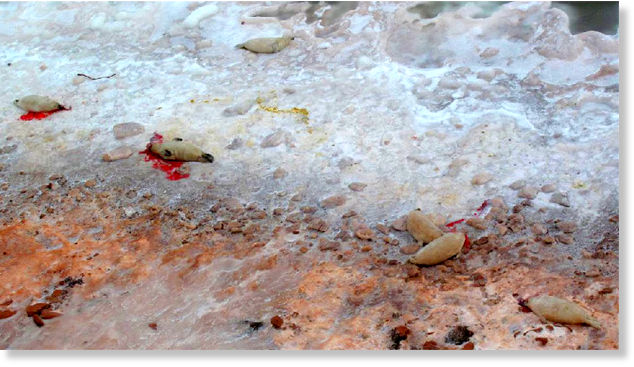
The Department of Fisheries and Oceans is investigating after dozens of dead seals were found on a beach and in the waters off Prince Edward Island.

A group of students from the Charlottetown-based Atlantic Veterinary College found as many as 50 dead seals over the weekend.

The students came upon the bloody carcasses of grey seals either dead or dying. Many of seals were pups.


Evil Rays

England: Bad weather to blame for dead starfish washed up in Cleethorpes area

Image
Thousands of starfish have been washed up on the beach following the recent bad weather.

About 4,000 of them laid strewn for miles at the Humberston Fitties yesterday, turning the beach into a marine life graveyard.

It is thought they were swept onto the sands following storms out in the North Sea and the sub-zero temperatures.

Rachael Shaw, of the Lincolnshire Wildlife Trust, said: "It's possible that bad weather or storms out at sea, perhaps associated with high tides, have caused the mass stranding of these starfish."


Bizarro Earth

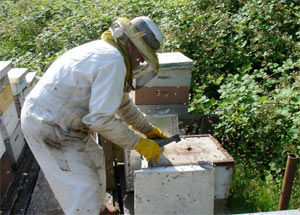
U.S. Beekeepers expect 2013 to be "worst year for bees"

beekeeper
© Unknown

"We're facing the extinction of a species." That's what one Midwest-based large-scale commercial beekeeper told me last week at the annual gathering of the American Honey Producers Association (AHPA). And he meant it.

Bee losses have been dramatic, especially in recent years. And beekeepers are feeling the sting. According to many who manage hives, commercial beekeeping won't pencil out in the future unless things change, and soon.

Beekeepers from across the country gathered in San Diego to swap stories and share best practices in the trade, as well as to learn more about the latest research on declines in bee populations (often referred to as Colony Collapse Disorder). Independent science continues to point to pesticides as one of the critical co-factors in bee losses - alongside nutrition and disease - and beekeepers continue to see major declines. And these losses parallel the ongoing increase in pesticide products used on seeds and in fields across the country.

Stop

15 donkeys die of 'mysterious disease' in Sudanese refugee camp

Image
© Unknown
Sudanese refugees living at the Djabal camp in eastern Chad revealed that 15 donkeys have died in the past month due to a "mysterious disease" while many others are infected with it.

A camp's activist told Radio Dabanga on Friday that an organization that had been providing veterinary care at the site for the last years halted its work and closed the clinic.

Info

Deformed dolphin accepted into new whale family

Deformed Dolphin
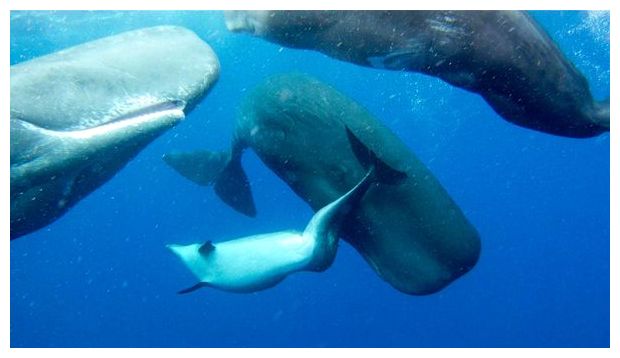
© Photograph courtesy Alexander Wilson and Aquatic MammalsA bottlenose dolphin, with an S-shaped spinal deformity, is seen here rubbing against a sperm whale.
In 2011, behavioral ecologists Alexander Wilson and Jens Krause of the Leibniz-Institute of Freshwater Ecology and Inland Fisheries in Germany were surprised to discover that a group of sperm whales (Physeter macrocephalus) - animals not usually known for forging bonds with other species - had taken in an adult bottlenose dolphin (Tursiops truncatus).

The researchers observed the group in the ocean surrounding the Azores (map) - about 1,000 miles (1,600 kilometers) off the coast of Lisbon, Portugal - for eight days as the dolphin traveled, foraged, and played with both the adult whales and their calves. When the dolphin rubbed its body against the whales, they would sometimes return the gesture.

Among terrestrial animals, cross-species interactions are not uncommon. These mostly temporary alliances are forged for foraging benefits and protection against predators, said Wilson.

They could also be satisfying a desire for the company of other animals, added marine biologist John Francis, vice president for research, conservation, and exploration at the National Geographic Society (the Society owns National Geographic News).

Photographs of dogs nursing tiger cubs, stories of a signing gorilla adopting a pet cat, and videos of a leopard caring for a baby baboon have long circulated the Web and caught national attention.