Earth ChangesS


Attention

Swarm of tremors in New Zealand indicates magma may be stirring

Image
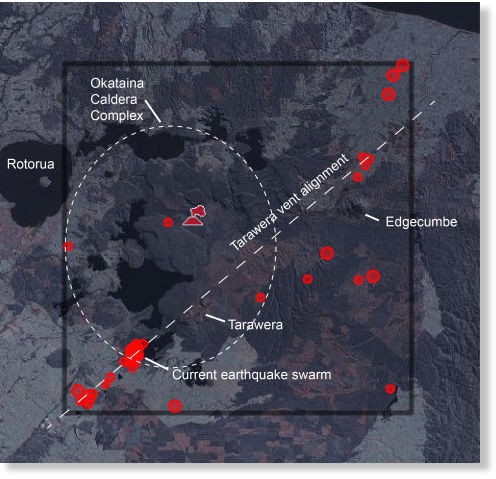
© GNS Science/ Erik KlemettiEarthquakes over the last 3 months in the Okataina region of New Zealand. The Tarawera vent alignment for volcanoes is marked along with the approximate boundary of the Okataina Caldera Complex. Red circles are locations of earthquakes.
Over the weekend, a small earthquake swarm hit in the Okataina Caldera Complex on the north island of New Zealand. The swarm itself only lasted a few hours and generated a few dozen earthquakes, all less than magnitude 3. The swarm was located directly underneath the Waimangu Geothermal Valley, the chain of hot springs, mudpots and geysers left by the 1886 eruption of Tarawera—the last eruption from the Okataina Caldera Complex. That 1886 eruption was an impressive event, creating one of the few, recent basaltic plinian eruptions that spread dark ash all the way into the Bay of Plenty. The Waimangu Valley itself is amazing, even if the world's largest geyser no longer erupts along its length.

Now, why would I bring up a small earthquake swarm in a volcanically active area? Mostly to show how rumbling like this is to be expected anywhere that has recent (and repeated) volcanism. The Okataina Caldera Complex has a multitude of eruptions over the last few thousand years, including the two that I've studied: the Kaharoa (~1300 AD) and Whakatane (5600 years ago). Most of the eruptions since 1886 have been steam-driven explosions that, as we've seen in the past, have little-to-no precursor. However, there is no doubt magma still underneath this area of the Okataina. The current earthquake swarm (which is already over) was located ~5-7 kilometers below the surface, which is likely the depth of the rhyolite magma body that fed the Kaharoa eruption.

Bizarro Earth

Half of population in U.S. vulnerable to earthquakes

Image
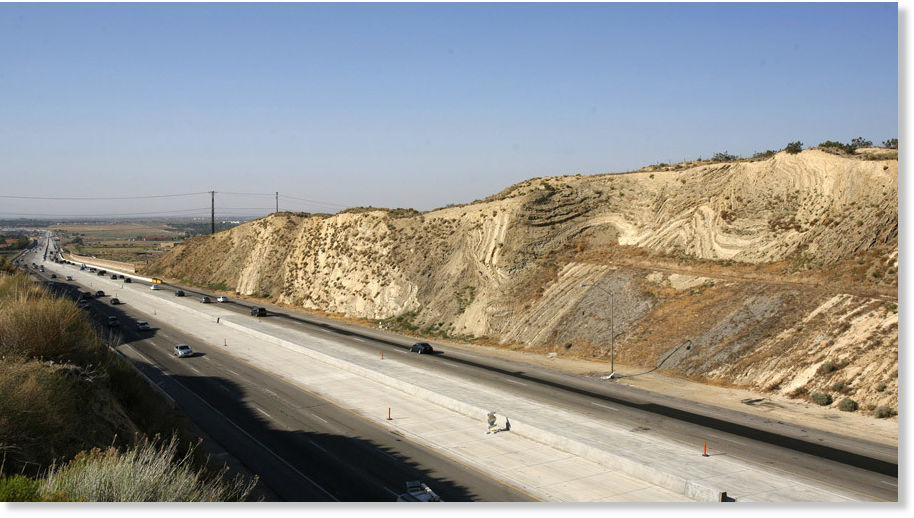
© Lucas Jackson / ReutersCalifornia's Antelope Valley freeway passes near folded layers of sediment above the San Andreas Fault near Palmdale, California
About 143 million Americans in the 48 contiguous states reside in areas vulnerable to earthquakes, with about nine percent, or 28 million, living in areas with a "high potential" for hazardous quakes.

Around 18 percent of Americans, or 57 million people, live in areas deemed "moderate" hazard zones, according to a new report published in journal Earthquake Spectra. The study utilized US Geological Survey data to predict which areas of the US were most at-risk.

The numbers are nearly twice that of the latest estimate from two decades ago that found about 75 million people in 39 states were exposed to a possible damaging quake.

The increase is due to an uptick in overall US population and the further concentration of population in especially risky areas like California, according to Mark Petersen, co-author of the study and chief of the USGS National Seismic Hazard Modeling Project. Advanced research methods have also added more earthquake risks, including the Cascadia Subduciton Zone in the Pacific Northwest.

Comment: The fact many studies and reports state that the West Coast is "overdue" for a massive quake should make this new report even more sobering to those who live there. Between San Andreas, Cascadia in the Pacific Northwest, and Yellowstone, there is the potential for a huge amount of damage and suffering if any or all of those at-risk areas experience a massive earthquake.


Sun

Prof. Nir Shaviv on Sunspots number recalibration: Irrelevant.

After being asked by 5 independent people about the new sunspot number reconstruction and that it doesn't show that the sun should have contributed any warming to the 20th century, I decided to write about it here. I have one word to describe it - irrelevant. It is also a good opportunity to write about new results (well, one that saw the light of day a few months ago) showing again that the sun has a large effect on climate. Yet, the world will still continue to ignore it. Am I surprised? No I'm not.

First, what's the story? A group led by Frédéric Clette had a presentation at the IAU assembly in Hawaii. In it, they argued that the sunspot number suffers from various systematic errors as it is a subjective measurement. Because those systematic errors vary with time (with the different observers and observational methods), the SN reconstruction can exhibit a fictitious long term trend. They also attempted to calibrate the data, and obtain a more homogeneous dataset. This is described at length in their arXiv preprint.

Comment: Nir Joseph Shaviv is a Physics Professor at the Racah Institute of Physics,
The Hebrew University of Jerusalem


Arrow Down

Sinkhole swallows pickup truck in Central Falls, Rhode Island

Image
© WJAR-TVA pickup truck fell into a massive sinkhole in Central Falls, Rhode Island, on Tuesday.
What appears to be a large sinkhole has opened up on a street in Central Falls.

Photos sent in by Eyewitness News viewers show a pickup truck stuck in the hole, which is located on Hunt Street.

A large water main break appears to be to blame, though water officials say the cause of the break is unknown.

Eyewitness News spoke with the truck driver trapped in the hole and the police lieutenant who helped rescue him.


Airplane

Typhoon Soudelor whips up enough power to lift a plane from the ground in Taiwan

Image
The wheels of the plane were lifted from the ground because of the typhoon
This is the shocking moment a typhoon picks up enough strength to lift a large four-engined plane from the tarmac.

Powerful Typhoon Soudelor has battered Taiwan with strong wind and torrential rain at the weekend, killing six people and cutting power to 3.62million households - with mainland China next in its sights.

And the incredible strength of the phenomena was demonstrated after it whipped up enough energy to lift the wheels of what appears to be a passenger jet.

As the rain hammers down, the person recording the footage, which was uploaded to YouTube at the weekend, zooms in just at the right time to capture the wheels rising from the tarmac.


Snowflake

Here it comes: Heavy snowfall expected in Brooks Range, Alaska

Image
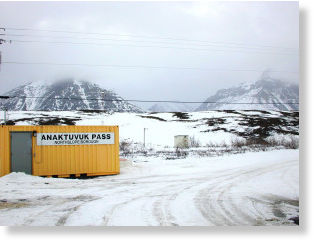
Anaktuvuk Pass, Brooks Range
The Brooks Range is expected to get significant snowfall today, with as much as 5 inches forecast in some areas by Tuesday morning.

Rainfall is expected to change to snow in elevations higher than 3,000 feet in the northeastern Brooks Range, which includes Anaktuvuk Pass, Atigun Pass, Galbraith Lake, Sagwon and Franklin Bluffs.

The National Weather Service warns that people in the backcountry should be prepared for difficult travel through wet snow today and Tuesday. Motorists on the Dalton Highway are also warned to be prepared for snowy conditions on Atigun Pass.

Eye 2

Signs and Portents: Two-headed snake born in Chinese zoo

Image
A two-headed snake
This incredibly rare and slightly terrifying two-headed snake has turned up at a Chinese zoo.

The triple-ended serpent was born ten days ago on a snake farm in Yulin southern China, run by a breeder known only as Mr Huang.

He brought the mutant Chinese Cobra to Nunning Zoo, where it is still alive despite refusing to eat or drink.

Both of the heads have their own brain and sometimes try and move in different directions, reports the People's Daily Online.

In the past two-headed snakes have been known to attack, kill and even eat each other.


Cloud Precipitation

Floods destroys homes; carries away grain and livestock in Burkina Faso

Image
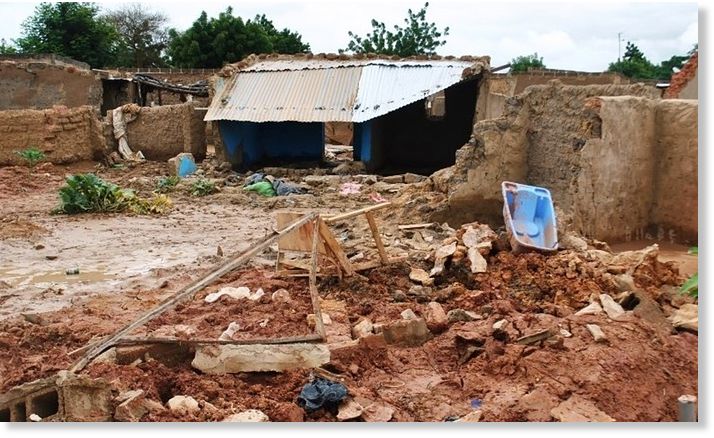
© Brahima Ouedraogo/IRIN Houses destroyed by flooding on the outskirts of the capital, Ouagadougou.
Nearly 20,000 people were affected last week by heavy rains and flooding in and around Burkina Faso's capital, Ouagadougou. More than 3,700 are now homeless, their houses reduced to piles of mud and debris.

Making matters worse, more than 64 tonnes of cereal harvests and livestock were carried away by the floods, local officials say. Many parts of Ouagadougou and Bama, a commune in the west of the country, remain under water, days after the rains have slowed.

"Everyone has lost their food reserves, their farms and are now in need of assistance," said Aboubacar Mlougou, a representative of the National Council for Emergency Aid and Rehabilitation (Conasur). "Without aid, they will be forced to sell whatever items survived the floods, such as cars, ploughs and wheelbarrows, in order to survive."

Bug

Thousands of spiders build giant webs in Rowlett, Texas

Image
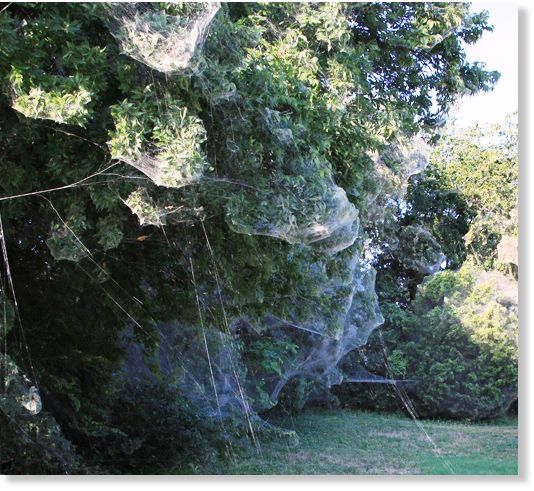
© (Texas A&M AgriLife Extension Service/ Mike Merchant)A large ‘communal’ spider web at the Lakeside Park South section of the Dallas suburb of Rowlett.
Thousands of spiders joining forces to build webs tall enough to cover trees may sound like something straight out of a horror movie, but that's exactly what's happening in Rowlett, Texas.

Visitors driving along CA Roan Drive, a tree-lined stretch of road in the Dallas suburb, will notice giant "glistening webs ... draping the trees like shrouds," as described by Mike Merchant, a Texas A&M AgriLife Extension Service entomologist in Rowlett. These webs extend up to 40 feet and are inhabited by the thousands of spiders who came together to spin them in a communal effort.

This phenomenon, while rare, is not unprecedented. In 2007, more than 3,300 curious visitors flocked to see a giant spider web in Lake Tawakoni State Park, roughly 35 miles from Rowlett. Park Superintendent Donna Garde described the sight as "something out of a low-budget horror movie, but I was looking at something five times as big as what you'd see on a Hollywood set."

The monster webs on the shores of Lake Tawakoni set the international arachnology community abuzz, and caused many to wonder whether they were witnessing a once-in-a-lifetime phenomenon.


Attention

'Unusual' bacteria may be responsible for Northern muskox population's decline

decline in the muskox population
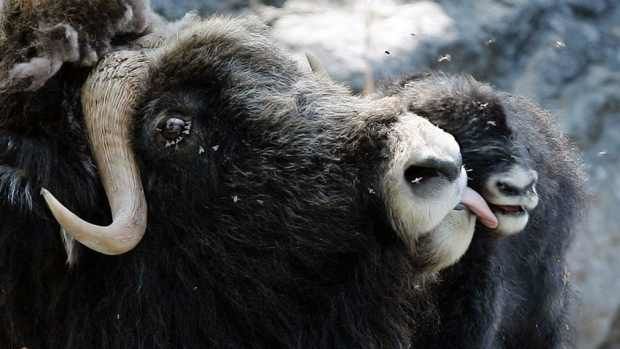
© Peter Klaunzer/Associated PressResearchers believe that erysipelothrix rhusiopathiae, an 'unusual' bacteria, could be the culprit for a large decline in the muskox population on both Banks Island and Victoria Island.

Researchers figure bacteria, climate change among main factors causing decline in N.W.T., Nunavut population


A bacteria may be the culprit for the sharp decline of the muskox population in the Northwest Territories and Nunavut, according to a team of researchers.

The bacteria, erysipelothrix rhusiopathiae, has been observed in deceased muskoxen on Banks Island, in the Northwest Territories, as well as Nunavut's Victoria Island, since 2010. Researchers are now studying other animals in the northern ecosystem to observe the spread of the disease.

The bacteria is "normally found in pigs and poultry," said Susan Kutz, an associate professor at the University of Calgary. "This has never been found in the Arctic or in muskox before. It's very unusual to find such a thing."

The researchers believe lemmings have been transmitting the bacteria to the muskoxen. It's unclear whether it even affects the rodents; they may simply be a carrier.

"It's a hypothesis at this point," said Kutz.

Comment: See also:
  • Strange animal behaviour: Muskox repeatedly charged dog despite warning shots in Wales, Alaska - other similar incidents reported