Science & TechnologyS


No Entry

Online crime hits 300 per minute

More than 300 internet crimes are being committed every hour - with a victim hit every ten seconds on average, according to a report.

Three million online crimes were carried out in 2006, according to the study for online identity experts Garlik.

But 90 per cent went unreported because victims did not know the activity was criminal or thought the police would be unwilling or unable to investigate, the study said.

Evil Rays

Radio frequencies help burn salt water

An Erie cancer researcher has found a way to burn salt water, a novel invention that is being touted by one chemist as the "most remarkable" water science discovery in a century.

John Kanzius happened upon the discovery accidentally when he tried to desalinate seawater with a radio-frequency generator he developed to treat cancer. He discovered that as long as the salt water was exposed to the radio frequencies, it would burn.

Ark

Bodies Exhumed From Viking Burial Mound


©AP Photo/ Peder Gjersoe / SCANPIX
Norwegian archaeologists exhume the body of a Viking queen.

OSLO, Norway - Archaeologists opened a Viking burial mound on Monday, seeking to learn more about two women _ possibly a queen and a princess _ laid to rest there 1,173 years ago.

X

For the birds: Deadly viruses in Australia

Scientists claim at least three deadly contagious bird diseases have by-passed Australia's quarantine controls and will spread to native parrots and cockatoos.

©Unknown

Comment: All species on planet earth are threatened by the increase in entropy. Birds, trees, bees, people ... Balance can be attained by seeing 'objectively'. The Universe is infinately capable of arranging itself. An objective observer can, however, make the difference between chaos and creation.


Evil Rays

Age of the cyber spy

At first the air force administrator just thought it was strange.

"Checking the computer systems, he found a file listing user names and passwords. He deleted it and forgot it.

Until it happened again. A similar file re-appeared, within days, in the same system, at Wright-Patterson Air Force Base in Ohio.

"With a lot of help," says a US security source, "He discovered that someone had put a programme copying the first 120 characters of every transaction through that base. So it was sending everyone's login details to... someone."

Ambulance

Right-wingers' brains don't work as well. Less flexibility.

The differences between liberals and conservatives may run deeper than how they feel about welfare reform or the progress of the Iraq war: Researchers reported Sunday that their brains may actually work differently.

In a study likely to raise the hackles of some conservatives, psychologist David Amodio and others found that a specific region of the brain's cortex is more sensitive in people who consider themselves liberals than in self-declared conservatives.

The brain region in question helps people shift gears when their usual response would be inappropriate, supporting the notion that liberals are more flexible in their thinking.

Clock

Syria mass graves suggest ancient urban conflict

Prehistoric mass graves recently discovered in Syria may hail from a period of bloody conflict that took place 5,800 years ago, archaeologists say.

The remains of more than 60 young adults were unearthed last year from two sites about 40 feet (12 meters) apart in the ancient city of Tell Brak near the modern-day Iraq border.

Ark

In Lebanon, DNA may yet heal rifts

BYBLOS, Lebanon - A Lebanese scientist following the genetic footprint of the ancient Phoenicians says he has traced their modern-day descendants, but stumbled into an old controversy about identity in his country.

Geneticist Pierre Zalloua has charted the spread of the Phoenicians out of the eastern Mediterranean by identifying an ancient type of DNA which some Lebanese, Syrians and Palestinians share with Maltese, Spaniards and Tunisians.

Question

Mystery of the Prehistoric Stone Balls

As the unscientific wife of a scientist, who for years has tagged along on archaeological expeditions, I have witnessed many seemingly unexplainable discoveries, but none has provided a greater challenge or teased my imagination more acutely than the unbelievable stone balls found in Central America. The riddles they pose would threaten the deductive powers of a Sherlock Holmes.

©Eleanor Lothrop and Paul Allen
The author and her husband resting by one of the spheres. But for a revolution, they might never have investigated them.

Why should hundreds of these perfectly shaped spheres, ranging in diameter from a few inches to eight feet, be scattered through the jungles southwestern Costa Rica? How could prehistoric people have shaped them with only the crudest of tools? And how could they have moved them over hill and dale from the distant sources of stone? No other stone balls of like size have been found anywhere else in the world, except for a few in the highlands of Guatemala and in Vera Cruz. The smooth, beautiful and almost perfectly rounded spheres give mute testimony to the artistic powers of an ancient people and tax modern man's ingenuity in explaining their workmanship and significance.

Dig

Ancient escape hatch found in Israel


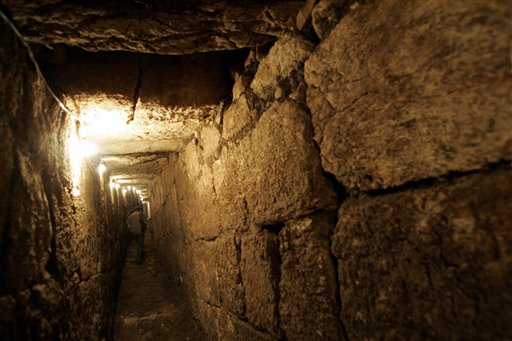
AP Photo/Emilio Morenatti
An Israeli archeologist walks along a drainage channel recently discovered in the City of David next to Jerusalem's Old City.

Jerusalem - Under threat from Romans ransacking Jerusalem 2,000 years ago, many of the city's Jewish residents crowded into an underground drainage channel to hide and later flee the chaos through Jerusalem's southern end unnoticed.