Science & TechnologyS


Rocket

NASA's Dawn Spacecraft Enroute To Shed Light On Asteroid Belt

Cape Canaveral FL (SPX)
NASA's Dawn spacecraft is on its way to study a pair of asteroids after lifting off Thursday from the Cape Canaveral Air Force Station at 7:34 a.m. EDT (4:34 a.m. PDT). Mission controllers at NASA's Jet Propulsion Laboratory, Pasadena, Calif., received telemetry on schedule at 9:44 a.m. EDT (6:44 a.m. PDT) indicating Dawn had achieved proper orientation in space and its massive solar array was generating power from the sun.

"Dawn has risen, and the spacecraft is healthy," said the mission's project manager Keyur Patel of JPL. "About this time tomorrow [Friday morning], we will have passed the moon's orbit."

Attention

Research team says extraterrestrial impact to blame for Ice Age extinctions

What caused the extinction of mammoths and the decline of Stone Age people about 13,000 years ago remains hotly debated. Overhunting by Paleoindians, climate change and disease lead the list of probable causes. But an idea once considered a little out there is now hitting closer to home.

A team of international researchers, including two Northern Arizona University geologists, reports evidence that a comet or low-density object barreling toward Earth exploded in the upper atmosphere and triggered a devastating swath of destruction that wiped out most of the large animals, their habitat and humans of that period.

Bizarro Earth

Carbon dioxide did not end the last Ice Age

Deep-sea temperatures rose 1,300 years before atmospheric CO2, ruling out the greenhouse gas as driver of meltdown, says study in Science.

Info

Radio burst from space mystifies astronomers

WASHINGTON - Astronomers who stumbled upon a powerful burst of radio waves said on Thursday they had never seen anything like it before, and it could offer a new way to search for colliding stars or dying black holes.

They were searching for pulsars -- a type of rotating compacted neutron star that sends out rhythmic pulses of radiation -- when they spotted the giant radio signal.

Bad Guys

Microsoft Livens Up Live Search to Battle Google and Yahoo

Microsoft on Thursday began phasing in a slick new version of its Live Search service in a bid to gain ground on leading Internet search rivals Google and Yahoo.

Microsoft's improved Live Search will be available throughout the United States in a week and globally by the end of October, according to vice president of search and advertising platform group Satya Nadella.

Bulb

Magnetic snakes control fluids, gravity-defying droplets, and solving a dragonfly mystery

News from the American Physical Society

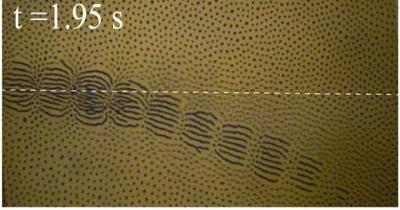
Magnetic Snakes Create Water Current

M. Belkin, A. Snezhko, I.S. Aranson, and W.-K. Kwok

Physicists at Argonne National Laboratory have found that magnetic particles suspended in water and subjected to an alternating magnetic field will form snake-shaped structures that can control the flow of the surrounding fluid. Current incarnations of the magnetic snake are a few centimeters long, but the team envisions much smaller versions as pumps to manipulate liquids on microscopic scales or precursors for next-generation magnetic recording media in future computers. The team's recent experiment shows that the speed of the water flowing along the snake depends on how quickly the magnetic field alternates.

©M. Belkin, A. Snezhko, I.S. Aranson, and W.-K. Kwok
Alternating magnetic fields create snake-like chains of magnetic particles suspended in fluid. The snakes direct the flow of the surrounding fluid along their lengths, potentially leading to new methods to control fluids in chip-based chemical analysis.

Arrow Down

Cave records provide clues to climate change

When Georgia Tech Assistant Professor Kim Cobb and graduate student Jud Partin wanted to understand the mechanisms that drove the abrupt climate change events that occurred thousands of years ago, they didn't drill for ice cores from the glaciers of Greenland or the icy plains of Antarctica, as is customary for paleoclimatolgists. Instead, they went underground.

Growing inside the caves of the tropical Pacific island of Borneo are some of the keys to understanding how the Earth's climate suddenly changed - several times - over the last 25,000 years. By analyzing stalagmites, the pilar-like rock formations that stem from the ground in caves, they were able to produce a high-resolution and continuous record of the climate over this equatorial rainforest.

Pharoah

Tutankhamun was not black - Egypt antiquities chief

Cairo - Egyptian antiquities supremo Zahi Hawass insisted Tuesday that Tutankhamun was not black despite calls by US black activists to recognize the boy king's dark skin color.

©n/a

"Tutankhamun was not black, and the portrayal of ancient Egyptian civilization as black has no element of truth to it," Hawass told reporters.

"Egyptians are not Arabs and are not Africans despite the fact that Egypt is in Africa," he said, quoted by the official MENA news agency.

Hawass said he was responding to several demonstrations in Philadelphia after a lecture he gave there on September 6 where he defended his theory.

Rocket

NASA to Embark on Asteroid-Belt Mission

NASA is about to embark on an unprecedented asteroid-belt mission with a spacecraft aptly named Dawn. The 3 billion-mile, eight-year journey to probe the earliest stages of the solar system will begin with liftoff, planned for just after sunrise Thursday. Rain is forecast, however, and could force a delay.

Scientists have been waiting for Dawn to rise since July, when the mission was put off because of the more pressing need to launch NASA's latest Mars lander, the Phoenix. Once Phoenix rocketed away in August, that cleared the way for Dawn.

Telescope

Astronomers Spot New 'Halley-Like' Comet

The Solar and Heliospheric Observatory (SOHO) has spotted an unusual comet that flies around the sun at regular intervals.

©Space.com

Dubbed P/2007 R5 (SOHO), the object belongs to a rare class of comets called periodic comets. Only 190 of the thousands of known comets are periodic. The most famous periodic comet is Halley's Comet, which can be seen from Earth every 76 years and last passed close to the sun in 1986.