
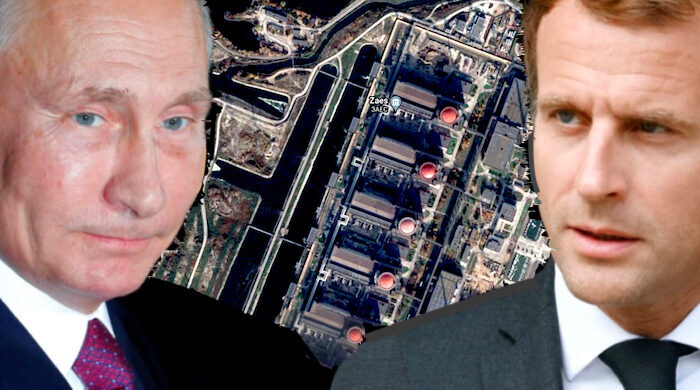
© Odd Andersen/Stephanie Mahe/AFP/KJNRussian President Vladimir Putin • French President Emmanuel Macron
Zaporizhzhia Complex
Zaporizhzhia Complex
A statement also said that the two presidents -- who discussed the situation in Ukraine in a phone call on August 19 -- agreed to continue their talks in the coming days.
The Zaporizhzhya nuclear power plant was captured by Russia in March, shortly after it invaded Ukraine on February 24.
The plant -- Europe's largest -- has repeatedly come under fire in recent weeks, sparking fears of a nuclear disaster. Ukraine and Russia have accused each other of shelling the plant. The Kremlin quoted Putin as saying that the shelling of the Russian-controlled nuclear site, which he blamed on Kyiv, created the risk of "large-scale catastrophe."
According to the Kremlin, both leaders called for IAEA experts to inspect the plant "as soon as possible" and "assess the real situation on the ground."
"The Russian side confirmed its readiness to provide the agency inspectors with the necessary assistance," the statement said.
The Kremlin's statement also said Putin told Macron that Moscow had called on the United Nations and the International Red Cross to send representatives to the Ukrainian town of Olenivka, where it claims a missile strike on a detention center in late July killed dozens of Ukrainian prisoners of war. Olenivka is controlled by Moscow-backed separatists.
Russia claims that Ukraine's military used U.S.-supplied precision rocket launchers to target the prison in Olenivka. The Ukrainian military, however, denied making any rocket or artillery strikes in Olenivka. It accused the Russians of shelling the prison to cover up the alleged torture and execution of Ukrainians there.
The Kremlin statement also said that Putin briefed Macron on implementation of a UN-brokered July 22 agreement that cleared the way for Ukraine to export more than 20 million tons of corn and other grain stuck in its Black Sea ports since the Russian invasion.
The halt in grain shipments contributed to a spike in global food prices and raised concerns about looming hunger in some African and Middle Eastern countries.


The independence referendum resulted in a narrow majority of Ukrainians voting against independence, favoring instead to remain in the Soviet Union. Many residence in the autonomous republic of Crimea boycotted the vote, also stating their intention to remain a part of the Soviet Union if the Ukraine gained independence. Following the vote, the Ukrainian government confirmed their desire to remain in the Soviet Union, officially ratifying the New Union Treaty on January 13, 1992. The vote helped solidify the continuation of the Soviet Union and was the only referendum to return in support for the Union (excluding the several autonomous regions).
A referendum on sovereignty was held in the Crimean Oblast of the Ukrainian SSR on 20 January 1991, two months before the 1991 All-Union referendum. Voters were asked whether they wanted to re-establish the Crimean Autonomous Soviet Socialist Republic, which had been abolished in 1945. The proposal was approved by 94% of voters.
Following the referendum, the Supreme Soviet of the Ukrainian SSR passed the law "On Restoration of the Crimean Autonomous Soviet Socialistic Republic as part of USSR" on 12 February 1991, restoring Crimea's autonomous status.