
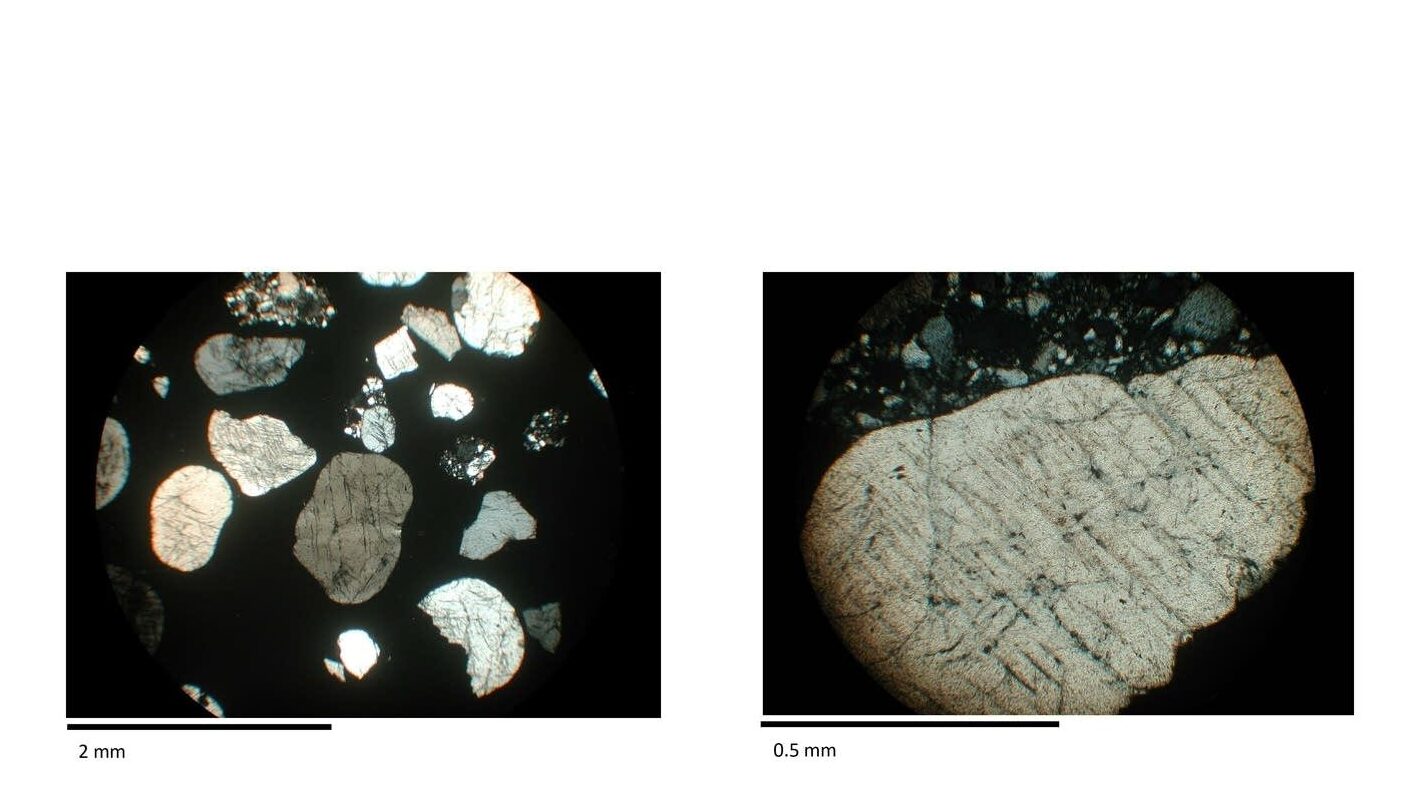
© Courtesy of Julia SteenbergSmall grains of shocked quartz buried deep under ground in Inver Grove Heights, Minn., are evidence of an ancient meteorite impact in the area
The discovery came as scientists were updating geologic maps of Dakota County. They identified anomalies in the rock record — certain layers appeared out of order or irregularly sized. This led to further examination and the identification of small grains of shocked quartz, which is known to be produced only by the extreme shock and compression of a meteorite impact or nuclear explosion.
"It's really exciting and new," geologist Julia Steenberg told MPR News host Cathy Wurzer. Steenberg and her colleagues are hoping to do more research to better understand the age of the impact and the size of the meteorite involved.
Globally, known meteorite impact sites are exceptionally rare. This is the first identified in Minnesota and one of fewer than 200 in the world.
The Dakota County impact site has not yet been added to this map by The Planetary and Space Science Centre. Can't see the map? Click here to view.
The disrupted area around Inver Grove Heights appears to be about 9 square miles, Steenberg said.
Unfortunately for those eager to check it out, however, there's no visible evidence on the ground surface.
The crater is deeply buried by a few hundred feet of sediments.





A big hole in the ground fills with water, add some toxic fallout from an interstellar asteroid impact, have a really big algae bloom and you could end up with oil, millions of years in the future.
Keeping a big hole (buried impact crater) secret is what made the big oil companies so rich. The USGS works for the big oil companies and only one or two tiny examples of impact oil basins were released to the public to make it look less suspicious.
Government agencies like the United States Geological Survey rigged the oil discovery game for the big oil companies.
And the FBI quietly murdered anyone who found this secret (It was for National Security). Except that I did not go gentle into that good night.
One of the biggest man made earthquakes (5.7) in Oklahoma occurred at a buried impact structure located under the town of Meeker. The fractured rock underneath the impact makes a great place to pump toxic fracking waste. The downside is that this pressurized fluid turns the sedimentary plug above it into a piston. When that billion ton piston moves up it creates an earthquake. Only one of the edges of the piston gave way for the Meeker structure. This moved the earthquakes to the edge of the buried crater (near Prague) rather than the center north of Meeker.
Why are there so few recognized impact craters? Money controls American science and especially the USGS. This information is too valuable to be released to the public.