
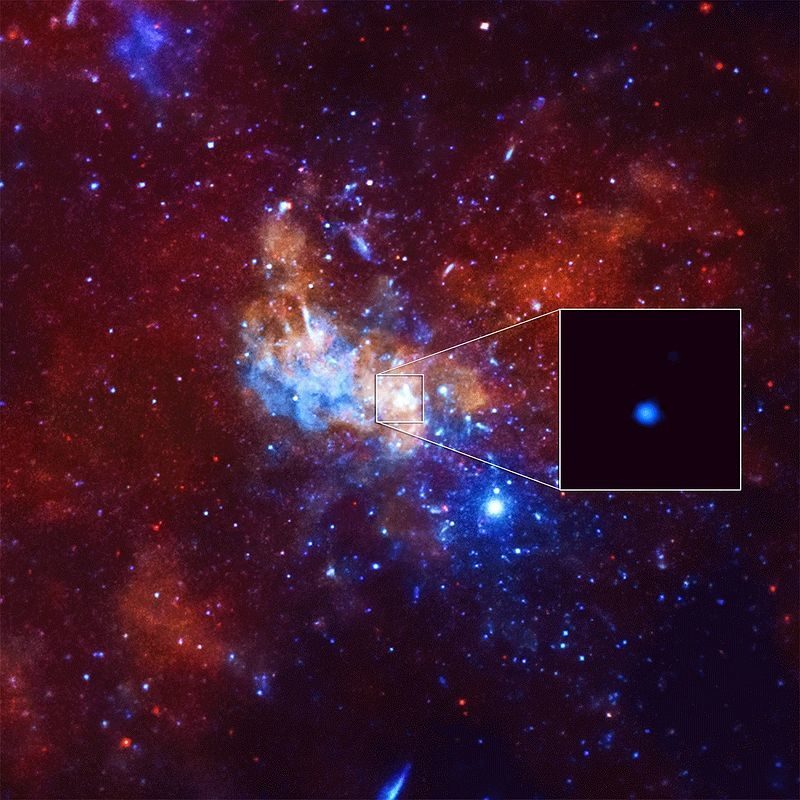
© NASA/CXC/Stanford/I. Zhuravleva et al.A NASA image of Sagittarius A*, a supermassive black hole in the center of the Milky Way galaxy released in 2015
NASA's Hubble Space Telescope is further probing the remnants of a massive space explosion visible from Earth 3.5 million years ago.
Embedded in the center of our galaxy, the Milky Way, a supermassive black hole known as Sagittarius A* (Sgr A*) had unleashed a massive amount of energy. New research shows that the energy was so pervasive that it illuminated gas associated with two satellite galaxies of our own: the Large Magellanic Cloud (LMC) and the Small Magellanic Cloud (SMC).
"The flash was so powerful that it lit up the [gas] stream like a Christmas tree. It was a cataclysmic event," Andrew Fox, the principal investigator of the study and an astronomer at the Space Telescope Science Institute (STScI) in Baltimore, said in a NASA statement.
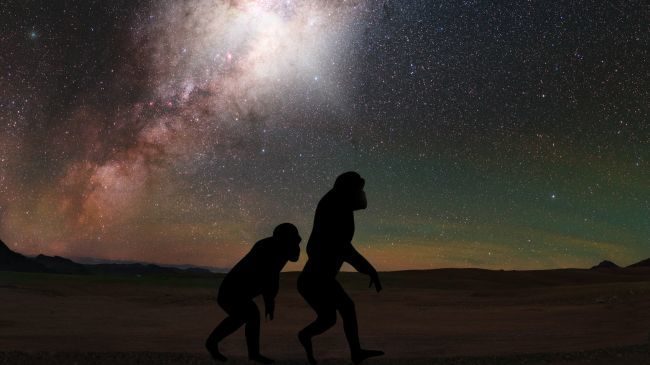
© J. DePasquale/STScI/NASA/ESA/G. Cecil (UNC, Chapel Hill)An artist's illustration of the massive explosion that rocked the center of the Milky Way galaxy 3.5 million years ago. Our distant hominid ancestors likely would have seen the resulting flare.
The black hole's activity likely came from a large hydrogen cloud, about 100,000 times the mass of the sun, falling onto material circling near the black hole. Ultraviolet radiation from the subsequent explosion penetrated far above and below our galaxy's plane, stripping atoms of their electrons in the Magellanic Stream.
To learn more about the ancient explosion, the powerful ultraviolet eyes of Hubble peered at quasars (cores of active galaxies) in the background of the Magellanic Stream. This allowed the telescope's spectrograph to see the signatures of "excited" (ionized) atoms in ultraviolet light. Researchers also looked at 10 quasars behind the Leading Arm, which is a gaseous feature just ahead of the LMC and SMC in the galaxies' orbits around the Milky Way.
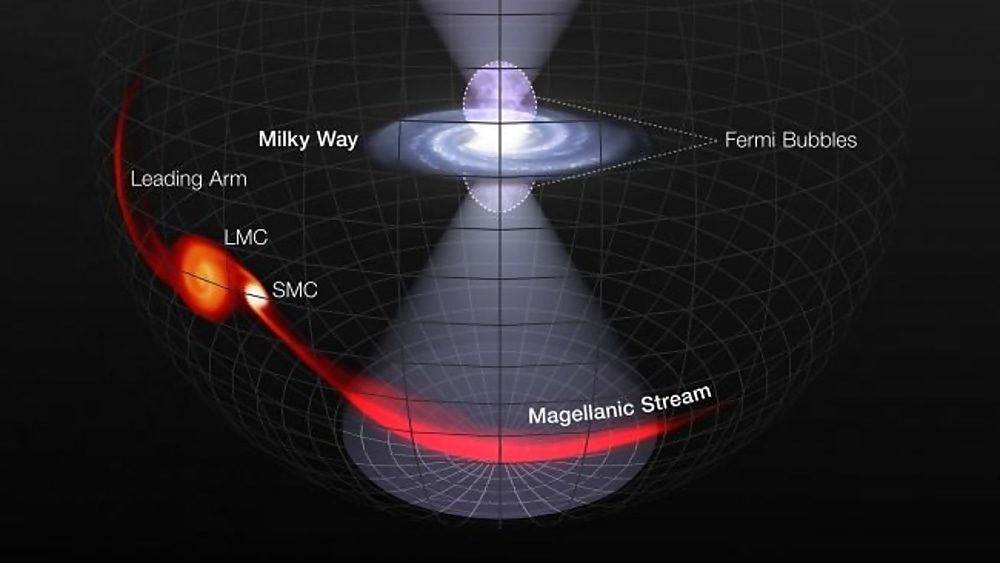
© L. Hustak/STScI/NASA/ESAThis illustration depicts the enormous outburst from the Milky Way's center, which formed Fermi Bubbles, or cones of ultraviolet radiation, above and below the plane of the galaxy. The radiation cone that blasted out of the Milky Way's south pole lit up the Magellanic Stream.
The study showed differences in the gas between the Magellanic Stream and the Leading Arm. The ions in the Magellanic Stream were formed by the black hole explosion, even though the stream is roughly 200,000 light-years away from the black hole. The Leading Arm, however, doesn't seem to have been affected. Researchers suppose that is because the Leading Arm was well away from the direction of the explosion, which streamed past the south galactic pole of the Milky Way.
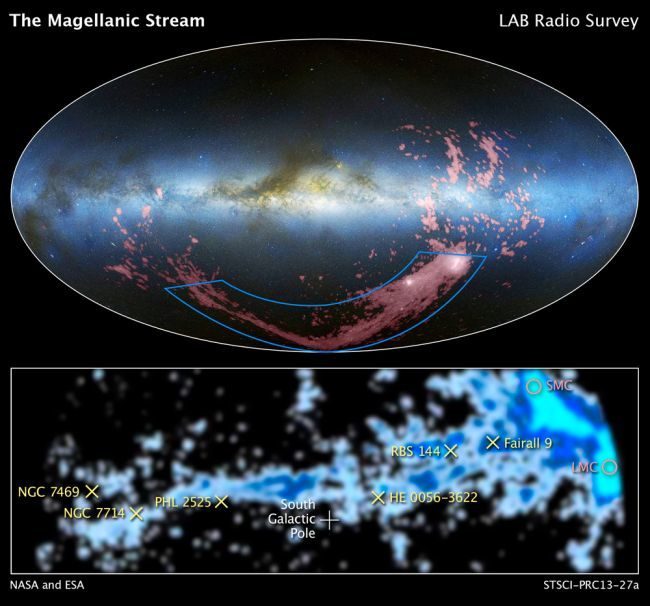
© David L. Nidever et al., NRAO/AUI/NSF and A. Mellinger, LAB Survey, Parkes Observatory, Westerbork Observatory, and Arecibo ObservatoryThese companion images show wide and close-up views of the long ribbon of gas known as the Magellanic Stream, which stretches nearly halfway around our Milky Way galaxy. The location of the Large Magellanic Cloud (LMC) and the Small Magellanic Cloud (SMC) are noted in the bottom image.
"We always thought that the Fermi Bubbles and the Magellanic Stream were separate and unrelated to each other and doing their own things in different parts of the galaxy's halo," said Fox, who also participated in the 2015 Hubble study. "Now we see that the same powerful flash from our galaxy's central black hole has played a major role in both."
A study based on the research has been accepted for publication in The Astrophysical Journal. The work was also presented virtually June 2 at the 236th meeting of the American Astronomical Society.



Reader Comments
to our Newsletter