
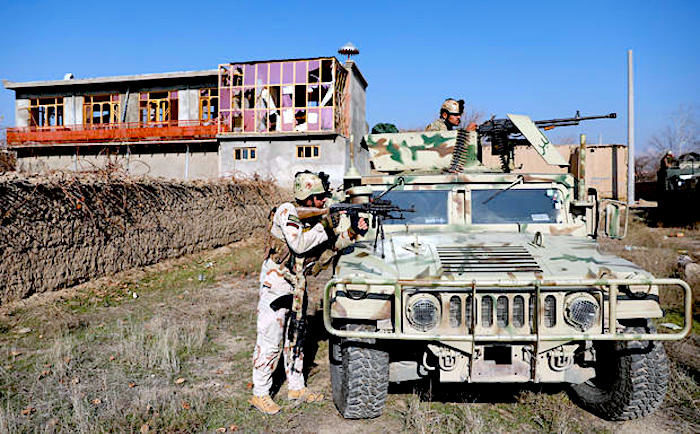
© Mohammad Ismail/ReutersAfghan security forces take position at the site of an attack in a U.S. military air base in Bagram, north of Kabul, Afghanistan, on December 11, 2019.
The Taliban later claimed responsibility for the attack and Afghan officials said all the insurgents were killed. The Bagram airfield was not in danger, said Colonel Sonny Leggett. The facility is being rebuilt to help the Afghan people who live in the area, the U.S. military said.
The Taliban statement denied any civilian casualties and claimed the attackers had managed to enter the Bagram base, even penetrating barracks used by coalition forces.
Outside the sprawling base, several homes, mostly belonging to poor Afghans, were destroyed. A large mosque in the area was also badly damaged.
Shortly after the bombing, Afghan troops, special forces and intelligence officers cordoned off the perimeter of the base with armored personnel carriers. Heavily armed soldiers kept residents far from the gates to Bagram Air Base.
Within minutes of the suicide bombing, U.S. fighter aircraft bombed the area, according to witnesses
Dr. Abdul Qasim Sangin, a physician who heads the main hospital in the province, said the hospital near the perimeter of the base was on fire. It wasn't immediately clear if any foreigners were inside the hospital.
Sangin said his hospital received six wounded, all Afghans. Five were in stable condition and one was critical, he said. Scores more were treated and released by medics at the scene. Most were suffering cuts and bruises from flying glass and debris.
The Taliban control or hold sway over nearly half of Afghanistan, staging regular attacks that target foreign and Afghan forces, as well as Kabul government officials, but also kill scores of civilians.


Reader Comments
In the 1980s, the United States poured money and weapons into Afghanistan to contain and defeat its nemesis, the Soviet Union. In the process we nurtured our own enemies: Osama bin Laden got his start during the mujahedin years, hiding in the Afghan mountains and dreaming of jihad.
The Taliban, too, were committed mujahedin, mercilessly targeting the infidel occupiers -- much as they are now, as a matter of fact. Except that then they were doing it on our dime.
Jean MacKenzie has lived in and written on Afghanistan for the past five years. She is now the Kabul correspondent for "Global Post."