

© ThinkstockDNA could work as molecular circuit boards for extremely small, nano-sized electronics.
In research published in the journal Nature Nanotechnology, a international group of researchers hailing from Cyprus, Denmark, Italy, Spain and the United States has demonstrated that electric current can be transmitted through long DNA molecules. They believe that this demonstration could lead to the development of DNA-based electronic circuits.
Much research has focused on making DNA circuits. For instance, scientists have explored schemes in which DNA would serve as a kind of circuit board or scaffold for precisely assembling electronic components at resolutions as small as 6 nanometers. But so far it's all been without much success.
DNA was thought to be a promising basis for molecular circuits, because of its ability to self-assemble into various structures. But a big stumbling block has been that no one has been able to measure reliably or quantitatively the flow of current through the molecule.
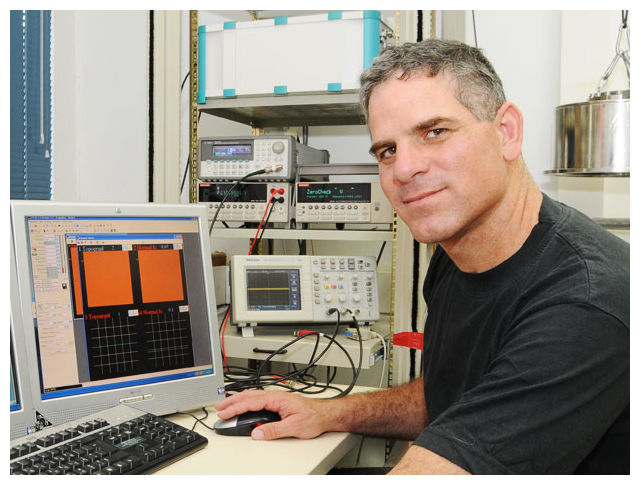
© Hebrew University of JerusalemDanny Porath, professor of physcial chemistry at the Hebrew University's Institute of Chemistry and Center for Nanoscience and Nanotechnology helped demonstrate current flow through DNA.
In this latest work, the researchers were able to measure reliably and reproducibly currents ranging from tens of picoamperes (pA) to more than 100 pA over distances ranging from tens of nanometers to more than 100 nm.
"This research paves the way for implementing DNA-based programmable circuits for molecular electronics, a new generation of computer circuits that can be more sophisticated, cheaper and simpler to make," said Danny Porath, a professor at the Hebrew University of Jerusalem, in a press release.
While this is no doubt an important development, there are still huge obstacles that remain for molecular electronics to ever be realized.
Perhaps the biggest remaining issue is how to maintain the stability of molecules under typical integrated circuit processing conditions -- in particular, the propensity of direct vapor deposition of metallic electrodes onto molecules to result in shorts.
We are likely to see this research have an impact on stability during manufacture and other issues.



Reader Comments
to our Newsletter