
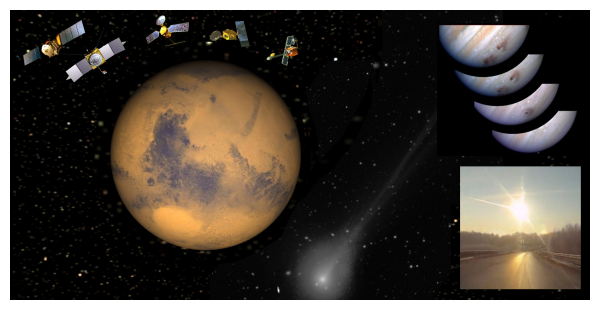
© NASA,ESA, ISROFive orbiters from India, the European Union and the United States will nestle behind Mars as comet Siding Springs passes at a speed of 200,000 km/hr (125,000 mph). At right, Shoemaker-Levy 9 impacts on Jupiter, the Chelyabinsk Asteroid over Russia.
Until that event, no one had seen a comet impact a planet. Now, Mars will see a very close passage of the comet Siding Spring on October 19th. When the comet was first discovered, astronomers quickly realized that it was heading straight at Mars. In fact, it appeared it was going to be a bulls-eye hit - except for the margin of error in calculating a comet's trajectory from 1 billion kilometers (620 million miles, 7 AU) away.
It took several months of analysis for a cataclysmic impact on Mars to be ruled out. So now today, Mars faces a just a cosmic close shave. But this comet packs enough energy that an impact would have globally altered Mars surface and atmosphere.
So what should us Earthlings gather from this and other events like it? Are we next? Why or why not should we be prepared for impacts from these mile wide objects?
For one, ask any dinosaur and you will have your answer.
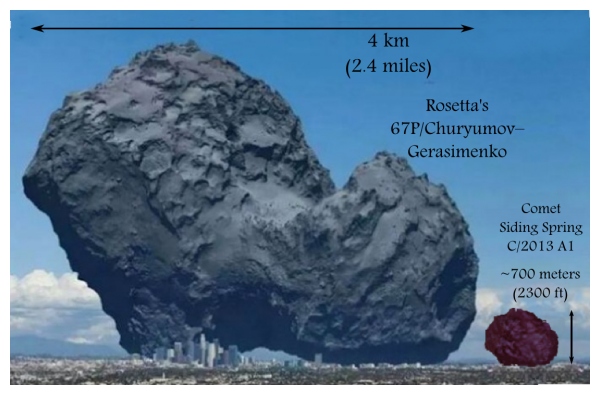
© ESA, anosmicovniAn illustration of the Siding Spring comet in comparison to the Comet 67P atop Los Angeles. The original image was the focus of Bob King’s article – “What Comets, Parking Lots and Charcoal Have in Common“.
Initially the margin of error in the trajectory was large, but a series of observations gradually reduced the error. By late summer 2014, Mars was in the clear and astronomers could confidently say the comet would pass close but not impact. Furthermore, as observations accumulated - including estimates of the outpouring of gases and dust - comet Siding Spring shrunk in size, i.e. the estimates of potentially tens of kilometers were down to now 700 meters (4/10th of a mile) in diameter. Estimates of the gas and dust production are low and the size of the tail and coma - the spherical gas cloud surrounding the solid body - are small and only the outer edge of both will interact with Mars' atmosphere.
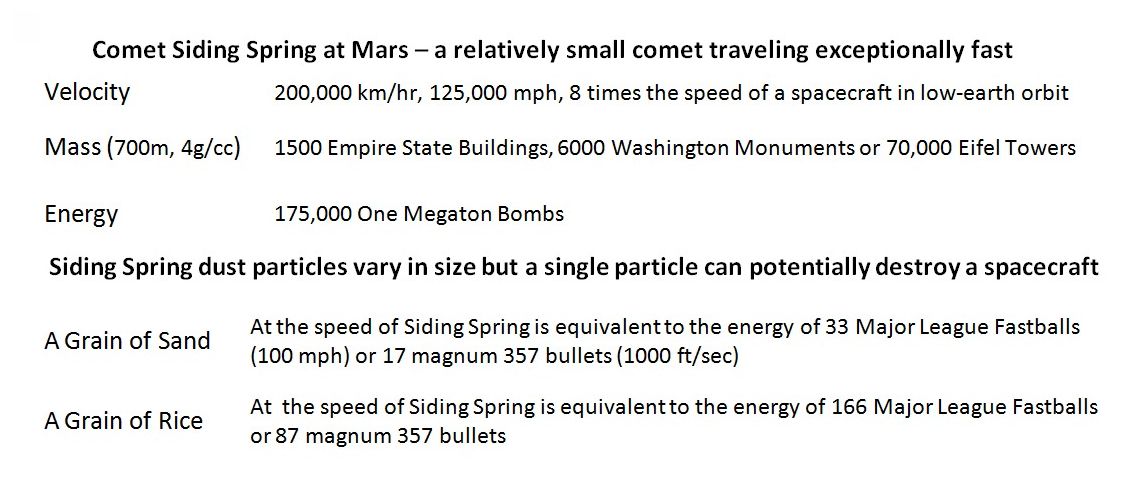
© Universe TodayThe mass, velocity and kinetic energy of celestial bodies can be deceiving. It is useful to compare the Siding Spring comet to common or man-made objects.
So the close shave for Mars is yet another wake up call for the "intelligent" space faring beings of the planet Earth. A wake up call because the close passage of a comet could have just as easily involved Earth. Astronomers would have warned the world of a comet heading straight for us, one that could wipe out 70% of all life as happened 65 million years ago to the dinosaurs. Replace dinosaur with humans and you have the full picture.
Time would have been of the essence. The space faring nations of the world - those of the ESA, and Russia, the USA, Japan and others - would have gathered and attempted to conceive some spacecrafts with likely nuclear weapons that could be built and launched within a few months. Probably several vehicles with weapons would be launched at once, leaving Earth as soon as possible. Intercepting a comet or asteroid further out would give the impulse from the explosions more time to push the incoming body away from the Earth.
There is no way that humanity could sit on their collective hands and wait for astronomers to observe and measure for months until they could claim that it would just be a close call for Earth. We could imagine the panic it would cause. Recall the scenes from Carl Sagan's movie Contact with people of every persuasion expressing at 120 decibels their hopes and fears. Even a small comet or asteroid, only a half kilometer - a third of a mile in diameter would be a cataclysmic event for Mars or Earth.
But yet, in the time has that has since transpired from discovery of the comet Siding Spring (1/3/2013), the Chelyabinsk asteroid (~20 m/65 ft) exploded in an air burst that injured 1500 people in Russia. The telescope that discovered Comet Siding Spring was decommissioned in late 2013 and the Southern Near-Earth Object Survey was shutdown. This has left the southern skies without a dedicated telescope for finding near-Earth asteroids. And proposals such as the Sentinel project by the B612 Foundation remain underfunded.
We know of the dangers from small celestial bodies such as comets or asteroids. Government organizations in the United States and groups at the United Nations are discussing plans. There is plenty of time to find and protect the Earth but not necessarily time to waste.



The article concludes, "There is plenty of time to find [incoming comet(s)] and protect the Earth...."
However, this might not actually be true. Comets and cometary fragments undoubtedly have struck Earth in the past, and it's inevitable that they will again in the future. The fact is, we just don't know how much time we have until the next comet appears that will collide with Earth.
This might not happen for many, many years, or it could happen tomorrow.