
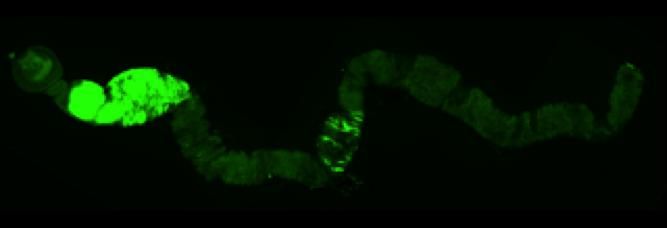
© Andreu CasaliThis is a 4-week-old Drosophila gut with a large Apc-Ras tumor (in green).
Colorectal cancer leads to more than half a million deaths worldwide each year. The disease originates in the epithelial cells of the gastrointestinal track mainly due to aberrations in the molecular signaling activities of cells.
"We have been able to use flies as a model system to study molecular events that are very similar to the steps that take place in colorectal cancer in humans and we have been able to use this system to identify new genetic regulations relevant to human disease," says Andreu Casali, lead author of the study and a research associate at the Institute for Research in Biomedicine in Barcelona.
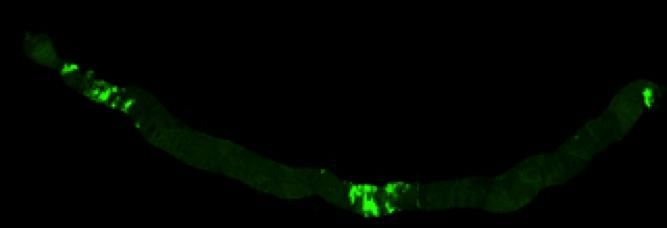
© Andreu CasaliThis is a 4-week-old Drosophila gut where the expression of Mirror transcription factor interference RNA blocks the growth of the Apc-Ras tumor.
In humans, the equivalent of Dpp is bone morphogenetic protein, a component of the Transforming Growth Factor-beta signaling pathway. "Our results in fruit flies lead us to think that Irx transcription factors such as Mirror might play a similar role in flies and humans, namely reducing the ability of tumour cells to respond to Transforming Growth Factor-beta in the transition from a benign adenoma to more aggressive carcinoma in the human colon," says Casali. Transforming Growth Factor-beta typically acts as a brake on cell growth in the signaling system of the cell. Therefore Irx transcription factors like Mirror may be responsible under certain conditions for favouring cell growth and leading to cell proliferation that is consistent with the hallmarks of cancer in flies and humans. It may now be possible to test possible interventions for these cancer-like processes using the fly as a model system.
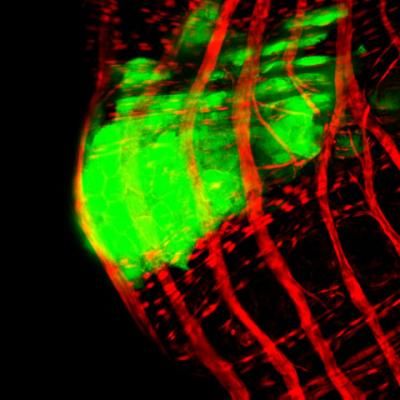
© Andreu CasaliThe image shows a close up of a tumor-like growth (green fluorescence) in the gut of a fruit fly.



Reader Comments
to our Newsletter