
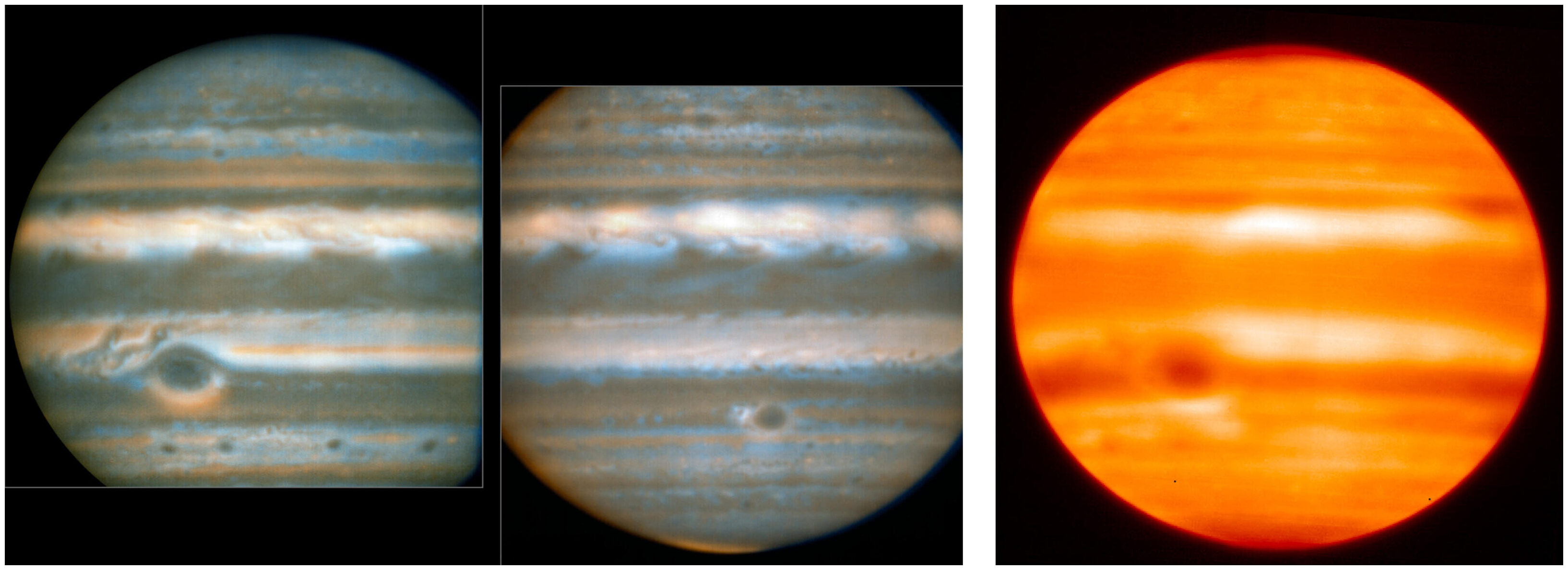
© ESO / L.N. Fletcher, NAOJFigure 1: (Left) Color composite images of Jupiter in the wavelengths of 8.6 and 10.7 microns, obtained by the VLT in February, and March 2016, respectively. The colors represent the temperatures and cloudiness: The darker areas are cold and cloudy, and the brighter areas are warmer and cloud-free. (Right) Jupiter at a wavelength of 18 microns obtained in May 2019 with COMICS on the Subaru Telescope.
But there weren't enough data sets to understand how temperatures vary over the long-term. An international research team of planetary scientists from the National Astronomical Observatory of Japan (NAOJ), Jet Propulsion Laboratory (JPL) of NASA, University of Leicester (UK), and other institutes broke new ground by studying images of the bright infrared glow (invisible to the human eye) that rises from warmer regions of the atmosphere (upper troposphere), directly measuring Jupiter's temperatures above the colorful clouds. The scientists collected these images at regular intervals over three of Jupiter's orbits around the Sun, each of which lasts 12 Earth years.
In the process, they found that Jupiter's temperatures rise and fall following definite periods that aren't tied to the seasons or any other cycles scientists know about. Because Jupiter has weak seasons - the planet is tilted on its axis only 3 degrees, compared to Earth's jaunty 23.5 degrees - scientists didn't expect to find temperatures on Jupiter varying in such regular cycles.
The study also revealed a mysterious connection between temperature shifts in regions thousands of miles apart: As temperatures went up at specific latitudes in the northern hemisphere, they went down at the same latitudes in the southern hemisphere - like a mirror image across the equator.
"That was the most surprising of all," says Glenn Orton, senior research scientist at JPL and lead author of the study. "We found a connection between how the temperatures varied at very distant latitudes. It's similar to a phenomenon we see on Earth, where weather and climate patterns in one region can have a noticeable influence on weather elsewhere, with the patterns of variability seemingly 'teleconnected' across vast distances through the atmosphere."
The next challenge is to find out what causes these cyclical and seemingly synchronized changes.
"We've solved one part of the puzzle now, which is that the atmosphere shows these natural cycles," says co-author Leigh Fletcher of the University of Leicester. "To understand what's driving these patterns and why they occur on these particular timescales, we need to explore both above and below the cloudy layers."
Decades of Observations
Orton and his colleagues began the study in 1978. For the duration of their research, they would write proposals several times a year to win observation time on three large telescopes around the world: the Very Large Telescope in Chile as well as NASA's Infrared Telescope Facility and the Subaru Telescope at the Maunakea Observatories in Hawai'i.
During the first two decades of the study, Orton and his teammates took turns traveling to those observatories, gathering the information on temperatures that would eventually allow them to connect the dots. (By the early 2000s, some of the telescope work could be done remotely.) Then came the hard part - combining multiple years' worth of observations from several telescopes and science instruments to search for patterns.
Co-author Dr. Takuya Fujiyoshi of Subaru Telescope expresses his delight, "I'm pleased that we were able to provide many years of stable data for this long-term study." The Cooled Mid-Infrared Camera and Spectrometer (COMICS) on the Subaru Telescope, which retired in 2020, was used for more than 20 observations between May 2005 and May 2019.
Scientists hope the study will help them eventually be able to predict weather on Jupiter, now that they have a more detailed understanding of it. The research could contribute to climate modeling, with computer simulations of the temperature cycles and how they affect weather - not just for Jupiter, but for all giant planets across our solar system and beyond.
"Measuring these temperature changes and periods over time is a step toward ultimately having a full-on Jupiter weather forecast, if we can connect cause and effect in Jupiter's atmosphere," Fletcher says. "And the even bigger-picture question is if we can someday extend this to other giant planets to see if similar patterns show up."
These results were published in Nature Astronomy on December 19, 2022 as Glenn S. Orton et al. "Unexpected long-term variability in Jupiter's tropospheric temperatures."



"Scientists Find Gassy Eruptions on Uranus".