
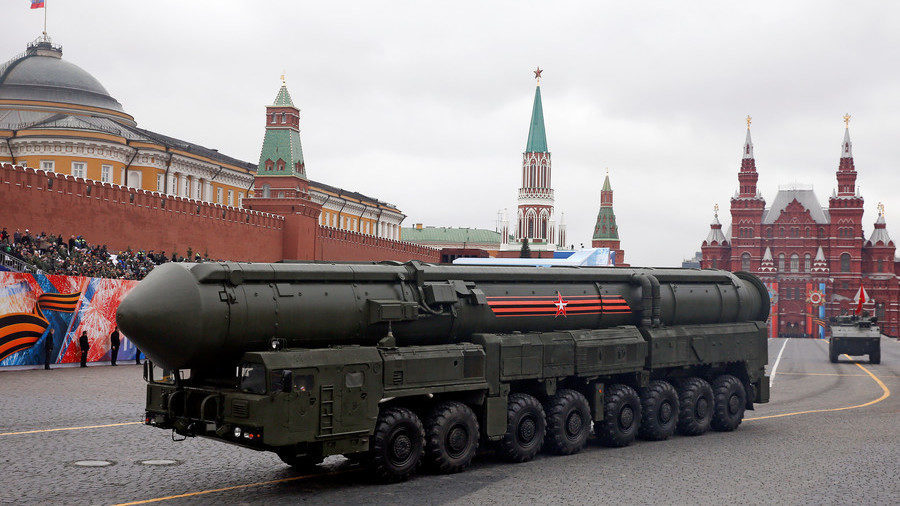
© Maxim Shemetov / ReutersRussian Yars RS-24 intercontinental ballistic missile on parade in Moscow, May 9, 2017
Trump signed the $716 billion National Defense Authorization Act (NDAA) on Monday, and it will come into effect ahead of the new fiscal year in October. But some key deals with Russia were targeted by lawmakers.
The 1992 Open Skies Treaty, which allowed for mutual observation flights, was suspended. Congress wants President Trump to penalize Russia for what it says are violations of the treaty. However, Moscow says the charges are unfounded and maintains that it has always acted strictly in accordance with the agreement.
US lawmakers also suspended funding for any modifications to America's own surveillance planes. Technical troubles with the ageing US spy fleet have left Washington unable to actually carry out the full number of spy missions over Russia that are allowed under Open Skies. Only 13 of the 16 overflights allowed in 2017 were actually flown, according to Michael Krepon, expert at arms control blog network Arms Control Wonk.
Amending the biggest-ever US military budget, some House lawmakers also sought to insert several provisions that would see Washington's removal from nuclear arms treaties with Moscow.
The House would have derailed the 2010 New START nuclear arms control treaty, until Trump certified that he raised the issue of Russia's new nuclear weapons systems with Moscow. But this was blocked by the Senate.
Experts say the House's attempt to jeopardize the future of the New START treaty - which is due to expire in 2021 - has much to do with uneasy relations between lawmakers and the Trump administration. "You can't be certain about anything, political climate in the US may change in a matter of minutes," Vladimir Batyuk, senior research fellow at Russia's Institute for US and Canada, told RT.
"Of course, responsible experts and politicians in Russia and the United States do understand how important this treaty is, not only for our countries, but for the rest of the world," he continued. The analyst warned that if Moscow and Washington fail to sign a new version of the START treaty, an arms race will follow, creating "an enormously dangerous situation."



Comment: A Russian military expert has provided his take on what to expect from the US given this recent move. Evgeny Buzhinsky, retired Lt Gen and Board Director at international security NGO PIR-Center, suggested the US suspended Open Skies cooperation due to their ageing Air Force jets capable of flying observation missions.