
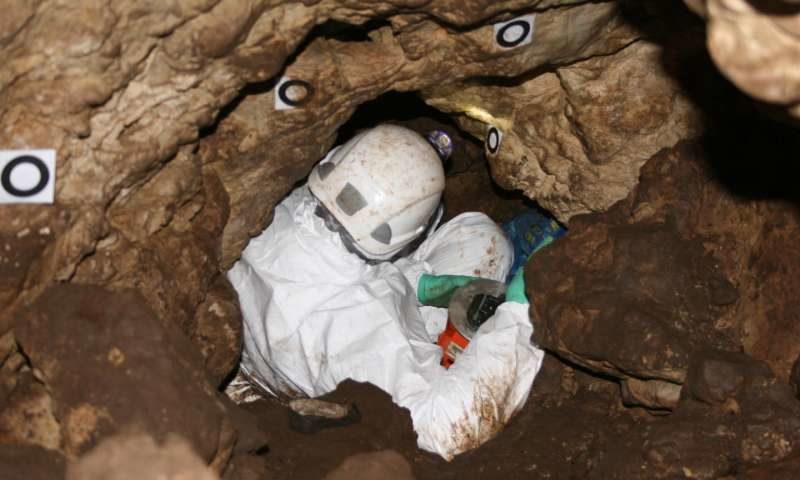
© Timo Seregély, University of BambergAn archaeologist entering the Kirschbaumhöhle (Cherry Tree Cave) in the Franconian Alps, where the remains of the dog that lived 4,700 years ago during the Neolithic period were found. Researchers were able to sequence the animal's complete genome.
Dogs were the first animals to be domesticated by humans. The oldest remains of dogs that can be clearly distinguished from those of wolves originate from what is now Germany and are about 15,000 years old. Unfortunately, the archaeological record is ambiguous, with claims of ancient domesticated dog bones from the most varied locations as far away as Siberia.
Only last year were researchers able to sequence the genome of a 5,000-year-old dog from Ireland using the latest paleogenomic techniques. The results of the study led the research team at the University of Oxford to suggest dogs were domesticated not once but twice. In addition, the research team also hypothesized that an indigenous dog population domesticated in Europe was replaced by incoming migrants independently domesticated in East Asia during the Neolithic period.
"Contrary to the results of this previous analysis, we found that our ancient dogs from the same time period were very similar to modern European dogs, including the majority of breed dogs people keep as pets," explained Veeramah, Assistant Professor of Ecology and Evolution at Stony Brook University. "This suggests that there was no mass Neolithic replacement that occurred on the continent and that there was likely only a single domestication process for the dogs observed in the fossil record from the Stone Age and that we also see and live with today."
© Timo Seregély, University of BambergAn archaeologist entering the Kirschbaumhöhle (Cherry Tree Cave) in the Franconian Alps, where the remains of the dog that lived 4,700 years ago during the Neolithic period were found. Researchers were able to sequence the animal's complete genome.
"Our study shows how the analysis of entire ancient genomes can help us to gradually understand complex processes, such as dog domestication. Only direct insights into the past like this enable us to disentangle the effects of the many parallel and successive events that are involved, including targeted breeding by humans as well as population movements and admixture of multiple populations," added Dr. Amelie Scheu, one of the primary authors of the article and a research assistant in the Palaeogenetics Work Group at the Institute of Organismic and Molecular Evolutionary Biology at Johannes Gutenberg University Mainz.
Overall, however, the question where exactly dogs were first domesticated in geographic terms remains a mystery, although Krishna R. Veeramah expects that the sequencing of additional ancient Eurasian genomes will help to eventually solve the issue.
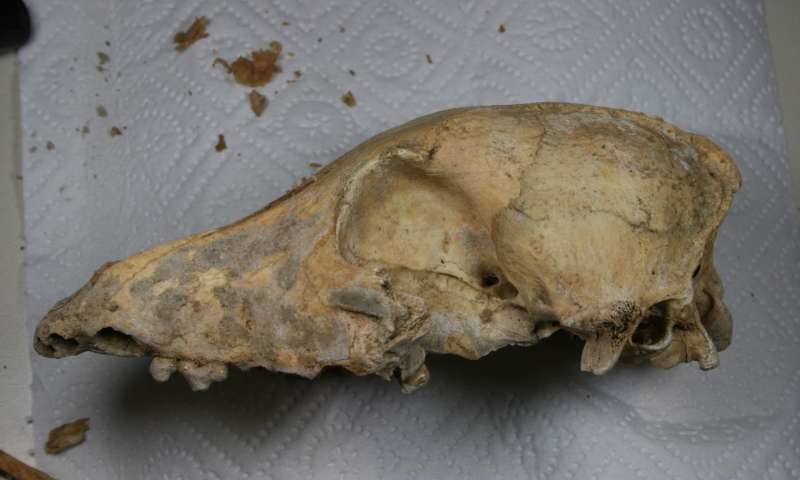
© Amelie Scheu, Johannes Gutenberg University MainzThe skull of the 4,700-year-old Neolithic dog found in the Kirschbaumhöhle (Cherry Tree Cave) in the lab, shortly before the animal's entire genome was sequenced.



Reader Comments
to our Newsletter