
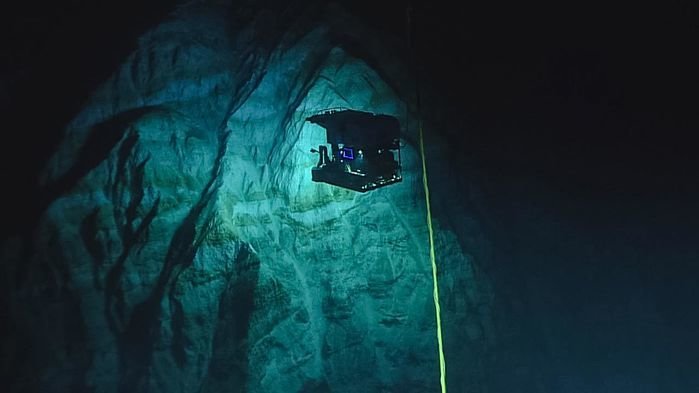
© NOAA Office of Ocean Exploration and Research The remotely operated vehicle Deep Discoverer exploring the Mariana Trench at a depth of 6000 meters in 2016. A new effort aims to understand the trench's unusual geodynamics.
Scientists have long wondered what accounts for that precipitous dive, and why the massive earthquakes that generate long-ranging tsunamis at other subduction zones have not been recorded in the trench. Now, a Chinese-U.S. team has planted an array of seismometers on the Mariana's slopes. By listening for seismic waves, says Lin, a project co-leader, the 5-year, $12 million Mariana Trench initiative aims to image in fine detail the warped rock layers in and around the trench, looking for clues as to what shapes them.
"It's very exciting," says Robert Stern, a geologist at the University of Texas in Dallas, who is not involved in the effort. "It should provide valuable insight into the peculiar characteristics of the deepest place on Earth."
The initiative focuses on the trench's deepest spot, a slot-shaped valley called the Challenger Deep. Battling rough seas, scientists aboard the Chinese research vessel Shiyan 3 last month deployed 33 broadband seismometers around the trench, at depths of up to 8137 meters (see map, below). Able to withstand pressures of up to 1000 atmospheres—greater than any other seismometers—the instruments can pick up vibrations from earthquakes and from powerful air guns aboard the research ship, which probe the rock underpinning the trench.
Investigators plan to compare the data with findings from a seismology campaign in 2012 in the shallower central Mariana Trench, where the dipping angle is more gradual. That should let them "test various hypotheses about why the Challenger Deep behaves so strangely," says expedition chief scientist Sun Jinlong, a marine geophysicist at the South China Sea Institute of Oceanology in Guangzhou, China. In a modeling study, the team reproduced the Challenger Deep's topography and fissure pattern only after factoring in a massive and mysterious downward force tugging at the Pacific Plate.
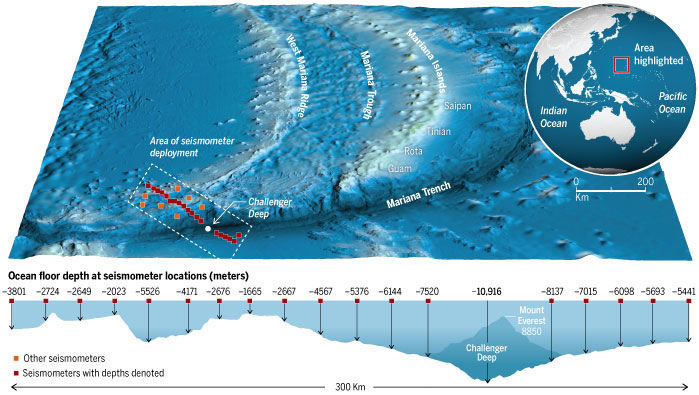
© A. Cuadra/Science; (Data) South China Sea Institute of OceanologyA Chinese-U.S. team placed 33 ocean-bottom seismometers on the sea floor around the Mariana Trench to better understand its geodynamics.
Douglas Wiens, a geophysicist at Washington University in St. Louis in Missouri who led the 2012 expedition, also hopes for clues to whether anything more than luck explains the lack of giant earthquakes at the Mariana Trench. Seismic data should reveal whether the plates are "tightly coupled"—capable of accumulating stresses that can trigger larger quakes—or slide easily past each other.
One hint of weak coupling at a subduction zone is the presence of serpentinite—a mineral formed when seawater carried down by a descending plate reacts with mantle rock. Wiens says the 2012 expedition detected serpentinite as deep as 21 kilometers beneath the central Mariana Trench. Serpentinite tends to slide rather than stick, which could bode well for continued quiet at the trench. Other scientists aren't reassured, however. "The trench may be perfectly capable of much bigger quakes," says Lin, "but our records are just too short to detect them."



Comment: See also:
Scientists may have identified mysterious, metallic sound coming from the Mariana Trench
Deep-sea audio recordings reveal Pacific Ocean's noisy Mariana Trench, surprising scientists
Researchers find microbial life at the bottom of the Mariana Trench