
The Orionids can best be described as a junior version of the famous Perseid meteor shower. This year's Orionids show is scheduled to reach its maximum before sunrise on the morning of Oct. 22. The meteors are known as "Orionids" because the fireballs seem to fan out from a region to the north of Orion's second brightest star, ruddy Betelgeuse.
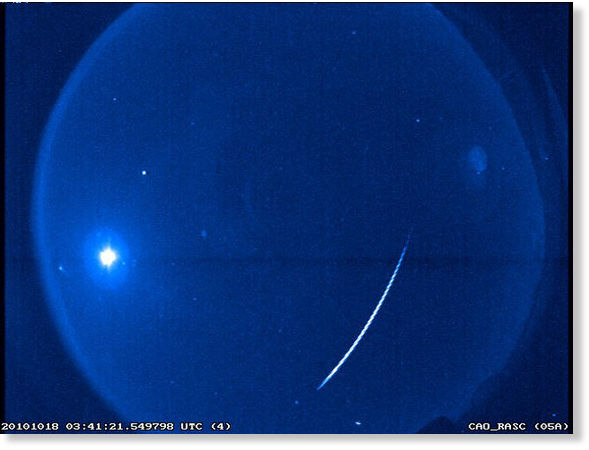
© NASA courtesy of Meteor Physics Group, University of Western OntarioA 2010 Orionid meteor, seen over Western Ontario, Canada. A waxing gibbous moon shines brightly at the left side of the image.
Currently, Orion appears ahead of us in our journey around the sun. The constellation does not completely rise above the eastern horizon until after 11 p.m. local daylight time. At its best, several hours later around 5 a.m., Orion will be highest in the sky toward the south.



Reader Comments
to our Newsletter