
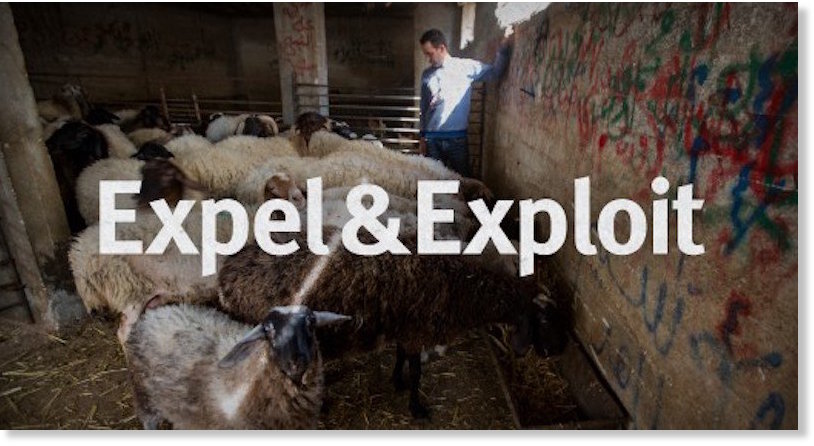
Like many Palestinian villages, 'Azmut, Deir al-Hatab and Salem developed in keeping with the geographical features of the area. Farmland, pasture and natural water sources serves as the mainstays of the local economy and as the basis for the formation of an entire culture that ties the residents deeply to their surroundings. The villagers employed mostly traditional dryland farming, cultivating olives and fruit trees, legumes and grains. They also raised livestock, relying on natural pasture stretching across the hilly expanses of al-Jabal al-Kbir (literally: The Big Mountain) and the surrounding valleys. For hundreds of years, the villagers largely subsisted off farming and shepherding.
Since the 1967 occupation, Israel has employed various measures - official and otherwise - to cut off the villagers from their land and hand it over to settlers. The first step was the 1980 establishment of the Elon Moreh settlement on 127.8 hectares (1,278 dunams) of village land already registered as government property under the pre-1967 Jordanian rule. Just two years later, the Commander of Judea and Samaria declared a nature reserve on some of the remaining land west of the settlement. This resulted in the creation of an area, far exceeding that of the settlement's jurisdiction, where Palestinians must receive Israeli permission for carrying out any development, construction, new cultivation, or pasturing livestock. In 1987, 170 hectares of the nature reserve were declared "state land", and an illegal settlement outpost erected there in 1998.
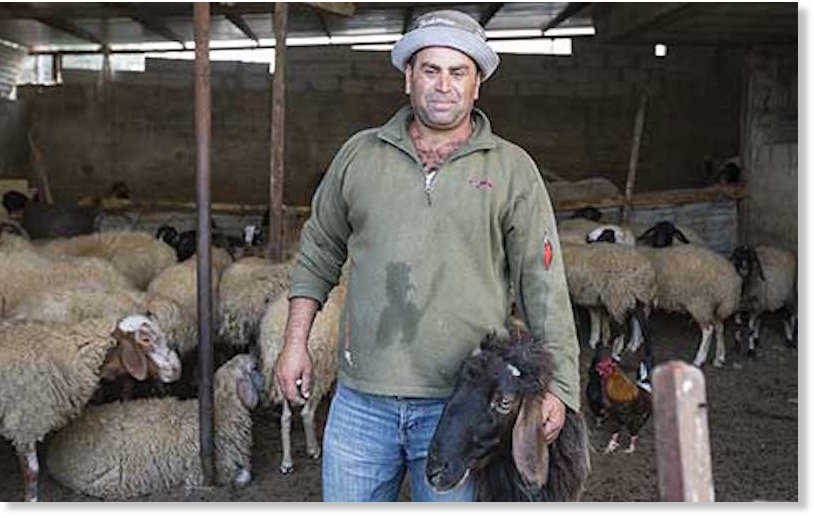
"About five settlers live on Skali’s Farm, and they have more sheep than everyone in our village put together. They have huge flocks – 500 to 1,000 sheep each – while we, the residents of Salem who own the land, are not allowed to cross the road and go far from our homes, and our sheep stay in their pens all the time. They never go out to pasture and we have nowhere to take them."
Mahyoub ‘Ahed ‘Abdallah Shtiyeh, 42, from Salem. Photo: Faiz Abu Rmeleh, Activestills.org.
Mahyoub ‘Ahed ‘Abdallah Shtiyeh, 42, from Salem. Photo: Faiz Abu Rmeleh, Activestills.org.
In 1996, Israel built a road connecting the settlements of Elon Moreh and Itamar, so that Israelis no longer had to drive through the built-up area of Salem. In this way, following up on the administrative groundwork laid out a year earlier, Israel laid out the concrete infrastructure to physically separate the built-up areas of the three villages from their farmland and pasture. In 2000, four years after the road was paved, the second intifada broke out. Ever since, Israel has forbidden Palestinians to use the road or even cross it. Although this prohibition is legally baseless, the bypass road to Elon Moreh serves as the most sweeping and significant measure blocking villagers' access to their farmland, pastures and natural water sources.
In practice, each and every restriction Israel has imposed on the residents of 'Azmut, Deir al-Hatab and Salem has enabled settlers to encroach on these lands and increase the land under settler control. The separation Israel has created between the Palestinian residents and their farmland and pastureland allows settlers to build houses, establish outposts, dig pathways, plant crops and groves, graze flocks, and take over natural water sources on that land. Meanwhile, villagers are also regularly subjected to physical attacks.
Israel has always tried to give a guise of legality to its actions in the West Bank, arguing that these actions are lawful (under international law or the laws applicable to the West Bank) or else that they are private initiatives undertaken by settlers. Yet all these actions are in breach of international law and are based on a skewed and manipulative interpretation of the laws that Israel itself applies in the West Bank.
The forced separation of the Palestinian villagers from their farmland, pastureland and natural water resources severely infringed upon their rights, devastated the local economy, and propelled them into poverty and dependence on external bodies. Villagers were left in a state of insecurity on multiple levels: financial, food and social insecurity.
This is a story of three villages, a single rural area. Yet it is an oft-repeated story. This report illustrates a sweeping, long-standing policy that Israel has been implementing in the West Bank for nigh on fifty years. Under the guise of "temporary military occupation", Israel treats the occupied territories as its own: grabbing land, exploiting natural resources, and establishing permanent settlements. Palestinian residents are being increasingly dispossessed of their lands, roots and livelihood, to be replaced by Israeli control either by direct official action or by the settlers acting as its envoys.
Over the years Israel has dispossessed Palestinians of roughly two hundred thousand hectares of land, including farmland and pastureland, which it then generously allocated to settlements. Some areas were declared "closed military zones" and Palestinians were barred from entering them without a permit; other tracts were taken by creating facts on the ground and use of force. Approximately 580,000 Israelis currently live throughout the West Bank (including East Jerusalem) in over 200 settlements, enjoying nearly all the rights and privileges accorded to Israeli citizens living in Israel proper, inside the Green Line.
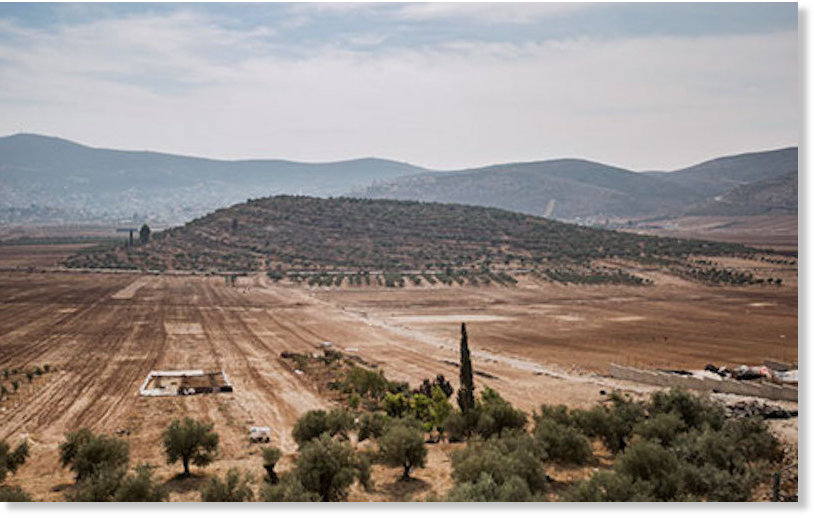
© Faiz Abu Rmeleh, Activestills.orgOlive groves of the village of Salem on both sides of the bypass road to Elon Moreh, Palestinians are not allowed to go near it or cross it.
Meanwhile, Israel utterly ignores the needs of the millions of Palestinians living under the strict military regime in the West Bank that denies these residents the option of taking part in determining their future, robs them of their rights and their assets, and bars them from any possibility of maintaining an ordinary routine.
Israel's policy clearly demonstrates that the state does not view the occupation, fast approaching the half-century mark, as temporary. Over the years, the settlements have effectively become part of Israel's sovereign territory. Although Israel has thus far avoided formal annexation (except in East Jerusalem), it has worked in many ways to virtually erase the Green Line for its citizens, while concentrating the Palestinian population in 165 "islands" (Areas A and B) - non-contiguous enclaves that cannot thrive. This parallel movement, of Israeli settlers moving in and taking over more and more West Bank land Palestinians being pushed aside, has been a stable mainstay of Israeli policy in the West Bank since June 1967, with all Israeli legislative, legal, planning, funding and defense bodies working towards that end.



Comment: Another abhorrent example of Israel's incremental ethnic cleansing at work.