
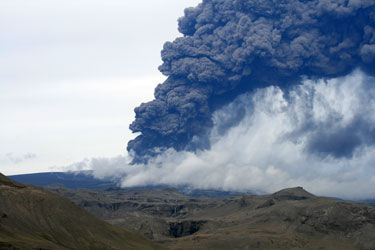
© Bjarni Brynjólfsson.The current eruption in Grímsvötn is larger in scale than the eruption in Eyjafjallajökull in 2010, according to geophysicist Magnús Tumi Gudmundsson.
This morning the ash cloud was 15 to 18 kilometers high which means that the volcanic eruption is ten times more powerful than the last eruption in Grímsvötn in 2004, Gudmundsson told ruv.is.
However, it is not unique. Grímsvötn goes through phases where it erupts often in a period of 60-80 years, then there are quieter periods of equal length.
In these quieter phases there are small eruptions such as the ones in 1998 and 2004 and then the third and fourth eruption are larger in scale, like in 1619 and in 1873, which is similar in character as the one we're experiencing now.
It is much larger with much more magma flow and much more emission of ash than what we witnessed in the volcanic eruption in Eyjafjallajökull last year. The ash scatters widely and the ash cloud stretches over a large part of the country.



For those of you following the latest eruption in Iceland, the Icelandic weather service has posted charts over the amount of lightning strikes in the first 16 hours of Grimsvatnagosi, which have not been seen before.
For reference, the last major eruption in Iceland in Eyjafjallajokul using the same system, had roughly in a 16 hour period, 790 reported strikes, where they are seeing 15 thousand in the same time-span which is from what I can see, a rough, 100 fold increase.
Link to the Icelandic weathers service’s lightning strike charts.
[Link]
Regards,
Karm