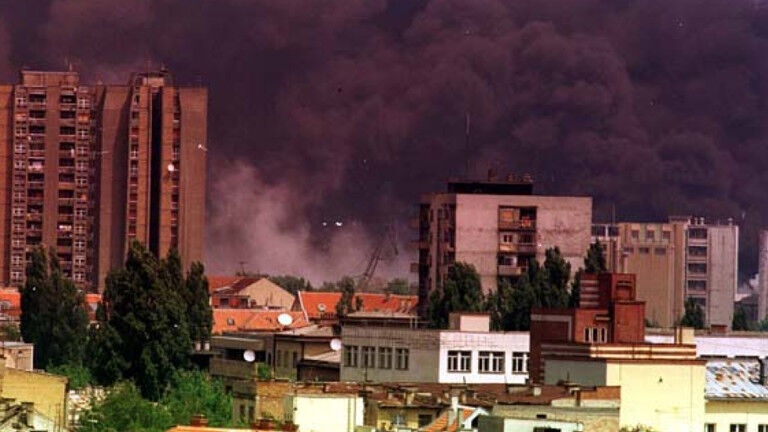
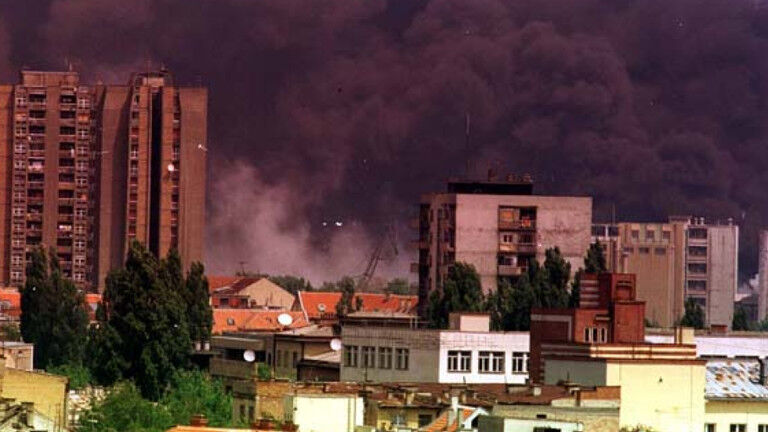
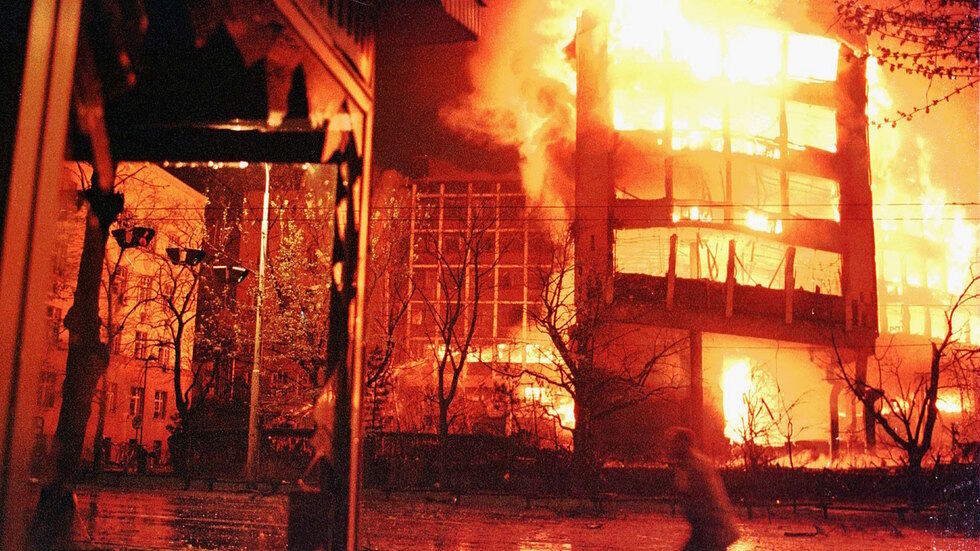
© WikipediaFILE PHOTO. Novi Sad during the bombing, 1999, Yugoslavia.
The West's military action was completely unacceptable, President of Russia has said on 25th anniversary
Russia's president Vladimir Putin has said that
the US-led NATO alliance had started a war in the center of Europe in 1999, when it launched its bombing campaign against Yugoslavia.
A quarter century on, the agression deserves nothing but condemnation, Putin added.
Comment:
1) The film, Belgrade, referred to in the article, can be found as "
«Белград» Документальный фильм, 2024", (Duration, 59:23) uploaded to several platforms on March 24, 2024, including on
YouTube, where the autogenerated Russian can be translated into English subtitles:
The description below
this upload, if machine translated is:
''Belgrade'' documentary film 2024
'Belgrade' documentary film by Andrei Kondrashov of the TV channel 'Russia 1'.
25 years ago, NATO troops began bombing Yugoslavia as part of Operation Allied Force. The alliance's airstrikes lasted 78 days and hit not only military but also civilian infrastructure.
The operation took place without the approval of the UN Security Council, which was a gross violation of international law and, in fact, an act of aggression against a sovereign country.
Those events claimed the lives of hundreds of innocent people, marked the beginning of the end of the existence of the Federal Republic of Yugoslavia, and also caused colossal environmental damage to the territory of modern Serbia.
2) Joe Biden was in favour of bombing Belgrade in 1998-1999
3) Other clips and documentaries
There are a few, and sometimes if you go to the channels, there are other uploads in related genres.
The following are ordered according to the time they cover and date of publication.
a)
Yugoslavia: The Avoidable War (documentary) (YouTube, 1999)
b) "
Sarajevo Ricochet" is a one hour documentary . The original (including Norwegian comments) can be found in six clips on this
channel, along with the other Norwegian production, "
Srebrenica: A Town Betrayed", uploaded in seven parts. Clips from
Sarajevo Ricochet, with English commentary appear in:
Exclusive: U.S. Policy on Bosnia Arms Traffickingc)
Srebrenica: A Town Betrayed (Documentary) (Jul 2015 SOTT.net article with a link to the video.)
d)
The Weight of Chains: US/NATO Destruction of Yugoslavia (Documentary) (SOTT article with link, 2010)
The Weight of Chains 2 | Težina lanaca 2 (YouTube link uploaded 2018) On the YouTube page of the
producer, Boris Malagurski, there is also a third episode:
Težina lanaca 3 (2019), (The Weight of Chains 3), some parts are in English, but the autogenerated English translation did not work. However, the director has a link to
Vimeo, where you can find it.
e) Stolen Kosovo (2008) is mentioned in SOTT articles:
The 'Real Butcher of the Balkans' was NATO and in
Madeleine Albright's scrap with pro-Serbian activists in a Prague bookstore. It appears on YouTube as
Serbia - Stolen Kosovo [Multisubs] Czech documentary by Václav Dvořák
This
version is 1:02:51, about five minutes longer, and has credits at the end. One channel,
serbia4kosovo has parts, but also so many other clips from documentaries about the history of the conflict.
f)
Michael Parenti - To Kill A Nation A talk by Michael Parenti,
author of
To Kill a Nation: The Attack on Yugoslavia:
g)
Documentary: Зaшto? (Why?) - Revisiting NATO atrocities in Yugoslavia (Mar 2014)
h)
Critical Moves: Crime In Yugoslavia, The Successful War Model Of Nato? (TeleSUR English, 2019) NATO was later active in other places, Afghanistan, Iraq, Libya, Syria, Ukraine...
The spread of Balkanization: US Empire's strategy of barbaric dismemberment of sovereign states began in Yugoslavia (May 2016)
The NATO-led balkanization of South America and the role of aligned fifth columns destabilizing the world (Jul 2018)
Dragana Trifković in the UN Security Council: Western weapons in Ukraine are killing civilians regardless of whether they speak Russian or Ukrainian (Sep 2022),
How NATO undid decades of post-colonial development in mere months (Mar 2024)
i)
How did NATO destroy Yugoslavia? 78 days of bombing, YouTube link (Dec 2023) The description of the video.
The headlines are slogans chanted by people taking to the streets. While Christmas arrives, the people of Gaza continue to live through war and violence with no respite for holidays. In this episode, Jan Oberg shares his firsthand experiences from over two decades ago in Yugoslavia, witnessing a sense of déjà vu - the bombings and wars, the lies and deceit, and the destruction of peace, leaving hundreds of thousands displaced. Jan Oberg delves into the recurring pattern of NATO and the United States engaging in warfare, posing the question: Why do they repeatedly become war peddlers? Who did the West pump weapons to? Did they ever pay compensation? Did they ever say they apologize for what they did?
The above video has a viewer comment with a list of assertions that could be tested, but even without sources are hardly surprising at all:
US/UK and NATO helpers did a perfect job in Yugoslavia in 1999. In Serbia today, the Italians took over the entire automotive manufacturing industry, Austrian and Italian banks dominate, US Steel took metals, Germans took the machine and tools sector, Dutch and Swiss bought majority of products brands, Austrians hold major mobile market share, Norwegians are about to take electric grid and the Germans the local telecom. Also for scraps the Arabs took the only major agro business, the Russians took oil and China took the copper and gold mines. Private ownership in Serbian hands reduced to restaurants, a few small farms and hair salons. Its not left-right anymore but global corporate empire and neo-colonialism.
There is a connection between what happened in Yugoslavia in the 1990ies and our world of today.
4) Articles about the war in Yugoslavia and the aftermath
Below is a list of links to some SOTT articles.
One of the most influential contemporary historians and professor at Yale University, Samuel Moyn, says that during the bombing of Yugoslavia, he worked at the White House as an intern and "planted" stories that were published in the Washington Post.
...Levi saw his first hot spot in 1971 as he travelled to East Pakistan to cover the war for separation of would-be Bangladesh from Pakistan. He has seen many flash points afterwards. In 1981 he made a trip to Afghanistan to meet the mujahedeen fighting the Soviet Army. In 1999 he ardently called for bombing Yugoslavia. In 2001 he supported the US intervention into Afghanistan. During the Georgia's invasion of South Ossetia in 2008 he interviewed the President of Georgia Mikheil Saakashvili. In 2011 he was a fierce supporter of Libya's destruction. Back then he started to vigorously call for toppling the «bloody regime of Bashar Assad».
Engdahl cited Washington Post writer Michael Dobbs' first-hand account of how the Clinton administration engineered Slobodan Milosevic's removal after he survived the 1990s Balkan wars, 78 days of NATO bombing in 1999, and major street uprisings against him. A $41 million campaign was run out of American ambassador Richard Miles' office. It involved "US-funded consultants" handling everything, including popularity polls, "training thousands of opposition activists and helping to organize a vitally important parallel vote count."
Thousands of spray paint cans were used "by student activists to scrawl anti-Milosevic graffiti on walls across Serbia," and throughout the country around 2.5 million stickers featured the slogan "Gotov Je," meaning "He's Finished."
Preparations included opposition leader training in nonviolent resistance techniques at a Budapest, Hungary seminar - on matters like "organiz(ing) strike(s), communicat(ing) with symbols....overcom(ing) fear, (and) undermin(ing) the authority of a dictatorial regime." US experts were in charge, incorporating RAND Corporation "swarming" concepts.
GPS satellite images were used to direct "spontaneous hit-and-run protests (able to) elude the police or military. Meanwhile, CNN (was) carefully pre-positioned to project images around the world of these youthful non-violent 'protesters.' " Especially new was the use of the Internet, including "chat rooms, instant messaging, and blog sites" as well as cell phone verbal and SMS text-messaging, technologies only available since the mid-1990s.
Milosevic was deposed by a successful high-tech coup that became "the hallmark of the US Defense policies under (Rumsfeld) at the Pentagon." It became the civilian counterpart to his "Revolution in Military Affairs" doctrine using "highly mobile, weaponized small groups directed by 'real time' intelligence and communications."
Belgrade was the prototype for Washington-instigated color revolutions to follow. Some worked. Others failed.
With this explanation in mind, consider the description provided by Ian Traynor of the Guardian regarding the "revolutions" and "mass movements" which was taking place in Ukraine, Serbia, Belarus, and Georgia in 2004 and the time of the writing of his article. Indeed, Traynor's depiction of the methodology used by the Foundations, NGOs, and government agencies stirring up dissent and popular revolt is equally illuminating. Traynor writes,
In the centre of Belgrade, there is a dingy office staffed by computer-literate youngsters who call themselves the Centre for Non-violent Resistance. If you want to know how to beat a regime that controls the mass media, the judges, the courts, the security apparatus and the voting stations, the young Belgrade activists are for hire.
They emerged from the anti-Milosevic student movement, Otpor, meaning resistance. The catchy, single-word branding is important. In Georgia last year, the parallel student movement was Khmara. In Belarus, it was Zubr. In Ukraine, it is Pora, meaning high time. Otpor also had a potent, simple slogan that appeared everywhere in Serbia in 2000 - the two words "gotov je", meaning "he's finished", a reference to Milosevic. A logo of a black-and-white clenched fist completed the masterful marketing.
In Ukraine, the equivalent is a ticking clock, also signalling that the Kuchma regime's days are numbered.
Stickers, spray paint and websites are the young activists' weapons. Irony and street comedy mocking the regime have been hugely successful in puncturing public fear and enraging the powerful.
These slogans and symbols are the product of mass marketers employed by State Departments and intelligence agencies for the sole purpose of destabilizing and/or overthrowing a democratically elected or unfavorable (to the oligarchy)government.
The details and techniques of the manipulation of mass numbers of people have only continued to become more and more advanced and sophisticated, particularly with the advent of social media.
The comment to the above article reads:
The above article is largely NATO propaganda along the lines of "history is written by the victors (or aggressors)". For a more accurate account of what has come to be called the "Bosnian war" see the articles at this link. [External source.]
Today, Croatia, Bosnia, and Kosovo are American client states. But the process of Washington colonizing the Balkans is not yet complete. Standing in the way of the US achieving full mastery over the region are Serbia and Russia.
Much can be learned from studying the case and demise of Yugoslavia. Maybe some people will even feel that it is more accessible to learn about what happened to Yugoslavia, than trying to relate to cases closer to the present time.











Comment: See also: