Earth's magnetic field acts as a vital shield against radiation arriving from space, but it is not constant. A new international study has examined
how a reduction of the magnetic field similar to the Laschamps excursion would affect aviation on routes such as Helsinki-Dubai and Helsinki-New York if it occurred today.
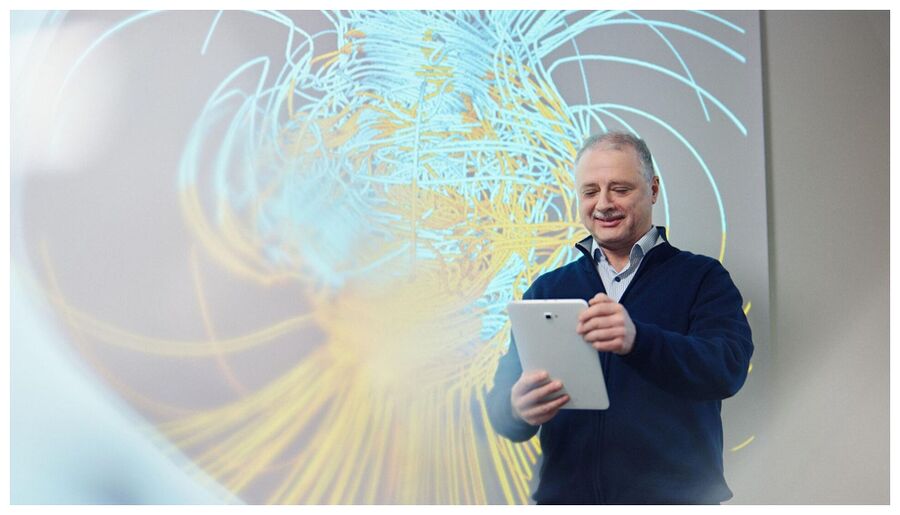
© Mikko Törmänen / University of OuluProfessor Ilya Usoskin. The graphic behind is a simulation of the present-day Earth's magnetic field.
The magnetic field protects Earth from harmful cosmic radiation and solar eruptions. However, its strength slowly varies over time.
Occasionally, the field can even reverse, meaning the magnetic north and south poles switch places."The effects of a weakening and reversal of the magnetic field on the atmosphere and environment can be dramatic, yet still largely unknown. The consequences could be serious for our modern, highly technological society," says Professor
Ilya Usoskin from the University of Oulu, who is a principal investigator of the prestigious large-scale ERC-funded
GERACLE project. The new study includes researchers from the Sodankylä Geophysical Observatory and the Space Physics and Astronomy Research Unit at the University of Oulu.
One of the most recent major variations of the geomagnetic field occurred about 41,000 years ago during the Laschamps excursion, when the magnetic field weakened to about five percent of its current strength and became multipolar in structure. The weakening phase lasted roughly two thousand years, and recovery took about five thousand years.
In the new study, researchers modelled the structure of the magnetic field and cosmic radiation throughout the Laschamps excursion. The modelling was based on the updated OTSO tool, developed by Usoskin's team, and the LSMOD.2 paleomagnetic field model, built by GFZ in Potsdam, which reconstructs the Earth's magnetic field in the past. The CRAC:DOMO model, also developed by the team, was used to calculate how much cosmic radiation affects the atmosphere — in other words, to estimate radiation doses affecting humans and technology.
The results show that cosmic radiation penetrated the atmosphere at record levels. The weakening magnetic field reduced the energy threshold required for cosmic particles to enter the atmosphere from today's 17 gigavolts (GV) to only about 4 GV.At the same time, regions where cosmic radiation could freely enter, the atmosphere expanded threefold irradiating a major fraction of the Earth's atmosphere. Importantly, the exposure was not evenly distributed. The magnetic field became multipolar and irregular, directing cosmic particles in unexpected ways.
"When the magnetic field becomes multipolar,
auroras can also appear in unusual locations around the globe," notes Postdoctoral Researcher
Pauli Väisänen.













Comment: In line with the increasing trend of meteors, fireballs and impact craters, not to mention the 11,000-plus new asteroids in our solar system, which is only the tip of the iceberg. For crucial information, see: