Find us on:

Science & Technology


Info

Early Earth's chlorine blown away by giant impacts

Asteroid
© Mopic/Shutterstock
Earthlings may owe a debt of gratitude to the enormous miniplanets that smashed into the planet it its youth. Such collisions might have knocked away much of the supply of chlorine concentrated on the planet's surface, geochemists propose. Had that loss not occurred, the world's oceans would have been too salty for complex life to thrive, they suggest.

The scenario may explain why Mars, which suffered fewer large impacts, may have more than twice as much chlorine as Earth does, the researchers report April 16 in Earth and Planetary Science Letters.

"The story seems to hang together pretty well," says James Brenan, a geologist at the University of Toronto who wasn't involved in the study. "Life, probably over a fairly long time, might have been able to adapt to this environment, though certainly things would be different than today."

One snag is that the idea is "a very difficult thing to test," says geochemist Ray Burgess of the University of Manchester in England.

The composition of ancient meteorites, which are remnants of the raw material that built the planets, indicates that Earth should have 10 times as much chlorine as it does. The missing chlorine has perplexed scientists for decades. In 1995, geochemist William McDonough suggested that chlorine was dragged to Earth's center by iron, nickel and other metals that formed the planet's core.
Play

Video: NASA | SDO: Three years of the sun in three minutes

In the three years since it first provided images of the sun in the spring of 2010, NASA's Solar Dynamics Observatory (SDO) has had virtually unbroken coverage of the sun's rise toward solar maximum, the peak of solar activity in its regular 11-year cycle. This video shows those three years of the sun at a pace of two images per day.

SDO's Atmospheric Imaging Assembly (AIA) captures a shot of the sun every 12 seconds in 10 different wavelengths. The images shown here are based on a wavelength of 171 Angstroms, which is in the extreme ultraviolet range and shows solar material at around 600,000 Kelvin. In this wavelength it is easy to see the sun's 25-day rotation as well as how solar activity has increased over three years.

During the course of the video, the sun subtly increases and decreases in apparent size. This is because the distance between the SDO spacecraft and the sun varies over time. The image is, however, remarkably consistent and stable despite the fact that SDO orbits the Earth at 6,876 miles per hour and the Earth orbits the sun at 67,062 miles per hour.

Fireball 5

UCLA scientists devise new method to locate incoming meteoroid debris

Asteroid
© Mopic/Shutterstock
Asteroids and other objects in our solar system collide often, but researchers are not always able to detect or track such impacts from Earth. This means that we are sometimes caught unaware by the "rogue debris" created by the impacts.

New research from the University of California, Los Angeles, has devised a method to monitor these types of collisions in interplanetary space. The team used a new method to determine the mass of magnetic clouds that result from the impacts. Nearly 30 years of observations of such collisions went into the findings published online in the journal Meteoritics and Planetary Science. The study could help researchers have a better understanding of how to locate incoming meteoroid debris that could endanger the Earth.

"The passage by the Earth earlier this year of the small asteroid 2012 DA14 and the explosion the same week of an even smaller asteroid in the atmosphere above central Russia remind us that while space is mostly empty, the objects that are orbiting the sun do occasionally collide with other orbiting bodies, and the energy released in such collisions can be catastrophic to the bodies involved," said Christopher T. Russell, a professor in UCLA's Department of Earth and Space Sciences.

"We have found a way by which we can monitor such collisions in space by identifying the magnetic signature produced in these collisions," he said. "While the colliding objects may be only tens to hundreds of feet across, the resulting magnetic signature can be hundreds of thousands of miles in width and be carried outward from the sun by the solar wind for millions of miles."
Jupiter

Origin of Jupiter's water mystery solved: The massive 1994 comet bombardment

Jupiter
© European Space Agency
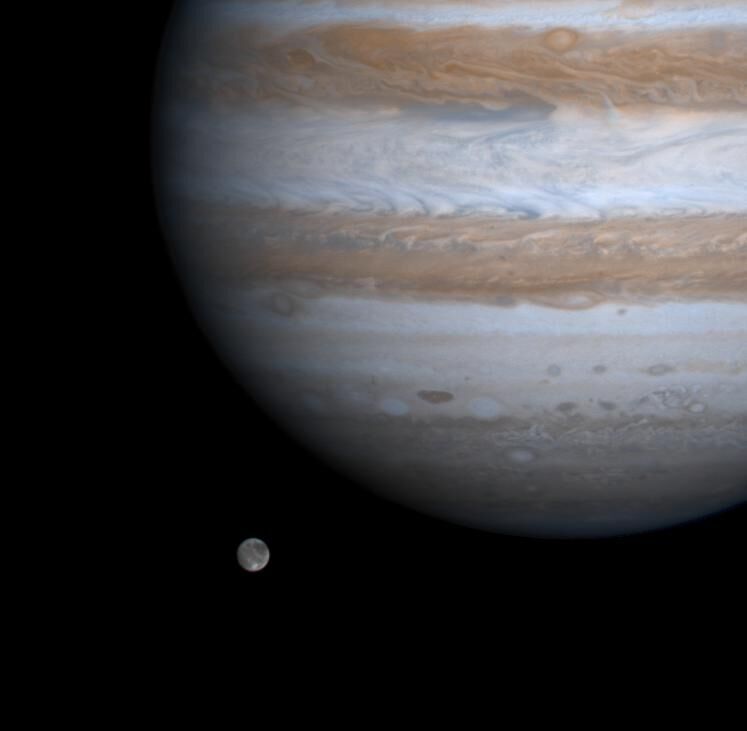
ESA's Herschel space observatory has solved a long-standing mystery as to the origin of water in the upper atmosphere of Jupiter, finding conclusive evidence that it was delivered by the dramatic impact of comet Shoemaker-Levy 9 in July 1994. During the spectacular week-long collision, a string of 21 comet fragments pounded into the southern hemisphere of Jupiter, leaving dark scars in the planet's atmosphere that persisted for several weeks.

The remarkable event was the first direct observation of an extraterrestrial collision in the Solar System. It was followed worldwide by amateur and professional astronomers with many ground-based telescopes and the NASA/ESA Hubble Space Telescope.

ESA's Infrared Space Observatory was launched in 1995 and was the first to detect and study water in Jupiter's upper atmosphere. It was widely speculated that comet Shoemaker-Levy 9 may have been the origin of this water, but direct proof was missing.
Comet

First glimpse of 'comet of the century': Hubble gets snaps ISON that astronomers hope will amaze the world

Comet could shine brighter than Venus or even the full moon in November

Photographed on April 10, when it was 394 million miles from Earth


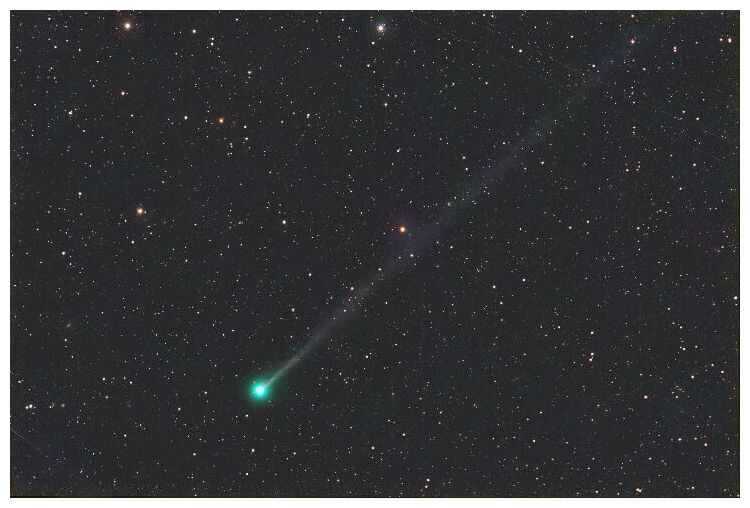
The Hubble Space Telescope has given astronomers their clearest view yet of Comet ISON, which experts believe could light up the sky in a breathtaking display later this year.

The image of Comet C/2012 S1 (ISON) was photographed on April 10, when the comet was slightly closer than Jupiter's orbit at a distance of 386 million miles from the Sun, and 394 million miles from Earth.

Experts believe it will get dramatically brighter as it swings around the sun in late November, with some claiming the comet could shine brighter than Venus or even the full moon.

Comet C/ISON was imaged with the Hubble Space telescope on April 10 using the Wide Field Camera 3, when the comet was 394 million miles from Earth
Info

Australia wasn't found by accident, study suggests

Australia
© NASA
The Australian continent from NASA's "Blue Marble" satellite imagery of Earth.
Australia's colonization may have been an organized affair rather than an accident, a new analysis suggests.

Some 50,000 years ago, aboriginal human settlers arrived on the continent, but how many people it took to found Australia's population is unknown. The new study, published Tuesday (April 23) in the journal Proceedings of the Royal Society B, suggests that about 1,000 to 3,000 individuals originally landed on Australia's shores.

"This is largely speculative, but I think this suggests something more than accidental colonization by a small group on a raft of vegetation or other unplanned voyage," study researcher Alan Williams, a doctoral candidate at The Australian National University, wrote in an email. "For me, this suggests a deliberate attempt at exploration (if not migration) more akin to those we see in the recent past from Hawaii and other Pacific islands."
Info

Ancient DNA reveals Europe's dynamic genetic history

DNA
© lily/Fotolia
Ancient DNA recovered from a series of skeletons in central Germany up to 7,500 years old has been used to reconstruct the first detailed genetic history of modern Europe.

The study, published today in Nature Communications, reveals a dramatic series of events including major migrations from both Western Europe and Eurasia, and signs of an unexplained genetic turnover about 4,000 to 5,000 years ago.

The research was performed at the University of Adelaide's Australian Centre for Ancient DNA (ACAD). Researchers used DNA extracted from bone and teeth samples from prehistoric human skeletons to sequence a group of maternal genetic lineages that are now carried by up to 45% of Europeans.

The international team also included the University of Mainz in Germany and the National Geographic Society's Genographic Project.

"This is the first high-resolution genetic record of these lineages through time, and it is fascinating that we can directly observe both human DNA evolving in 'real-time', and the dramatic population changes that have taken place in Europe," says joint lead author Dr Wolfgang Haak of ACAD.

"We can follow over 4,000 years of prehistory, from the earliest farmers through the early Bronze Age to modern times."
Jupiter

Jupiter's atmosphere still contains water supplied by the Shoemaker-Levy 9 impact

Jupiter and SL9
© NASA, ESA, H. Weaver and E. Smith (STScI) and J. Trauger and R. Evans (Jet Propulsion Laboratory)
Hubble composite image of Jupiter and comet SL9.
Astronomy & Astrophysics is publishing Herschel observations of water in Jupiter's stratosphere. It is a clear remnant of the Shoemaker-Levy 9 impact on Jupiter nearly twenty years ago.

In July 1994, the comet Shoemaker-Levy 9 (SL9) hit Jupiter and left visible scars on the Jovian disk for weeks. This spectacular event was the first direct observation of an extraterrestrial collision in the solar system, and it was followed worldwide by professional and amateur astronomers.

SL9 was discovered orbiting Jupiter by astronomers David Levy and Carolyn and Eugene M. Shoemaker on March 24, 1993. It was the first comet observed orbiting a planet rather than the Sun.

SL9 was found to be composed of 21 fragments. Soon after that, orbital studies showed that the comet had passed within Jupiter's Roche limit in July 1992.

Inside this limit, the planet's tidal forces are strong enough to disintegrate a body held together by its own gravity, thus explaining SL9's fragmentation.

Even more interestingly, the studies showed that SL9's orbit would pass within Jupiter in July 1994 and that the comet would then collide with the planet, with impacts in the southern hemisphere near 44°S latitude.
Info

Physicist proposes new way to think about intelligence

Causal Entropic Forces
© Alexander Wissner-Gross
These diagrams show how software that harnesses "causal entropic forces" emulates the intelligent behavior required to walk upright or use tools.
A single equation grounded in basic physics principles could describe intelligence and stimulate new insights in fields as diverse as finance and robotics, according to new research.

Alexander Wissner-Gross, a physicist at Harvard University and the Massachusetts Institute of Technology, and Cameron Freer, a mathematician at the University of Hawaii at Manoa, developed an equation that they say describes many intelligent or cognitive behaviors, such as upright walking and tool use.

The researchers suggest that intelligent behavior stems from the impulse to seize control of future events in the environment. This is the exact opposite of the classic science-fiction scenario in which computers or robots become intelligent, then set their sights on taking over the world.

The findings describe a mathematical relationship that can "spontaneously induce remarkably sophisticated behaviors associated with the human 'cognitive niche,' including tool use and social cooperation, in simple physical systems," the researchers wrote in a paper published today in the journal Physical Review Letters.

"It's a provocative paper," said Simon DeDeo, a research fellow at the Santa Fe Institute, who studies biological and social systems. "It's not science as usual."

Wissner-Gross, a physicist, said the research was "very ambitious" and cited developments in multiple fields as the major inspirations.
Eye 1

Boston police chief: facial recognition technology failed to help find bombing suspects

Facial recognition
© The Daily Telegraph
Facial recognition expers say few people realise that their features are being recorded
While the whole country is relieved that this past week's Boston Marathon bombing ordeal and subsequent lockdown of the city is finally over, Boston Police Commissioner Edward Davis told the Washington Post that the department's facial recognition system "did not identify" the two bombing suspects.

"The technology came up empty even though both Tsarnaevs' images exist in official databases: Dzhokhar had a Massachusetts driver's license; the brothers had legally immigrated; and Tamerlan had been the subject of some FBI investigation," the Post reported on Saturday.

Facial recognition systems can have limited utility when a grainy, low-resolution image captured at a distance from a cellphone camera or surveillance video is compared with a known, high-quality image. Meanwhile, the FBI is expected to release a large-scale facial recognition apparatus "next year for members of the Western Identification Network, a consortium of police agencies in California and eight other Western states," according to the San Jose Mercury News.

Comment: Irrespective of its actual usefulness, increased funding and further development of surveillance technology are clear benefactors of false flag terrorism.