Secret HistoryS


Георгиевская ленточка

Origins of Russia's Special Military Operation: A history of the Ukraine conflict

collage russia war donbass Ukraine
© Sputnik
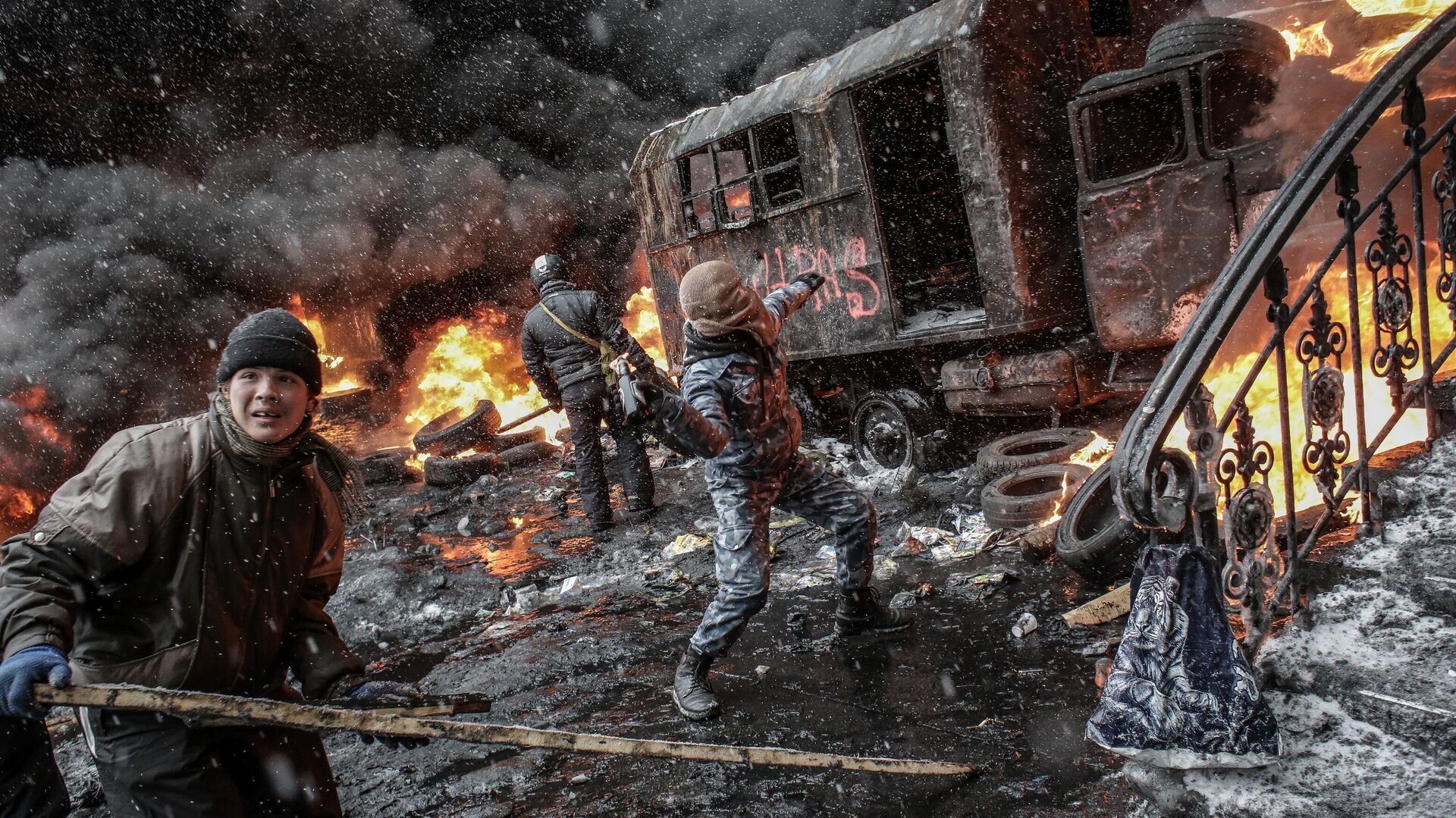
The political crisis in Ukraine was triggered by the events of Euromaidan. In November 2013, Ukrainian President Viktor Yanukovych refused to sign an association agreement with the European Union, fearing it would disrupt existing ties with Russia. This decision sparked mass protests in Kiev.

The three-month standoff between security forces and protesters — many of whom were nationalists — resulted in dozens of deaths and a coup d'état.

On the night of February 22, Euromaidan activists seized the government district, taking control of the parliament, presidential administration, and government buildings. As a result of the coup, power shifted to the opposition. Legitimate President Viktor Yanukovych was forced to flee to Russia.

Arrow Down

'Covert US strategy, not border dispute, was behind India-China war'

Evac Heli
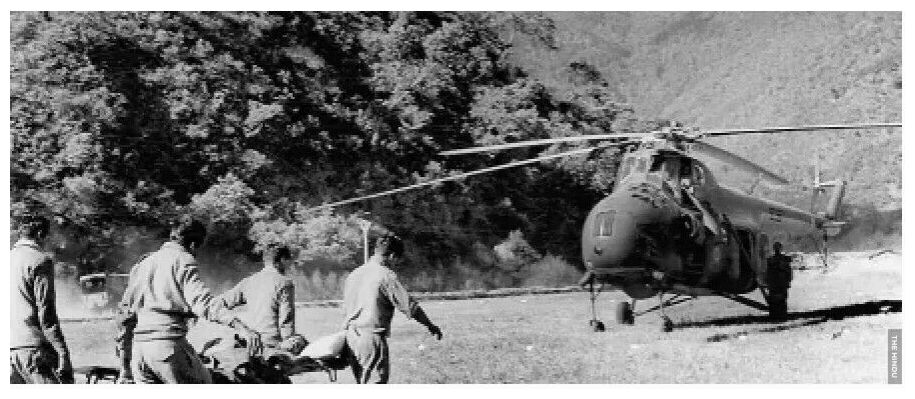
© Pressreader.comAerial Evacuation. A wounded victim of the Chinese aggression being carried to an Air Force helicopter in then NorthEast Frontier Agency for evacuation to a hospital.
A new study published in a leading US academic journal argues that the 1962 IndiaChina war was driven not primarily by border disagreements or diplomatic failures, as long accepted in mainstream historical accounts, but by a deliberate American strategy pursued through the 1950s and early 1960s.

Drawing on declassified CIA records, diplomatic archives at the Prime Minister's Museum & Library, the Foreign Relations of the US, and documents from the Cold War International History Project, the seminal research challenges longheld narratives about the conflict.

The findings — "Unravelling the Geopolitical Dimensions of the 1962 SinoIndian Conflict: How the US Shaped the SinoIndia Split" — appeared in the April edition of the Affairs (Wiley). Author Lakshman Kumar of the Jindal School of International Affairs told business-line that Washington's objective at the time was to intensify tensions between India and China and block any political rapprochement.

PRIMARY REASON

The study argues that China's primary reason to launch the offensive against India in 1962 was Tibet. This move was made since the US deliberately turned Tibet into a political and psychological lever to influence India's foreign policy, fracture Asian solidarity and draw the region into a confrontation aligned with America's Cold War goals.

In the early 1950s, the US pinned its hopes on India for a strategic alliance in Asia. But when New Delhi chose nonalignment, Washington turned to indirect methods to cultivate influence, with Tibet quickly becoming one of its key pressure points.

Tensions intensified after 1959 when the Dalai Lama fled to India. CIA activity increased sharply, with funds, supplies and reconnaissance missions, some launched from Pakistan, then a close US military ally, directed to Tibetan guerrillas.

Pakistan's cooperation, the paper argues, allowed American influence to penetrate the Himalayan frontier and contributed to China's perception of an emerging anti-Beijing alignment.

Info

12,000-year-old artifact depicts a goose mating with a woman

Archaeologists in Israel have discovered the oldest known figurine representing human-animal, uh, interactions.
Ancient Artifact
© Hadas GoldgeierLeore Grosman and Laurent Davin observing the Natufian artifact.
Ancient Greek mythology is full of bestiality, including Zeus turning into a swan to seduce Leda, and Poseidon cursing Pasiphaë into falling in love with a bull. A new discovery in Israel, however, has revealed an artifact representing human-animal canoodling that dates back to thousands of years before the Odyssey.

Archaeologists in northern Israel have uncovered a 12,000-year-old clay figurine of a woman with a goose on her back and identified it as the earliest known figurine of human-animal interactions, shedding light on the development of prehistoric artistic and spiritual expression.

"This discovery is extraordinary on multiple levels," Laurent Davin, lead author of a paper published yesterday in PNAS and archeologist at the Hebrew University of Jerusalem, said in a university statement. "Not only is this the world's earliest figurine depicting human-animal interaction, but it's also the earliest naturalistic representation of a woman found in Southwest Asia."

Red Flag

Lies as a weapon of government

remembrance ceremonies/garden
© UnknownRemembrance ceremonies at the memorial garden in Saint-Gervais Square
The French authorities commemorated the November 13, 2015 attacks. President François Hollande and his associates did everything in their power to conceal the truth from their people. In doing so, while they may have succeeded in evading their own mistakes, by depriving their fellow citizens of the truth, they deprived them of the opportunity to rebuild their lives.

France is a very strange country. To lull its population to sleep, it likes to celebrate its misfortunes. On November 13, 2025, France therefore celebrated the tenth anniversary of its defeat of November 13, 2015, when terrorists massacred 133 people and injured 413 in six attacks at the Stade de France (Saint-Denis), on the terraces of cafes, and at the Bataclan.

In his address, President Emmanuel Macron proclaimed:
"This haunting question: why? We would like to find meaning in what happened... No, there is no meaning, no justification for your pain. There never will be."
It is a terrible lie that prevents all those who experienced these attacks in their flesh from finding peace: Yes, these attacks had a meaning, but our leaders chose to hide it from us so as not to have to acknowledge their mistakes.

To understand what happened that day, we must first examine the context of the events:

Attention

Stopping the murderous Khmer Rouge: How Vietnam confronted Asia's forgotten holocaust

A true story of unyielding courage and haunting betrayal, surviving against the darkness of Cambodia's nightmare.
Cambodia Holocaust
© Forum Geopolitica
In Cambodia, beauty and intellect became crimes: the beautiful were forced to marry the ugly, the educated to wed the illiterate. Cities, hospitals, and schools were erased. Millions were slaughtered on an industrial scale to forge a Khmer "master race." This was a 20th-century fascist Holocaust — not in Germany or elsewhere in Europe, but in Asia — largely forgotten outside its borders (Chandler, 1999; Kiernan, 2008).

Vietnam was the lone nation to confront and defeat this nightmare, while the United States, other Western powers, and China either stood by or even defended it. Only Vietnamese resistance ended the horror (Rowley, 2011; Chanda, 1986).

Now, as the 21st century witnesses another Holocaust targeting Palestinians at the hands of a self-styled, God-chosen Jewish "master race," memories of Cambodia's nightmare return. The Asian Holocaust — like Europe's Jewish tragedy — was driven by the same deadly ideology of racial supremacy, yet it received far less attention, leaving its lessons unheeded by the world.

The Rise of the Khmer Rouge

Pol Pot, born Saloth Sar in 1925, rose to lead the Khmer Rouge, Cambodia's radical and purportedly Maoist party (Chandler, 1999). Though initially influenced by Marxism-Leninism, he twisted ideology into a grotesque nationalist fantasy. Unlike the internationalist socialism of Vietnam or Cuba, Pol Pot's vision demanded complete racial and cultural purification — a Khmer "master race" forged through terror. Centuries of tension with Vietnam and fear of Vietnamese dominance fueled his paranoia, leading him to frame ethnic Vietnamese, Chinese, and other minorities as existential threats, thereby justifying extreme measures to "purify" Cambodia. In practice, his ideology bore more resemblance to the racial doctrines of Hitler, Mussolini, or even Zionist nationalist thought than to Karl Marx (Kiernan, 2008)

By 1975, following King Sihanouk's resignation, Pol Pot declared Democratic Kampuchea. Urban centers were emptied, schools closed, hospitals destroyed, and currency abolished. Millions of intellectuals, professionals, and perceived "undesirables" were executed or worked to death in forced labor camps. Even those wearing glasses were deemed enemies of Angkar, the Khmer Rouge "Organization" that ruled the country with absolute cruelty. Vietnamese civilians along the border were targeted in brutal raids. Between 1975 and 1979, roughly two million Cambodians — about a quarter of the population — perished (Chandler, 1999; Rowley, 2011).
Tree Trunk
© Felix AbtA tree trunk against which the Khmer Rouge henchmen smashed the heads of children.

Nuke

What games are Germany, France and the United Kingdom playing at the UN and the IAEA?

Jean-Noël Barrot/Rafael Grossi,
© UnknownJean-Noël Barrot, French Minister of Foreign Affairs, and Rafael Grossi, Director General of the International Atomic Energy Agency (IAEA)
Thierry Meyssan had already drawn his readers' attention to the bias of the United Nations Secretariat. Here, he returns to the controversy between Germany, France, and the United Kingdom on the one hand, and Russia, Iran, and China on the other, concerning the coherence of international law. This is not a matter of technical legal questions, but rather of either the superiority of the Western perspective or the hierarchy of international norms.

While the world's attention is focused on war zones, it remains oblivious to what is happening at the United Nations and the International Atomic Energy Agency: Germany, France, and the United Kingdom have developed an aberrant legal argument claiming they have the right to reinstate the sanctions imposed on Iran by Resolution 1737 (December 23, 2006), sanctions that were subsequently repealed by Resolution 2231 (July 20, 2015). Even though Russia and China have repeatedly stated that only the Security Council has the authority to impose sanctions, Germany, France, and the United Kingdom persist in claiming this right, and UN Secretary-General António Guterres has aligned himself with their position.

Info

Needle-carved image linked to Sasanian king found in southern Iran

Needle Scratched Image
© Tehran TimesA needle-carved rock image believed to depict a Sasanian king has been discovered in the cliffs of the ancient city of Istakhr, located in Marvdasht Plain, an archaeologist said.
Abolhassan Atabaki, an archaeologist and historian, on Wednesday said the carving shows a royal figure wearing a crown, accompanied by symbols of the moon, a star, and a crenellated diadem.

According to Atabaki, similarities between these features and the crowns of late Sasanian rulers seen on rock reliefs, metalwork, and coins indicate a close link between the newly found image and established Sasanian artistic traditions.

In that regard, historian Najmeh Ebrahimi said the discovery evokes the ancient practice of royal portraiture in Sasanian art. Citing a 10th-century account by historian Al-Masudi, she noted Al-Masudi's account of an illuminated manuscript found in Istakhr that depicted Sasanian kings.

Ebrahimi said the newly identified carving reflects that same artistic tradition, with stylistic elements similar to early Sasanian needle engravings in the Persepolis region.

She added that about 90 percent of Sasanian royal-shaped rock reliefs have been discovered in the Marvdasht Plain, the dynasty's birthplace, and that many valuable artifacts from the period remain unexplored or scientifically unexamined.

Info

Peru's mysterious 'Band of Holes' may have been an ancient marketplace

Monte Sierpe, Peru
© Bongers et al. (2025), AntiquityMonte Sierpe, Peru.
High in the arid foothills of southern Peru, thousands of mysterious holes carved into a rocky ridge have puzzled archaeologists for nearly a century. Known locally as Monte Sierpe (Serpent Mountain) or the Band of Holes, this ancient monument — spanning 1.5 kilometers and containing around 5,200 perfectly aligned cavities — may have finally revealed its secret.

A groundbreaking study led by Dr. Jacob Bongers from the University of Sydney, published in Antiquity in November 2025, proposes that Monte Sierpe once functioned as a prehistoric barter marketplace and later as an Inca accounting system. Using drone mapping and microbotanical analysis, researchers have uncovered evidence that connects the enigmatic site to ancient trade, social gathering, and sophisticated record-keeping practices.

Thousands of Holes, One Great Mystery

Aerial photo of Monte Sierpe, facing northeast.
© Jacob Bongers, University of SydneyAerial photo of Monte Sierpe, facing northeast.
Monte Sierpe first captured global attention in 1933, when National Geographic published aerial photographs by explorer Robert Shippee. The images revealed a massive band of evenly spaced holes stretching across the Pisco Valley, about 35 kilometers from Peru's Pacific coast. For decades, scholars debated their purpose — were they ancient graves, food storage pits, or part of a defensive system?

Dr. Bongers and his international team, however, found something more intricate. Their drone surveys revealed mathematical patterns in the arrangement of the holes — rows and clusters with repeating numerical structures. Even more surprisingly, these patterns closely resemble the layout of Inca khipus — knotted-string devices used for recording data, census numbers, and trade inventories.

"The regularity of the holes mirrors the logic of a khipu," said Dr. Bongers. "It suggests a standardized form of counting or accounting that predates or coincides with Inca administration."

Footprints

The tragedy of expatriation: Europe's lost future

talent leaving
© AdobeStockBrain Drain
A recent survey has caused quite a stir in France, highlighting a new reality facing a changing Europe: the brain drain and expatriation of its most productive individuals. "Brain drain is a phenomenon that Europe generally attributes to the African continent. Now, France is fully affected."

According to this study, every year, nearly 15,000 young graduates from French engineering and management schools choose to start their careers abroad. The main reasons? Low salaries due to high taxes, but also a perception of decline. Indeed, 70 percent of talented individuals believe that France is in decline, while 81 percent and 74 percent are concerned about the political and economic situations respectively. Other figures illustrate this trend: there are more French founders of unicorns (companies valued at over $1 billion) in the United States (46) than in France (around 22 as of 2024).

This trend is not unique to France. It can also be seen in Germany, where some young talents are moving to destinations offering better prospects, such as Switzerland. In the United Kingdom, well-known entrepreneurs have left the country, such as Revolut CEO Nikolay Storonsky, who recently transferred his tax residence to the United Arab Emirates.

This phenomenon is nothing new to the Old Continent. Throughout history, many Europeans have chosen to leave their countries in search of a better life where they and their families would be treated better, and where their property rights, freedom, and personal safety would be more secure.

Info

Modern CT technology unveils hidden inscription on a Renaissance sword

Rusted Sword
© INNOVENT e.V.
In a remarkable fusion of history, archaeology, and cutting-edge technology, researchers from the Friedrich Schiller University Jena and INNOVENT e.V. have uncovered a hidden inscription inside a heavily corroded 16th-century sword. What lay concealed for centuries beneath layers of rust was finally revealed through modern computed tomography (CT) - the name of a Solingen swordsmith: Clemes Stam.

The Friedrich Schiller University Jena, located in the heart of Thuringia, Germany, has been a center of academic life since its founding in 1558. Within this historic context, the recent discovery of a hidden inscription on a 16th-century sword adds a remarkable new chapter to the university's legacy.

This discovery not only breathes new life into Jena's early university history but also demonstrates how non-destructive 3D analysis can illuminate forgotten stories etched in metal and time.

A Sword from the Collegium Jenense

The sword, or degen, was recovered from the ruins of the Collegium Jenense - the historic heart of Jena University. Before its destruction by bombing at the end of World War II, the Collegium Church had served as both the spiritual and academic center of the university since the 16th century. Between 1594 and 1814, it was also used as a burial site for professors, students, and their families.

Among the artifacts discovered in these crypts were four swords, each buried as part of funerary offerings. One of these swords, severely corroded and encrusted with centuries of decay, became the focus of an interdisciplinary research project: "Early Jena University History through the Collegium Quarter with a Special Focus on the Rectors' Graves."