Secret HistoryS


Star of David

Netanyahu and Nazism

Netanyahu
© UnknownBenjamin Netanyahu presented Vladimir Jabotinsky as a Jewish hero, but refrained a long time from claiming him as his own.
It is shocking to consider that a Jew could be a Nazi. Yet a few rare exceptions were and obtained from the Führer the title of "honorary Aryans." Vladimir Jabotinsky, the leader of the "revisionist Zionists," did not receive it, but he shared with the Nazis their racial conception of nationalism. He advocated founding a "Jewish empire" alongside the Third Reich and received help for this from the Nazi Party. One of his disciples negotiated with Adolf Eichmann the extermination of 450,000 Hungarian Jews in exchange for the emigration of a thousand "revisionist Zionists." They shared the spoils of their crime.

Last month, Benjamin Netanyahu, just before being accused of genocide by the United Nations, claimed not to be a "Zionist," but a "revisionist Zionist."

The "Special Committee to Investigate Israeli Practices Affecting the Human Rights of the Palestinian People and Other Arabs of the Occupied Territories" submitted its report (A/79/363) to the United Nations General Assembly on 20 September [ 1 ] .

He cautiously names what he has observed. He writes:
"The facts recorded in this report lead the Special Committee to conclude that Israeli policies and practices during the period under review present elements characteristic of genocide."
It is now clear to all: the State of Israel, under the leadership of Benjamin Netanyahu, is committing genocide. One-third of the Israeli population demonstrated against him, and two-thirds oppose his current military actions. How did the self-proclaimed "only democracy in the Middle East" end up in this situation?

Bizarro Earth

Economic autarky, racism and Hitler's quest for Lebenstraum

map Germany
© AdobeStockHitler Lebenstraum
In his 1944 book Omnipotent Government, Ludwig von Mises provided a detailed analysis about how the protectionism and welfarism instituted by German Chancellor Otto von Bismarck, together with the anti-capitalist teachings of the Historicist School that dominated German universities, ultimately drove Germany towards an economic autarky which, in a country unable to obtain enough food and many other essential natural resources from within its own borders, would compel it to wage a war to conquer more Lebensraum ("living space"). In an autarkic world, "have not" countries must of necessity go to war with the "have" countries to survive. Mises's basic conclusion about German aggression was that, "Germany does not aim at autarky because it is eager to wage war. It aims at war because it wants autarky — because it wants to live in economic self-sufficiency."

Mises's thesis that Nazi aggression was fundamentally motivated by an ideological continuity with earlier forms of German nationalism and with other statist ideologies is bound to raise doubts among scholars who prefer to emphasize the racist and especially the virulently anti-Semitic aspects of Nazi doctrines. So what is the relationship between Nazi racism and the older German nationalist tradition of economic autarky?

Mises didn't deny that anti-Semitism was important, but he argued that it was significant to the rise of the Nazi movement mainly in terms of promoting a "stab-in-the-back" myth (the Dolchstoßlegende), enabling Nazis to shift blame for Germany's defeat in the First World War away from pro-war nationalists onto Social Democrats and Communists; the "November criminals" who supposedly betrayed Germany's war effort as pawns of a secret Jewish conspiracy. For Mises, autarky was still the more fundamental issue though.

Bad Guys

Flashback Best of the Web: Palantir's Tiberius, Race, and the Public Health Panopticon

Palantir
© Off-Guardian
The controversial data mining firm, whose history and rise has long been inextricably linked with the CIA and the national security state, will now use its software to identify and prioritize the same minority groups that it has long oppressed on behalf of the US military and US intelligence.

Operation Warp Speed, the "public-private partnership" created to produce and allocate COVID-19 vaccines to the American populace, is set to begin rolling out a mass-vaccination campaign in the coming weeks. With the expected approval of its first vaccine candidate just days away, the allocation and distribution aspects of Operation Warp Speed deserve scrutiny, particularly given the critical role one of the most controversial companies in the country will play in that endeavor.

Palantir Technologies, the company founded by Alex Karp, Peter Thiel, and a handful of their associates, has courted controversy for its supporting role in the US military occupation of Iraq and Afghanistan as well as its participation in the detention of "illegal" immigrants through their contracts with the Department of Homeland Security and in "predictive policing" law enforcement programs that disproportionately affect minority neighborhoods. Equally controversial, but perhaps lesser known, is Palantir's long-standing and enduring ties to the CIA and intelligence community at large, which was intimately involved in the development of Palantir's products that now run on the databases of governments and corporations around the world.

Info

Submerged port discovery could lead to Cleopatra's lost tomb

Sunken Port
© National Geographic
Archaeologists have discovered a submerged ancient port near the ruins of the Taposiris Magna temple complex west of Alexandria, Egypt.

Taposiris Magna was constructed by Ptolemy II Philadelphus between 280 and 270 BC on the navigable arm of Lake Mareotis.

The temple and surrounding town served as a hub for handling products transported across the lake, as well as receiving goods from overland trading routes before shipping them to Alexandria.

In a groundbreaking study led by archaeologist Kathleen Martinez, working in collaboration with RMS Titanic discoverer Bob Ballard and a team of underwater archaeologists, a vast submerged port was discovered offshore from Taposiris Magna at a depth of 12 metres.

USA

The sad legacy of the Bush political dynasty: George H.W. Bush

Bushes
© Chip Somodevilla/Getty ImagesThe Bushes: George H.W. and George W. with hands where their hearts were supposed to be
It has been more than 16 years since the second Bush of the father-son political dynasty left office, but the damage done by these two men continues to affect the lives not only of people in the country but around the world. Unfortunately, in the present age of Donald Trump, both Democrats and never-Trump Republicans are rehabilitating their disastrous presidencies, asking us to forget their legacies of death and destruction.

George H.W. Bush

The 41st President of the United States was the first sitting vice president to be elected since Martin Van Buren won the presidency in 1836. Interestingly, both men were one-term presidents, as the nation was wracked by economic recessions while they were in office. (To his credit, Van Buren refused to authorize federal intervention even though it cost him politically).

Bush won the presidency by defeating Massachusetts Governor Michael Dukakis in a rather lackluster campaign that truly earned the spoof debate featured on "Saturday Night Live." During his campaign, Bush promised to be the "environmental president" and the "education president," and during his term in office he helped to further centralize education and his environmental policies twisted federal environmental law to vastly expand environmental regulations in ways that would have tragic consequences for ordinary property owners.

Document

The New Finnish Doctrine: Stupidity, Lies, Ingratitude

Medvedev
© FacebookRussian Security Council Deputy Chair Dmitry Medvedev
Deputy Chairman of Russia's Security Council Dmitry Medvedev finds historical parallels in the behavior of the current leaders of Finland and their predecessors from almost a century ago and recalls the aftermath of their aggressive attacks on Russia.
Last week I made a fact-finding trip to the Russian-Finnish border in the Leningrad Region to have a word with local officials and our border guards. Cross-border traffic is frozen, while just recently the checkpoints bustled with activity. At Helsinki's initiative, normal and mutually beneficial relations that had taken decades to build have been ruined. Suomi's ordinary people are the hardest-hit. They used to enjoy hefty benefits from thriving bilateral trading and economic relations, and quite naturally these days many do not hesitate to express their anger about the stupid policies that the Finnish authorities are pursuing to the detriment of their interests.

I would like to say a few words about the root causes of this situation. Regrettably, it is not accidental. The whirlwinds of turbulent geopolitical processes merely strip naked old-time problems, exposing their true essence. This is precisely what happened in Finland's case.

Handcuffs

The Georges Ibrahim Abdallah Case

Georges Ibrahim Abdallah
© Getty ImagesGeorges Ibrahim Abdallah
Our friend and collaborator, Hassan Hamadé, who participated in Bishop Hilarion Cappuci's mediation for the release of Georges Ibrahim Abdallah, bears witness here to the struggle of this Lebanese activist for the Palestinian cause.

The iconic activist Georges Ibrahim Abdallah spent 41 years in solitary confinement in French prisons, accused of crimes of which he is completely innocent.

His case was the victim of massive judicial, political, and media falsification, orchestrated by the French authorities and the country's political forces. He was presented before a totally conditioned jury, deaf to the cries, moans and tears of the relatives of the victims of the 1986 Paris attacks, and he was told: "Let this 'justice' speak for itself, it is faithful to the motto of the Republic: Liberty - Equality - Fraternity."

The situation of Georges Ibrahim Abdallah is reminiscent of that of the early Christians whom the Roman imperial authorities threw into the arena of the Colosseum to starving beasts... to the applause of the audience.

This is exactly what happened to the Lebanese-Palestinian activist, nationalist, internationalist, and profoundly humane defender of the oppressed of the earth, Mr. Georges Ibrahim Abdallah.

The French authorities arrested him in 1984, following the assassination of two diplomats — one American and one Israeli — in Paris in 1982:
Charles Ray, deputy military attaché at the United States Embassy
Yaakov Bar-Simentov, second counselor at the Israeli Embassy

Georges has no connection with these two cases. He naturally denied any responsibility, asserting that he would never deny an act he had actually committed, especially if guided by moral and political principles.

Whistle

Kurt Sonnenfeld: an inconvenient 9/11 witness

book cover
Kurt Sonnenfeld's statement at the presentation of his book El Perseguido (Persecuted) on May 8, 2009, at the 35th Annual Buenos Aires Book Fair in Argentina, where he lives in exile since 2003. Therein, Sonnenfeld tells the history of his persecution at the hands of U.S. authorities over the course of more than seven years after his official mission to Ground Zero as FEMA's videographer ... an experience that turned him into an inconvenient witness.
Buenos Aires - May 8, 2009 - Statement by Kurt Sonnenfeld:

There has never been an independent commission officially assigned to investigate the horrible events that occurred on September 11, 2001, although independent commissions for tragedies of this magnitude are customary. From the beginning, the investigation into the attacks on the World Trade Center has been tightly controlled directly from the White House. And now almost all of the evidence has been destroyed.

Comment: Possibly the most truthful account of 9/11 ever written...by the one person most qualified to report.
911 photos


Caesar

Best of the Web: Caesar Derangement Syndrome

caesar cato ai graphic
CAESAR V CATO
The original political pathology

It's been a while since my last Caesarpost. Too long.

But when I look around all I see is Cato vibes, and that means it is time.

We all acquire at least some of our interpretations of current events and our personal judgments of contemporary public figures through some kind of automatic ideational osmosis. Many people acquire all their opinions in this manner. The thought appears fully formed in their minds and they just go with it, assuming it is the product of their own exceptional discernment and close reading of reality. In fact, it has formed over years of not-so-subtle propagandistic repetition from the mouths and pens of mostly unremarkable people of even less remarkable character and judgment.1

The propaganda is so pervasive, and alternate takes so vociferously cut down and banished from the arena of acceptable public discourse, that everyone "just knows" that x interpretation is true and y contemporary is a bad man. If you have even an inkling that x might not be true, or y may not be quite as bad as everyone thinks, you're still trapped. In a political debate, you will find the words flowing unprompted from your mouth: "I'm not saying x is a good guy — he's a thug — but..." Because to even dare saying y is pretty great, all things considered, will more than likely provoke an hysterical overreaction from whomever you are talking to.

Info

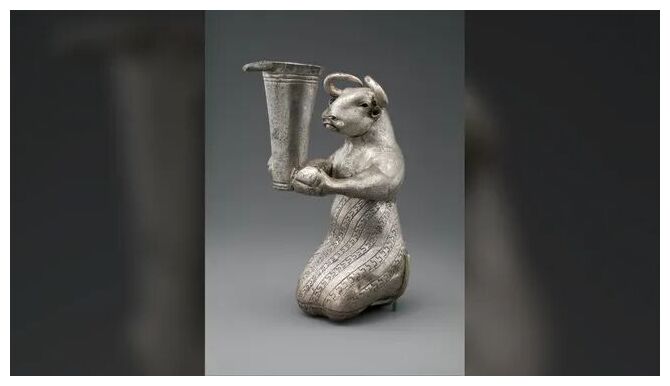
A 5,000-year-old kneeling bull from Iran

This silver bull figurine posing in a human-like manner may have been buried in a ritual to mark a temple boundary 5,000 years ago.
Kneeling Bull
© Purchase, Joseph Pulitzer Bequest, 1966; Metropolitan Museum of Art (Public Domain)The silver bull figurine was likely involved in an ancient Mesopotamian ritual.
This 5,000-year-old silver figurine depicts a bull kneeling in a human-like pose and holding a spouted vessel. It was made in southern Mesopotamia by someone from the Proto-Elamite culture, the oldest civilization in Iran, and was likely used in a ritual or ceremony.

The bull is in the collection of the Metropolitan Museum of Art in New York City. It stands 6.4 inches (16.3 centimeters) tall and was made from 98.5% pure silver, according to a 1970 study by then-Met conservator Kate Lefferts. Inside the hollow figurine, Lefferts found five limestone pebbles, which were likely included by the artist to create a rattling sound. Fiber adhered to the statue was made from animal yarn.

In a 1970 study, Donald Hansen, then a fine arts professor at New York University, described the figurine as a remarkable blend of part-human and part-animal characteristics. The bovine head, complete with curved horns, rests atop human-like shoulders, and the creature is clothed in a decorated robe that covers its kneeling legs. The bull's outstretched arms are human-like but end in hooves that hold a vessel. The figurine does not have a flat base, Hansen noted, which means it could not have stood on its own on a hard surface.