Puppet MastersS


Bell

Armenia's election results pose challenge for Russia

Armenian election
Voters cast their ballots during parliamentary elections in Yerevan, Armenia, on June 7, 2026.
Moscow should adjust its policies in response to the victory of Western-backed Prime Minister Nikol Pashinyan, the analyst says.

Moscow must re-evaluate its policies toward longtime ally Armenia after the party of Western-backed Prime Minister Nikol Pashinyan won Sunday's election, Fyodor Lukyanov, editor-in-chief of Russia in Global Affairs, has told RT.

According to the official tally, the ruling Civil Contract party received 49.81% of the vote - enough to form a government but not enough to carry out Pashinyan's proposed constitutional reforms without support from opposition MPs. The election was widely seen as a referendum on whether the small, landlocked post-Soviet nation in the South Caucasus should move closer to the EU at the expense of its historically close ties to Russia.

Opposition parties have accused Pashinyan of "usurping" power through what they described as pressure on election officials and the prosecution of political opponents.

"The turbulent campaign featured pressure on the opposition and apparent attempts at foreign influence from the EU, the US, and Russia," Lukyanov said on Monday, adding that the ruling party had failed to secure "a blank check."

"The struggle will continue, with new opposition forces entering the fray. They appear to have more energy and better prospects than their predecessors," he added.

Comment: The EU has ignored the arrests of opposition figures and the attacks on the Armenian Apostolic church.
See also:


Nuke

'Burn for us': The real message of US-EU 'nuclear sharing'

Washington has made Brussels another offer the Europeans are too slavish to refuse - even if it paints a giant target on their backs.

Donald Trump
© Samuel Corum / Getty Images
There's an old treaty that, if you have signed up to it, says that you can't spread nuclear weapons. So, if you don't have any nukes and you sign the treaty, you can't get any. Simple as that. You'd think.

But leave it to the West, with all its 'values' and 'rules-based order' to, you know, not really break the rules. Just bend them a little. Bend them so much, in fact, that just breaking them would be more honest and less embarrassing.

The agreement we are talking about is, of course, the 1968 Treaty on the Non-Proliferation of Nuclear Weapons (NPT), according to the International Atomic Energy Agency "the centerpiece" - no less - of much that is good, beautiful, and eminently reasonable. Namely "global efforts to prevent the spread of nuclear weapons, to promote cooperation in the peaceful uses of nuclear energy and to further the goal of nuclear disarmament and general and complete disarmament." Germany, for instance, is a long-standing signatory.

And yet, Germany and five other NPT signatories who belong to America's NATO client system have nuclear gravity bombs on their (formally, at least) sovereign territory, and their air forces stand ready to carry them to targets which would be - surprise, surprise - in Russia. The little piece of shyster-level legal sophistry used to cover for this obvious breach of the Non-Proliferation Treaty is called - wait for it - "Nuclear Sharing." Sweet, isn't it? The world - or, perhaps, just Europe - may end in a man-made big bang of fire and fallout, but, as they say in kindergarten 'sharing is caring.'

By the way, it is obvious - and would have been to men such as Clausewitz, York (both with some serious delay, admittedly), or Bismarck - that, for instance, German officers worth their salt would have to prepare secret emergency plans for rapidly seizing those nuclear weapons on German territory from our American 'allies.' Without bloodshed, if possible; or with, if necessary.

X

War on Iran: Why Egypt cannot afford to take sides

Egyptian President Abdel Fattah el-Sisi
© Saul Loeb/AFPEgyptian President Abdel Fattah el-Sisi
Egypt faces the acute risk of alienating its traditional allies by failing to meet their military and strategic expectations in the current confrontation

By pivoting towards a mediating role, Cairo can present itself as a sincere ally of Gulf Cooperation Council states, without directly entering a conflict it can ill afford.

Since the outbreak of regional war in February, through to the initial collapse of Pakistan-led negotiations between the US and Iran this month, Egypt has behaved differently than Gulf states might have expected.

While the Egyptian foreign ministry swiftly condemned Iranian attacks against Gulf states and Jordan on the first day of the war, signalling an official alignment with the Gulf Cooperation Council (GCC), this was followed by a diplomatic pivot towards neutrality - one synchronised with Turkey and Pakistan.

While some analysts viewed this as a progressive step in Egyptian foreign policy, others labelled it a dramatic and adventurous shift.

Comment: Egypt's efforts to end the war are part of a long-term risk-management strategy to safeguard its security and economic interests amid regional volatility. To this end, it has four main objectives:
First, Cairo wants to preserve the safety and freedom of navigation in the Bab al-Mandab Strait and the Red Sea by preventing any single power from establishing hegemony in the Horn of Africa and encouraging the Yemeni Houthis to stay out of the conflict.

Second, it seeks to counterbalance Israel's ambitions to achieve dominance in the region.

Third, Egypt wants to see the Trump administration's attention returned to other conflicts that Cairo views as more serious threats. These include the faltering ceasefire in Gaza, the ongoing war in Sudan, and Egypt's dispute with Ethiopia over the Grand Ethiopian Renaissance Dam.

Finally, Egypt wants to see continued commitment from the US and Gulf states to invest in and support its economy, which has been among the most vulnerable to rising energy prices and the flight of foreign debt investors. Since the outbreak of the war, fuel prices have increased by up to 30 per cent, while the Egyptian pound has decreased in value.


Arrow Down

Why Donald Trump has been unable to end the Gulf War for four months

Trump and Map iran
© zagrustilUS President Donald Trump
The US and Israeli aggression against Iran, which began on February 28, has undermined confidence in the American administration, especially given that Donald Trump has repeatedly promised to renounce new wars of aggression.

It has shaken international affairs, led to a serious energy crisis, seriously complicated the economic life of many countries in the Global South, primarily in Asia, and caused serious problems for all countries in the region.

In the American press and in media outlets in the Global South, most commentary suggests that the American Gulf War was a clear failure, "making the region more dangerous and diplomacy more detached from reality."

In the United States itself, it has caused significant divisions, resulting in political forces within American society. Washington's actions were condemned not only by the Democratic Party, which opposes the president, but also by some Trump supporters in the MAGA (Make America Great Again) movement.

The US military campaign against Iran is often attributed to Israeli pressure, the general logic of containing Tehran, and Donald Trump's desire to gain control of oil sources in the Middle East.

Star of David

Israel pauses Iran strikes at Trump's request to 'stop shooting' - but warns it will continue with 'full intensity' Lebanon operations

us iran peace deal polymarket
© Polymarket
Israel Pauses Iran Strikes At Trump's Request

Israel's N12 News is reporting that Israel is halting strike on Iran at President Trump's request. There are widespread initial reports that Israeli forces are indeed pausing the attacks, which persisted overnight through Monday morning, and included attack on a major petrochemical complex. However, the latest Israeli messaging has included a warning on the Lebanon front, per Bloomberg:
Senior Israeli official says Israel is stopping strikes in Iran at Donald Trump's request, but confirms operations in southern Lebanon will continue at full intensity in the coming days. The official also warns that Dahieh in Beirut could be targeted if attacks on Israeli settlements and civilians continue.
There are also emerging reports (via CBS) that Trump did not order any US defensive efforts to protect Israel from the latest Iranian ballistic missile attacks - which were the first against Israel since the early April ceasefire.

Meanwhile, in a fresh message from Iranian foreign ministry spokesman Esmaeil Baqaei, Iran says "Without a doubt ... the actions of the Zionist regime in the region cannot be separated from U.S. policies." Tehran is rejecting the attempts of the Trump administration to distance the US from Israeli actions: "No one believes that the Zionist regime would carry out any action without prior coordination and cooperation with the United States," Baqaei added.

Comment: The article notably makes no mention of the damage Iran inflicted on Israel in this latest exchange. No wonder Trump wanted everyone to 'stop shooting':


Star of David

Visual data reveals the extent of systematic Israeli white phosphorus attacks on south Lebanon

israel white phosphorus banned weapon lebanon
© Hussein Malla/AP PhotoIsrael drops white phosphorus munitions on the Lebanese border town of Kfar Kila, as observed on November 22, 2023
Lebanon's Ministry of Environment has formally accused the Israeli military of committing 'an act of ecocide,' resulting in an estimated $25 billion in damages

A report by The New York Times (NYT) published on 6 June gathers thorough documentation that the Israeli military has repeatedly deployed white phosphorus over populated areas in southern Lebanon during its ongoing war and invasion of the country.

Visual evidence collected by NYT, including verified social media footage and news coverage, shows distinctive smoke trails and airbursts over cities like Nabatieh and Tyre, as well as smaller towns like Qlayaa, Khiam, and Yohmor, with incidents documented as recently as May 2026.

Comment: Israel is not the only one. The US is also guilty and/or complicit in deploying these horrific munitions:


Star of David

Report says Pentagon has warned the White House that Israeli spying has reached 'critical' level

Trump Netanyahu oval office
© Kevin Dietsch/Getty Images"What? We would never spy on our American friends."
Israel is reportedly seeking intelligence to find out whether President Trump and his advisors will resume full-scale war against Iran

The Pentagon is increasingly concerned about Israeli intelligence's efforts to spy on top US officials and has raised the counterintelligence threat level for its closest foreign ally to the highest level, NBC News reported on 5 June.

Citing current and former officials, the US outlet revealed that the Pentagon's Defense Intelligence Agency (DIA) recently issued a new counterintelligence threat assessment amid differences between Washington and Tel Aviv over how to proceed with the war of aggression against Iran.

The DIA reportedly posted an internal message raising the espionage threat level regarding Israel to "critical." It also identified a series of specific incidents that heightened US concerns, one of the officials said.

Sheriff

Feds launch investigation into California's "elections"

california election ballot count
© AP Photo/Jae C. HongBallots are sorted the day after California’s primary election at the LA County Ballot Processing Center Wednesday, June 3, 2026, in City of Industry, Calif.
Days after California's primary election, the votes are still being counted, and the winners are still unknown, and no one, save for California officials, seems happy about it.
"The fact that California elections often can't be resolved for weeks is kind of insane and not common in other electoral systems around the world," Political data analyst Nate Silver wrote on X on Tuesday.

"Like honestly 'it's going to take us several weeks to tell you who won the election' is failed state sh-t and should be much more stigmatized. The fact that it's tolerated is bad too a textbook example of learned helplessness."
And President Donald Trump is now demanding answers.

Comment:


The X sleuths have turned up plenty of material for the Feds


Cross

FBI fires analysts who drafted controversial anti-Catholic memo

Catholic church abuse
As Headline USA exclusively revealed in April 2024, the FBI's troubling memo was crafted by analysts involved in an investigation into a schizophrenic man who began attending a traditional Catholic church in early 2022...

Several FBI analysts who drafted a 2023 memo that cited Southern Poverty Law Center information to justify targeting "radical-traditionalist Catholics" as potential violent domestic extremists were fired Friday, according to their lawyer, the latest wave of terminations under the leadership of its director Kash Patel.

The fired employees included four intelligence analysts and a supervisory analyst. The FBI declined to comment.

The January 2023 intelligence product produced by analysts in the FBI's Richmond, Virginia, field office emerged as a political flashpoint after it was issued, with Republicans in Congress repeatedly citing it as part of their broader contention that the FBI during the Biden administration was targeting conservatives.

Comment: The SPLC is at the root of so much malicious targeting. What won't they get up to in order to keep the funding flowing? Of course . . . .


SOTT Logo Radio

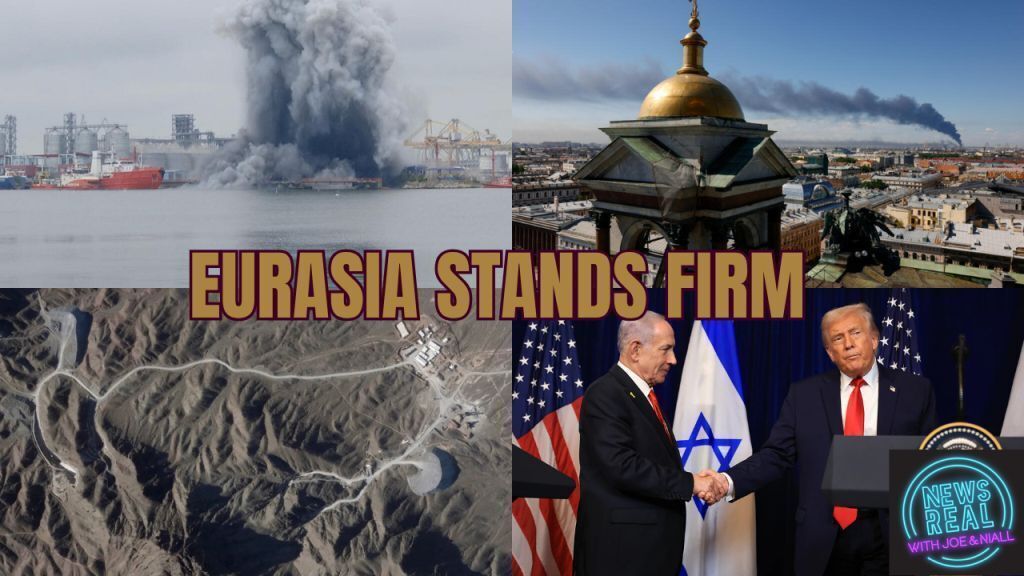
SOTT Focus: NewsReal: Does Ukraine Have a Death-Wish? And Does Iran Have a Nuke?

newsreal israel iran trump
© Sott.net
Ukraine's drone waves continue hitting Russia, last week targeting St Petersburg right as its annual 'Russian Davos' forum opened, Azerbaijani grain ships in the Sea of Azov, and the nuclear power plant in Zaporozhye. The Ukrainian puppet regime, egged on as ever by the Western Consortium that runs it, is feeling invincible, but its days are surely numbered.

Meanwhile the American side of the 'US-rael partnership' is showing rare signs of unease over their pact, with anonymous Pentagon sources complaining about the 'critical' extent of Israeli espionage inside the US.

Trump has been noticeably subdued in recent weeks regarding threats to 'obliterate' Iran, so it's worth considering rumors originating in Tehran that its leadership is preparing to demonstrate a 'new-found' nuclear weapons capability. In the meantime, Iran is poised to send new waves of missiles to defend the Lebanese people from Israeli assault...


Running Time: 01:43:16

Download: MP3 — 142 MB