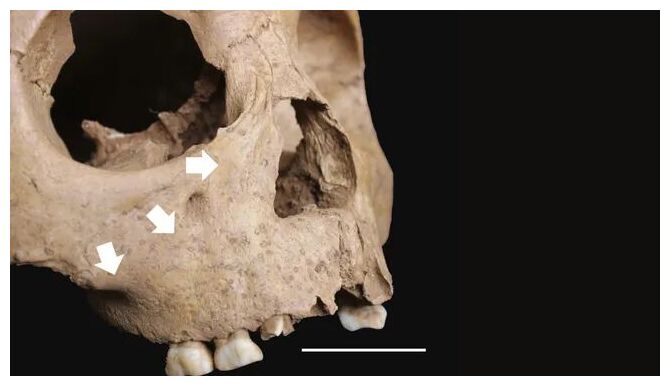
© Vlok et al. 2026, CC BY-NC 4.0Skeletal lesions consistent with congenital treponemal disease on a 5-year-old child from Man Bac, Vietnam.
The team found the Stone Age skeletons of three people who had a debilitating bacterial disease that left marks on their bones and teeth. This disease is in the same family as syphilis, and the discovery of it in prehistoric Vietnam could challenge the idea that syphilis-like diseases originated in the Americas.
In a study published March 13 in the International Journal of Osteoarchaeology, the researchers documented three cases of congenital treponematosis at two Neolithic sites in Vietnam dating to around 4,100 to 3,300 years ago. Treponemal diseases are a group of infections caused by the bacterium Treponema pallidum. These diseases, caused by different subspecies of the bacterium, include syphilis, bejel and yaws.
For decades, researchers believed that of these diseases, only syphilis could be spread through congenital transmission, meaning from parent to child during pregnancy, study first author Melandrie Vlok, a lecturer in anatomy and physiology at the Charles Sturt University, told Live Science in an email. The assumption has been used to back the claim that syphilis originated in the Americas, after previous research found that 5,500-year-old remains of children carried bacteria related to syphilis alongside signs of congenital infection, Vlok said.
But importantly, "none of this DNA is actually syphilis," she noted. This distinction matters as evidence of congenital infection by the bacteria has long been seen as evidence of syphilis itself.
"Our new research flips the script," Nicola Czaplinski, a doctoral candidate in health sciences at the University of Notre Dame Australia, said in an email to Live Science. According to their findings, "congenital transmission isn't unique to syphilis."