
Astronomy books and papers far too numerous to cite offer the assurance that "no one has ever been killed by a meteorite." (John S. Lewis, University of Arizona)
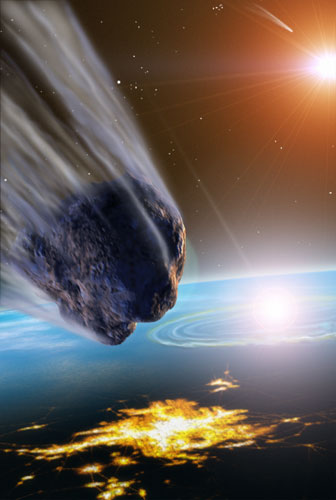
|
| ©Julian Baum |
Over the past few years, while sott.net has been tracking the increasing flux of fireballs and meteorites entering the earth's atmosphere, we have been, by turns, amused and horrified at the ignorant reactions and declarations that issue from academia and the media regarding these incursions. A few years ago, we read that "this is a 'once in a hundred years' event!" Not long after it was a "once in a lifetime" event. Still later, after a lot more incidents it became a "once in a decade" event. More recently, it has been admitted in some quarters that meteorites hit the ground (as opposed to safely burning up in the atmosphere) several times a year! And of course, we have discovered the fact that the governments of our planet are well aware that there are atmospheric explosions from such bodies numerous times a year. We have also learned in this series that the frequent reports of unusual booms and shaking of the ground is often due to such overhead explosions. Yet the media steadfastly refuses to honestly address this issue, though we have noted a plethora of recent articles presenting opposing academic arguments designed to put the populace back to sleep, to reassure them that there is nothing to worry about, that such things only happen every 100,000 years or so, and certainly, the Space Watch Program is going to find all the possible impactors and take care of things.
Recent articles we have covered on SOTT.net include:
Top Scientists Want Research Free From Politics
Leading U.S. scientists called on Congress Thursday to make sure the next president does not do what they say the George W. Bush Administration has done: censor, suppress and falsify important environmental and health research. [...]Another: Government's funding framework breeds scientific conformity
Among the more than 15,000 government scientists signing onto the statement are Harold Varmus, president of Memorial Sloan-Kettering Cancer Centre and former director of the National Institutes of Health (NIH); and Anthony Robbins, professor of medicine at Tufts University and former director of the National Institute for Occupational Safety and Health.
"Although surely the worst, the Bush Administration is not the first, nor will it be the last administration to mistreat and misuse science and scientists," Robbins said. The White House itself has been directly involved in the suppression and falsification of science, Robbins stressed.
But interference from the White House is just part of the problem, said Francesca Grifo, a former government researcher and now a director at the Union of Concerned Scientists. Industry lobbyists are all over government agencies, trying to influence research that will impact their corporations, she said. "These special interest groups are being given access at the highest level."
"Government scientists have had their findings subjected to censorship and misrepresentation," said Kurt Gottfried, professor of physics at Cornell University and a member of the Union of Concerned Scientists. "The public and Congress have often been deprived of accurate and candid scientific information."
"The pursuit of science in an open society has had a long and fruitful tradition in America," Gottfried said. "Unfortunately, this tradition has been violated in recent years by the government itself."
Here is a list of beliefs in the biomedical and climate sciences that must not be questioned if you're applying for a government grant:We most certainly can see that the issue of meteorite, cometary and asteroid impacts on our planet, and their true potential danger to each and every one of us, must be added to this list of unfunded research.
- That global warming is caused by humans;
- That AIDS is caused by a virus;
- That radiation, cigarette smoke and other toxins are dangerous in proportion to their strength, no matter how small the dose;
- That heart disease is caused by saturated fats;
- That cancer is caused by mutations.
This is part of a list offered by a University of Washington professor of surgery, Donald W. Miller, who is a heart surgeon at the VA Medical Center in Seattle. Miller believes that all the above ideas may be false, and ought to be tested. [...]
But much of science runs on government money. Some people find the stink of bias only in private money, and see government as free of it, but they are mistaken. Government likes certain beliefs. To get its money, you have to get the approval of the scientists it selects, and you are less likely to get it if they think your idea wrong.
What that means, Miller says, is that "If you say low doses of radiation aren't bad for you, or that global warming is due to variations in the sun, you can't get funded."
He says this happened to University of California scientist Peter Dues-berg, who challenged the viral theory of AIDS, and to Harvard's Willie Soon, who challenged the pollution theory of global warming, and to others. In a paper published in 2007 in the Journal of Information Ethics, Miller argued that conformity is built into the system of government grants. [...]
In 2005, in the scientific journal Cellular and Molecular Biology, Pollack made an argument similar to Miller's. American science, he wrote, has become "a culture of believers" whose rule is, "just keep it safe and get your funding."
For science, the result has not been good. [...]
Thomas Kuhn, the philosopher of science, argued famously that science progresses in revolutionary bursts, in which the "dominant paradigm" is overturned. But what if the supporters of the dominant paradigm are the people vetting your application?
This is a very bad and dangerous state of affairs. As Victor Clube wrote in his letter to SOTT.net:
First, I should say your references to the (cosmically complacent) paleoclimate community and to my otherwise unread narrative report to the USAF european office strike a very considerable chord with me. After all neither Ms Victoria Cox nor your good self can be aware how very much Bill and I had reason to appreciate the timely injection of USAF funds at a time when the line of research we championed appeared to be successfully closed down by the UK scientific establishment. Thus we were both in turn obliged to relinquish our career posts at the Royal Observatory, Edinburgh on account of this line of research - which gave rise to our reincarnation at a more tolerant haven namely my alma mater (Oxford).And so, it seems, we here at SOTT.net, and some brave souls with the good of humanity at heart, are on their own, opposed by the governments that are supposed to be in place to look after the interests of their people.
Also, whilst I broadly accept your commentary regarding the role of "national elites" in the face of near-Earth threats, I am quite certain the elites in practice currently know VERY "much LESS than they let on" and that the situation for humanity is dire. Any comfort you may draw from the opposite opinion seems to me to be entirely misplaced. Thus although the globally modest efforts to assess the NEO threat with telescopes by a few semi-enlightened national administrations (eg USA) or by a few private enterprises (eg Gates) are certainly to be commended, I look upon this aspect of the NEO threat as basically intermittent and therefore more or less symbolic so far as generally more urgent and still largely undetected low mass NEO flux (which is demonstrably climatological in its effect) is concerned. This particular threat (evidently responsible for our planet's evolving glacial/interglacial condition during the past 3 million years) is of course _fundamentally_ ignored by the current Body Scientific and hence by most of humanity as well.
Of course, the question arises: what led to this general and overall blindness on the part of the people we look to for interpretation and explanation of our reality? How can the people who write textbooks, teach in schools, even at the highest level, be so ignorant? The consequences of this ignorance are, after all, detrimental to everyone for many reasons, not the least of which is simple survival in a rather hostile environment.
The events that have been covered so far in this series have led us to understand that there have been many times when it is highly probable that the earth - or parts thereof - was bombarded with meteorites or exploding aerial cometary fragments. These events occurred, and were probably related to, periods of great stress on the environment and humanity as a whole. Climate changes brought floods, droughts, extreme temperatures, crop failures and famine. These pressures may have caused lowered disease resistance for given populations, and it is also conjectured that extra-terrestrial bombardments may have carried disease pathogens. Impacts or crustal disturbances could have placed stresses on the geological structures so that outgassings from fissures, the ocean, or lakes may have poisoned large numbers of people, not to mention the record of tsunamis that is now called into question. Do we know, for example, that the Christmas tsunami-causing earthquake near Malaysia was not impact induced? No, we don't. And we can't trust either our governments or the news media - or even most of academia who owe their livelihoods to the government - to tell us the truth.
Why do they lie to us?
Well, the main reason is rather simple: it's all about control. All of these things, taken together, place intolerable stresses on the human social organism and, as is typical for human beings, this brings on a crisis of faith, demands for answers, demands for protection that governments simply find it too expensive to provide.
When the world shows itself to be a hostile environment, when the environment suggests that there is no god and humanity is cast adrift in an uncaring cosmos, most people cannot tolerate this; they desperately need to restore their belief in something "out there" that is going to save them, and if there is no one to save them, that means that someone has to be blamed for the disasters: a scapegoat. The corrupt governments do not want to be blamed, so they seek to blame someone else and convince the masses that this object of derision is the chief cause of all terrors. And the masses invariably buy into these maneuvers because, of course, if you can find someone or something to blame for calamity, you can continue in your illusion that "God is in his heaven and - but for the evil acts of the chosen scapegoat - all would be right with the world." Otherwise, the tension and anxiety of having no control (even vicarious, via prayer or ritual) over the hostile environment, would be unbearable. I'm sure that you notice that this also relieves the individual of any responsibility as well, so this approach works in all kinds of situations.
We are going to examine this problem in some depth further on, but for now, I would like the reader to become acquainted with the facts. What I have prepared for today is The List, by no means exhaustive, of all the incidents I have been able to uncover of meteorite, asteroid, or cometary impacts that have caused death and destruction, property damage, or were near misses. Major parts of The List are extracted from the work of John S. Lewis, Professor of Planetary Sciences at the Lunar and Planetary Laboratory, Codirector of the NASA/University of Arizona Space Engineering Research Center, and Commissioner of the Arizona State Space Commission, in specific, his books entitled Rain of Iron and Ice and Comet and Asteroid Impact Hazards on a Populated Earth. In this latter volume, he writes:
The most intensively studied impact phenomenon, impact cratering, is of limited importance, due to the rarity and large mean time between events for crater-forming impacts. Almost all events causing property damage and lethality are due to bodies less than 100 meters in diameter, almost all of which, except for the very largest and strongest, are fated to explode in the atmosphere. ... [W]e are forced to conclude that the complex behavior of smaller bodies is closely relevant to the threat actually experienced by contemporary civilization.Based on the data he collected, Lewis noted that:
[O]n the century time scale, firestorm ignition and direct blast damage by rare, strong, deeply penetrating bodies are the most common threats to human life, with average fatality rates of about 250 people per year. ... On a 1000-year scale, the most severe single event, which is usually a 10 to 100 megaton Tunguska-type airburst, accounts for most of the total fatalities. On longer time scales, regional impact-triggered tsunamis become the most dangerous events. ...The exact impactor threshold size for global effects remains poorly determined. [...]Unfortunately, Prof. Lewis did not have to hand the information presented by Mike Baillie in his book New Light on the Black Death, nor did he consider the global events of 12000 years ago revealed by the work of maverick scientists, Firestone, West and Warwick-Smith. If he had added the estimated numbers of fatalities from those events into his calculations, he might not have decided that the small, faint, and numerous bodies were so easily ignored. I think that if ALL the data were plugged in, the average deaths per year would be a lot higher than 250. Regarding impacts from history, Lewis writes in Comet and Asteroid Impact Hazards on a Populated Earth:
Perhaps most interesting is the implication that the large majority of lethal events (not of the number of fatalities) are caused by bodies that are so small, so faint, and so numerous that the cost of the effort required to find, track, predict, and intercept them exceeds the cost of the damage incurred by ignoring them. [Lewis, 1999]
Many ancient sources from many cultures treat comets as literal, physical harbingers of doom. Such phenomena as the burning of cities and the overthrow of buildings and walls by aerial events are mentioned many times in Latin, Greek, Hebrew, and Chinese records, but there is no evidence of physical understanding of the nature of the bombarding objects or their effects until quite recently. [...]Now, that just gives you a taste of what is to come. (I would like you to notice the highlighted mention of the fall of chunks of ice.) So, without further ado, here is:
There is indeed a language problem in understanding the ancient reports, but it is largely a matter of the lack of an appropriate technical vocabulary in the older writings. [...] In certain locations and periods, especially in medieval Europe, all unusual heavenly events were interpreted as signs sent by God. Therefore, the surviving accounts are strongly biased toward explaining the moral purpose of these events, not their physical nature. Such fundamental information as exact date and time, exact location, place of appearance of the phenomenon in the sky, its duration and physical extent, luminosity, precise nature of the damage done, and the like were generally regarded as unimportant, and therefore rarely recorded for posterity. [...] Even in 20th century newspapers, bolide explosions may be described (and indexed) as "mysterious explosions," aerial blasts, aerolites, aeroliths, bolides, earthquakes, fireballs, meteorites, meteors, shocks, thunder, and so on. [...]
Reports of meteorite falls, often with consequent damage, extend back to the fall of a "thunderstone" in Crete in 1478 BC, described by Malchus in the Chronicle of Paros. The earliest Biblical source is the account of a lethal fall of stones in ... Joshua 10:11. [...]
Other ancient reports in the West are found in the writings of Pausanius, Plutarch, Livy, Pindar, Valerius Maximus, Caesar, and many others. The report of a great fall of black dust at Constantinople in 472 BC, perhaps the result of a high-altitude airburst, is documented by Procopius, Ammianus Marcellinus, Theophanes, and others.
Colonel S. P. Worden has called to my attention the following passage in The History of the Franks, written by Bishop Gregory of Tours:"580 AD in Louraine, one morning before the dawning of the day, a great light was seen crossing the heavens, falling toward the east. A sound like that of a tree crashing down was heard over all the countryside, but it could surely not have been any tree, since it was heard more than fifty miles away... the city of Bordeaux was badly shaken by an earthquake ... a supernatural fire burned down villages about Bordeaux. It took hold so rapidly that houses and even threshing-floors with all their grain were burned to ashes. Since there was absolutely no other visible cause of the fire, it must have happened by divine will. The city of Orleans also burned with so great a fire that even the rich lost almost everything."Astronomers who have sought documentary evidence of ancient astronomical phenomena (eclipses, comets, fireballs, etc.) have found that East Asian records are far superior to European records for many centuries. Kevin Yau has searched Chinese records and found many reports of deaths and injuries (Yau et al., 1994). The Chinese records of lethal impact events include the death of 10 victims from a meteorite fall in 616 AD, an "iron rain" in the O-chia district in the 14th century that killed people and animals, several soldiers injured by the fall of a "large star" in Ho-t'ao in 1369, and many others. The most startling is a report of an event in early 1490 in Ch'ing-yang, Shansi, in which many people were killed when stones "fell like rain." Of the three known surviving reports of this event, one says that "over 10,000 people" were killed, and one says that "several tens of thousands" were killed.
On 14 September 1511, a meteorite fall in Cremona, Lombardy, Italy, reportedly killed a monk, several birds, and a sheep. In the 17th century we find reports of a monk in Milano, Italy, who was struck by a meteorite that severed his femoral artery, causing him to bleed to death, and of two sailors killed on shipboard by a meteorite fall in the Indian Ocean.
In addition to these shipboard fatalities, there have been several striking accounts of near disasters involving impacts very close to ships. Near midnight of 24 February 1885, at a latitude of 37 degrees N and a longitude of 170 degrees 15 minutes E in the North Pacific, the crew of the barque Innerwich, en route from Japan to Vancouver, saw the sky turn fiery red: "A large mass of fire appeared over the vessel, completely blinding the spectators; and, as it fell into the sea some 50 yards to leeward, it caused a hissing sound, which was heard above the blast, and made the vessel quiver from stem to stem. Hardly had this disappeared, when a lowering mass of white foam was seen rapidly approaching the vessel. The noise from the advancing volume of water is described as deafening. The barque was struck flat aback; but, before there was time to touch a brace, the sails had filled again, and the roaring white sea had passed ahead."
A strikingly similar event occurred only 2 years later on the opposite side of the world. Captain C.D. Swart of the Dutch barque J.P.A. reported in the American Journal of Meteorology 4 (1887) that, when sailing at 37 degrees 39 minutes N and 57degrees W, at about 5 pm on 19 March 1887, during a severe storm in which it was "as dark as night above," two brilliant fireballs appeared as in a sea of fire. One bolide "fell into the water very close alongside the vessel with a roar, and caused the sea to make tremendous breakers which swept over the vessel. A suffocating atmosphere and perspiration ran down every person's face on board and caused everyone to gasp for fresh air. Immediately after this, solid lumps of ice fell on deck, and everything on deck and in the rigging became iced, notwithstanding that the thermometer registered 19 degrees C."
On 20 August 1907, the steamship Cambrian arrived in Boston from England with an equally extraordinary tale to tell. When the ship was several hundred miles south of Cape Race, Newfoundland, steaming along under a clear sky, a brilliant fireball appeared near the northeastern horizon and "rushed across the sky like a rocket. The next moment it passed over the topmast of the liner with a tremendous roar and plowed up the sea about fifty yards from the boat. The upheaval of the water was terrific, but the ship was not damaged." The report of this event was carried in the New York Times.
Next, according to the Times, on 13 September 1930, a fireball plunged into the sea near Eureka, California, barely missing the tug Humboldt, which was towing the Norwegian motorship Childar out to sea. It requires little imagination to appreciate that such an event, if it were to strike a ship, should easily cause fatalities, or even the loss of the vessel with all hands. [Lewis, 1999]
THE LIST: Damages, Disasters, Injuries, Deaths, and Very Close Calls
10,000 - 11,000 B.C. (10,700) - The earliest disaster we know of from our historical or mythic records is, of course, the legendary Deluge of Atlantis. The description of the end of Atlantis given by Plato in the "Timaeus" and "Critias" dialogues bears striking resemblance to what many scientists are now agreed would be the inevitable result of an oceanic impact by a disintegrating comet or large asteroid. The resultant 'tsunami', or tidal waves, would easily reach 2000 ft. high as they approached land, wiping out any and all coastal settlements. The deluge traditions, of which there are literally hundreds worldwide, appear in this light to be variations on Plato's account, and could even be actual observation-based tales, eye-witness accounts of the same, or similar, events. This is very likely the event discussed by Firestone, West and Warwick-Smith in The Cycle of Cosmic Catastrophes: How a Stone-Age Comet Changed the Course of World Culture. As I have discussed in my book, The Secret History of the World, the North and South American continents in the Western Hemisphere fit all the descriptions of "Atlantis," and it is very likely that the event that led to the extinction of about 30 species of large mammals about 12,000 years ago was the source of the legends of Atlantis and probably the legends of a global deluge: Noah's Flood. Let's look at some descriptions of what such an event can do.
Back in the 1940s Dr. Frank C. Hibben, Prof. of Archeology at the University of New Mexico led an expedition to Alaska to look for human remains. He didn't find human remains; he found miles and miles of icy muck just packed with mammoths, mastodons, and several kinds of bison, horses, wolves, bears and lions. Just north of Fairbanks, Alaska, the members of the expedition watched in horror as bulldozers pushed the half-melted muck into sluice boxes for the extraction of gold. Animal tusks and bones rolled up in front of the blades "like shavings before a giant plane". The carcasses were found in all attitudes of death, most of them "pulled apart by some unexplainable prehistoric catastrophic disturbance."[Hibben, Frank, The Lost Americans (New York: Thomas & Crowell Co. 1946)]Firestone, West and Warwick-Smith write:
The killing fields stretched for literally hundreds of miles in every direction.[ibid.] There were trees and animals, layers of peat and moss, twisted and tangled and mangled together as though some Cosmic mixmaster sucked them all in circa 12000 years ago, and then froze them instantly into a solid mass. [Sanderson, Ivan T., "Riddle of the Frozen Giants", Saturday Evening Post, No. 39, January 16, 1960.]
Just north of Siberia entire islands are formed of the bones of Pleistocene animals swept northward from the continent into the freezing Arctic Ocean. One estimate suggests that some ten million animals may be buried along the rivers of northern Siberia. Thousands upon thousands of tusks created a massive ivory trade for the master carvers of China, all from the frozen mammoths and mastodons of Siberia. The famous Beresovka mammoth first drew attention to the preserving properties of being quick-frozen when buttercups were found in its mouth.
What kind of terrible event overtook these millions of creatures in a single day? The evidence suggests an enormous tsunami raging across the land, tumbling animals and vegetation together, to be finally quick-frozen for the next 12000 years. But the extinction was not limited to the Arctic, even if the freezing at colder locations preserved the evidence of Nature's rage.
Paleontologist George G. Simpson considers the extinction of the Pleistocene horse in North America to be one of the most mysterious episodes in zoological history, confessing, "no one knows the answer." He is also honest enough to admit that there is the larger problem of the extinction of many other species in America at the same time. [Simpson, George G., Horses, New York: Oxford University Press) 1961] The horse, giant tortoises living in the Caribbean, the giant sloth, the saber-toothed tiger, the glyptodont and toxodon. These were all tropical animals. These creatures didn't die because of the "gradual onset" of an ice age, "unless one is willing to postulate freezing temperatures across the equator, such an explanation clearly begs the question." [Martin, P. S. & Guilday, J. E., "Bestiary for Pleistocene Biologists", Pleistocene Extinction, Yale University, 1967]
Massive piles of mastodon and saber-toothed tiger bones were discovered in Florida. [Valentine, quoted by Berlitz, Charles, The Mystery of Atlantis (New York, 1969)] Mastodons, toxodons, giant sloths and other animals were found in Venezuela quick-frozen in mountain glaciers. Woolly rhinoceros, giant armadillos, giant beavers, giant jaguars, ground sloths, antelopes and scores of other entire species were all totally wiped out at the same time, at the end of the Pleistocene, approximately 12000 years ago.
This event was global. The mammoths of Siberia became extinct at the same time as the giant rhinoceros of Europe; the mastodons of Alaska, the bison of Siberia, the Asian elephants and the American camels. It is obvious that the cause of these extinctions must be common to both hemispheres, and that it was not gradual. A "uniformitarian glaciation" would not have caused extinctions because the various animals would have simply migrated to better pasture. What is seen is a surprising event of uncontrolled violence. [Leonard, R. Cedric, Appendix A in "A Geological Study of the Mid-Atlantic Ridge", Special Paper No. 1 ( Bethany: Cowen Publishing 1979)] In other words, 12000 years ago, something terrible happened - so terrible that life on earth was nearly wiped out in a single day.
Harold P. Lippman admits that the magnitude of fossils and tusks encased in the Siberian permafrost present an "insuperable difficulty" to the theory of uniformitarianism, since no gradual process can result in the preservation of tens of thousands of tusks and whole individuals, "even if they died in winter." [Lippman, Harold E., "Frozen Mammoths", Physical Geology, (New York 1969)] Especially when many of these individuals have undigested grasses and leaves in their belly. Pleistocene geologist William R. Farrand of the Lamont-Doherty Geological Observatory, who is opposed to catastrophism in any form, states: "Sudden death is indicated by the robust condition of the animals and their full stomachs ... the animals were robust and healthy when they died." [Farrand, William R., "Frozen Mammoths and Modern Geology", Science, Vol.133, No. 3455, March 17, 1961] Unfortunately, in spite of this admission, this poor guy seems to have been incapable of facing the reality of worldwide catastrophe represented by the millions of bones deposited all over this planet right at the end of the Pleistocene. Hibben sums up the situation in a single statement: "The Pleistocene period ended in death. This was no ordinary extinction of a vague geological period, which fizzled to an uncertain end. This death was catastrophic and all inclusive." [Hibben, op. cit.] [Quoted from The Secret History of The World]
"Until recently, the astronomical mainstream was highly critical of Clube and Napier's giant comet hypothesis. However, the crash of comet Shoemaker-Levy 9 on Jupiter in 1994 has led to a change in attitudes. The comet, watched by the world's observatories, was seen split into 20 pieces and slammed into different parts of the planet over a period of several days. A similar impact on Earth, it hardly needs saying, would have been devastating."The Carolina Bays date to this time. The Carolina bays are mysterious land features often filled with bay trees and other wetland vegetation. Because of their oval shape and consistent orientation, they are considered by some authorities to be the result of a vast meteor shower that occurred approximately 12,000 years ago. What is most astonishing is the number of them. There are over 500,000 of these shallow basins dotting the coastal plain from Georgia to Delaware. That is a frightening figure.
Let me repeat: there are over 500,000 of these shallow basins.
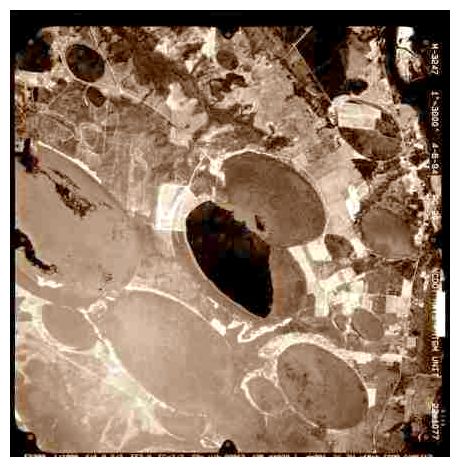
© Unknown"Carolina Bays": They are found the length of the US eastern seaboard and are not really bays
Unlike virtually any other bodies of water or changes in elevation, these topographical features follow a reliable and unmistakable pattern. Carolina Bays are circular, typically stretched, elliptical depressions in the ground, oriented along their long axis from the Northwest to the Southeast. [T]hey are further characterized by an elevated rim of fine sand surrounding the perimeter. [...]Now, how many human deaths ought we to assign to this event? As Firestone, et al discuss, it was global in effect and the evidence of a sharply reduced population of not only animals, but humans, is there in the geological record. But what was the total human population? What kind of numbers can we plug into Lewis' calculations? Frankly, we don't know. Undoubtedly, multiplied millions of human beings perished at that time along with the extinction of many animal species. One thing that seems certain is that if these numbers were included in Lewis' assessment, it would make a significant change in the "average number of deaths per year". Though, of course, this was a very big event, and those don't happen every year, or even every century. They happen on a scale of thousands of years and there hasn't been one like that for 12000 years.
Robert Kobres, an independent researcher in Athens, Georgia, has studied Carolina Bays for nearly 20 years in conjunction with his larger interest in impact threats from space. His recent, self-published, investigations have profound consequences for Carolina Bay study and demand research by academia as serious, relevant and previously unexamined new information. The essence of Kobres' theory is that the search for "debris," and the comparison of Bays with "traditional" impact craters, falsely and naively assumes that circular craters with extraterrestrial material in them are the only terrestrial evidence of past encounters with objects entering earth's atmosphere.
Kobres goes a logical step further by assuming that forces associated with incoming bodies, principally intense heat, should also leave visible signatures on the earth. And, finally, that physics does not demand that a "collision" of the bodies need necessarily occur to produce enormous change on earth. To verify that such encounters are possible outside of the physics lab, we need look no further than the so-called "Tunguska event."
At the epicenter of the explosion lay not a large crater with a "rock" in it, as might be expected, but nothing more than a number of "neat oval bogs." The Tunguska literature generally mentions the bogs only in passing, since the researchers examining the site failed to locate any evidence of a meteorite and went on to examine other aspects of the explosion. (The Secret History of The World)
9100 B.C. - Extinction of the Woolly mammoths.
7,500 B.C. - Brings ice age to an end.
5,900 B.C. - Metals found smelted "naturally" which gives rise to humans smelting metals.
4,300 B.C. - Metals smelted naturally; beginning of Homeric "religions." Possible time for event on which part of the Exodus story is based.
3195 B.C. - Eco-disaster as shown in tree rings. What evidence is there then that something unusual happened around 3100 BC other than the Mayan year zero supposedly relating to 3114 BC?
- Newgrange construction.
- Flood in paleoclimatic data.
- Stonehenge number one
- The unification of Egypt
- Methane peak (fires).
- Cold time according to bristlecone pines.
- The coastal menhirs in Brittany.
Although anyone of these in itself would not be unusual, the timing of them within a frame of only 100 years, is what makes us suspect that something unusual was going on. The next 1000 years or so were very restless time globally.
The postulated bombardments and dust-veils at around 3195 BC, another narrowest tree-ring date, would have wreaked havoc on both the local and global climate, and any and all cultures affected would have taken many decades, maybe even centuries, to recover. The sheer terror that 'multiple-Tunguska-class fireballs' would have instilled into the peoples of those times would have understandably motivated them towards building some form of observatories to help predict future meteor showers/storms as a matter of perceived urgency.Stonehenge may very well have been built to help in the watch for comets. And, yet again, we have no numbers of human fatalities to plug into the calculations but they must have been enormous.
3123 B.C. - 29 June - Germany - 'The clay tablet that tells how an asteroid destroyed Sodom 5,000 years ago'
A clay tablet that has baffled scientists for more than a century has been identified as a witness's account of an asteroid that destroyed the Biblical cities of Sodom and Gomorrah 5,000 years ago.2345 B.C. - Eco-disaster focused in the Levant as shown in tree-rings. End of Egyptian Old Dynasty?
Researchers believe that the tablet's symbols give a detailed account of how a mile-long asteroid hit the region, causing thousands of deaths and devastating more than one million sq km (386,000 sq miles).
The impact, equivalent to more than 1,000 tons of TNT exploding, would have created one of the world's biggest-ever landslides.
The Old Testament story describes how God destroyed the 'wicked sinners' of Sodom with fire and brimstone but allowed Lot, the city's one good man, to flee with his family.
The theory is the work of two rocket scientists - Alan Bond and Mark Hempsell - who have spent the past eight years piecing together the archaeological puzzle.
At its heart is a clay tablet called the Planisphere, discovered by the Victorian archaeologist Henry Layard in the remains of the library of the Royal Palace at Nineveh.
Using computers to recreate the night sky thousands of years ago, they have pinpointed the sighting described on the tablet - a 700 BC copy of notes of the night sky as seen by a Sumerian astrologer in one of the world's earliest-known civilisations - to shortly before dawn on June 29 in the year 3123BC.
Half the tablet records planet positions and clouds, while the other half describes the movement of an object looking like a 'stone bowl' travelling quickly across the sky.
The description matches a type of asteroid known as an Aten type, which orbits the Sun close to the Earth. Its trajectory would have put it on a collision course with the Otz Valley. [In Germany; in other words. In short, the story wasn't about Abraham and Lot in Palestine!]
'It came in at a very low angle - around six degrees - and then clipped a mountain called Gaskogel around 11 km from Köfels,' said Mr Hempsell.
'This caused it to explode - and as it travelled down the valley it became a fireball.
'When it hit Köfels it created enormous pressures which pulverised the rock and caused the landslide. But because it wasn't solid, there was no crater.'
The explosion would have created a mushroom cloud, while a plume of smoke would have been seen for hundreds of miles.
Mr Hempsell said another part of the tablet, which is 18 cm across and shaped like a bowl, describes a plume of smoke around dawn the following morning.
'You need to know the context before you can translate it,' said Mr Hempsell, of Bristol University.
Geologists have dated the landslide to around 9,000 years ago, far earlier than the Sumerian record. However, Mr Hempsell, who has published a book on the theory, believes contaminated samples from the asteroid may have confused previous dating attempts.
Academics were also quick to disagree with the findings, which were published in A Sumerian Observation of the Köfels's Impact Event.
John Taylor, a retired expert in Near Eastern archaeology at the British Museum, said there was no evidence that the ancient Sumerians were able to make such accurate astronomical records, while our knowledge of Sumerian language was incomplete.
'I remain unconvinced by these results,' he added.
The French archaeologist, Marie-Agnes Courty, presented a paper at the Society for Inter-Disciplinary Studies' July 1997 conference at Cambridge University, in which she first detailed the findings of excavations at a site in northern Syria, at Tell Leilan. This was the first time ever that an archaeological excavation had been initiated where the main purpose was to examine the stratigraphical record of the area with a view to searching for evidence of 'scorched earth' due to a suspected episode of extra-terrestrial 'fireball bombardment'.Another with no human fatality numbers included in the calculations.
She and her team found much evidence of microscopic glass spherules typical of melted sand and rock which is caused by the intense heat resulting from an asteroid impact or air-burst. She recommended further excavations there and at other sites. It would make sense that attention should be focussed on sites once occupied at dates where the tree-ring chronologies show evidence of abrupt climate changes - as at Tell Leilan in northern Syria, where the 'burn event' has now been dated by Courty as immediately prior to 2345 BC, a 'narrowest tree-ring' date.
Scientists have found the first evidence that a devastating meteor impact in the Middle East might have triggered the mysterious collapse of civilisations more than 4,000 years ago.1628 B.C. - "The Exodus" - Biblical scholars have been debating the date of the so-called Exodus for hundreds of years. The most recent researches have indicated that there was no exodus as depicted in the Bible, it was all made up by post-exilic priests - to create a "history" justifying their elite status and privileges. More than that, based on historical knowledge of how things were done in those times, they probably were not even related to any of the people "carried away to Babylon" in the first place. And so, it seems logical to speculate that the background information contained in the Exodus story - and other related stories in the Bible, such as the collapse of Jericho and the destruction of Sodom and Gomorrah - were legendary stories of events that occurred around the time of the eruption of Thera which has been fairly securely fixed around 1600 B.C. plus or minus 50 years. Mike Baillie reports that whatever happened at this period of history that includes this monstrous eruption, it was global in effect as is shown in the tree-ring chronologies. In other words, more was going on than just a volcanic eruption. Again, no numbers of fatalities to plug into the calculations though there are many ancient reports of plague and mass death and Egyptian records report many strange sky, weather, and plague phenomena.
Studies of satellite images of southern Iraq have revealed a two-mile- wide circular depression which scientists say bears all the hallmarks of an impact crater. If confirmed, it would point to the Middle East being struck by a meteor with the violence equivalent to hundreds of nuclear bombs. Today's crater lies on what would have been shallow sea 4,000 years ago, and any impact would have caused devastating fires and flooding. The catastrophic effect of these could explain the mystery of why so many early cultures went into sudden decline around 2300 BC. - The crater's faint outline was found by Dr Sharad Master, a geologist at the University of Witwatersrand, Johannesburg, on satellite images of the Al 'Amarah region, about 10 miles north-west of the confluence of the Tigris and Euphrates and home of the Marsh Arabs. (Robert Matthews Science Correspondent, The Telegraph - London 11-4-1)
1159 B.C. - Collapse of Shang and Mycenean cultures. Collapse of the Bronze Age in the Mediterranean region. Possible origin of more "Exodus" stories amalgamated with older tales of similar events. Wikipedia tells us:
The Bronze Age collapse is the name given by those historians who see the transition from the Late Bronze Age to the Early Iron Age, as violent, sudden and culturally disruptive, expressed by the collapse of palace economies of the Aegean and Anatolia, replaced after a hiatus by the isolated village cultures of the Dark Age period of history of the Ancient Middle East.Mike Baillie points out that a series of impacts/overhead explosions, would more adequately explain the longstanding problem of the end of the Bronze Age in the Eastern Mediterranean in the 12th century BC. At that time, many - uncountable - major sites were destroyed and totally burned and it has all been blamed on those supernatural "Sea Peoples." If that was the case, if it was invasion and conquest, there ought to at least be some evidence for that, like dead warriors or signs of warfare... but for the most part, that is not the case. There were almost no bodies found, and no precious objects except those that were hidden away as though someone expected to return for them, or didn't have time to retrieve them. The people who fled (extra-terrestrial events often have precursor activities and warnings because a comet can often be observed approaching for some time) were probably also killed in the act of fleeing and the result was total abandonment and total destruction of the cities in question.
John Lewis did not include this in his calculations either.
207 B.C. - Scientists Say Comet Smashed Into Southern Germany In 200 BC
A comet or asteroid smashed into modern-day Germany some 2,200 years ago, unleashing energy equivalent to thousands of atomic bombs, scientists reported on Friday.190 BC Consulship of Lucius Scipio and Gaius Laelius
The 1.1-kilometre (0.7-mile) diameter rock whacked into southeastern Bavaria, leaving an "exceptional field" of meteorites and impact craters that stretch from the town of Altoetting to an area around Lake Chiemsee, the scientists said in an article in the latest issue of US magazine Astronomy.
Colliding with the Earth's atmosphere at more than 43,000 kms per hour, the space rock probably broke up at an altitude of 70 kms), they believe.
The biggest chunk smashed into the ground with a force equivalent to 106 million tonnes of TNT, or 8,500 Hiroshima bombs.
"The forest beneath the blast would have ignited suddenly, burning until the impact's blast wave shut down the conflagration," the investigators said.
"Dust may have been blown into the stratosphere, where it would have been transported around the globe easily... The region must have been devastated for decades."
The biggest crater is now a circular lake called Tuettensee, measuring 370 metres (1,200 feet) across. Scores of smaller craters and other meteorite impacts can be spotted in an elliptical field, inflicted by other debris.
The study was carried out by the Chiemgau Impact Research Team, whose five members included a mineralogist, a geologist and an astronomer. [...]
Additional evidence comes from local discoveries of Celtic artefacts, which appear to have been scorched on one side.
That helped to establish an approximate date for the impact of between 480 and 30 BC.
The figure may be fine-tuned to around 200 BC, thanks to tree-ring evidence from preserved Irish oaks, which show a slowing in growth around 207 BC.
This may have been caused by a veil of dust kicked up the impact, which filtered out sunlight.
In addition, Roman authors at about the same time wrote about showers of stones falling from the skies and terrifying the populace.
The object is more likely to have been a comet than an asteroid, given the length of the ellipse and scattered debris, the report says.
The temple of Juno Lucina was struck by lightning in such a way that the gable and the doors were damaged. In neighbouring towns many things were struck by lightning. At Nursia stormclouds gathered from a clear sky, and two persons were killed. At tusculum there was a shower of earth. A mule at Reate produced a colt. A day of prayer was observed by ten boys with living fathers and mothers, and as many girls. (Livy XXXVII. iii 2-6)
Comment: The words fulmine ictum are used for "struck by lightning". However, fulmine can mean more than just lightning; it is a "bolt" which could be a solid flaming object. This passage could very well be a description of meteor/comet fragment strikes. That becomes more likely when you consider "shower of earth."
fulmen ("lightning which strikes and sets on fire, thunderbolt")
lightning
thunderbolt - which in many descriptions is clearly NOT lightning.
flash, lighten, glitter, gleam, glare, glisten, shine.
188 BC Consulship of Marcus Messala and Gaius Livius
Between the third and fourth hour of the day, darkness set in. On the Aventine, showers of stones were atoned fo by a nin-day observance. There was a successful campaign in Spain. (Livy XXXVIII xxxvi. 4.)
186 BC Consulship of Spurius Postumius Albinus and Quintus Marcius Philippus
A nine-day observance was held because there had been a shower of stones in Picenum, and because lightning bolts, appearing in many places, had scorched the clothes of many persons by a slight blast of heat. The temple of Jupiter on the Capitol was struck by lightning. In Umbria, a hermaphrodite about twelve years old was discovered, and by order of the soothsayers was put to death. Gauls who had crossed the Alps into Italy were expelled without a battle. (Livy XXXIX xxii. 3-5)
Comment: Now, notice that odd thing about lightning bolts that scorch the clothes of many persons by a "slight blast of heat." Sounds more like an exploding bolide. Also, this is, again, just two years after the previous event.
176 BC Consulship of Gnaeus Cornelius and Quintus Petillius
After the consuls had offered sacrifice, the liver melted away. Cornelius suffered a stroke on his way back from the Alban Mount and died at the spa of Cumae, while Petillius was killed in battle against the Ligurians. At a time when men's minds were already filled with religious fears... a firebrand was seen in the sky, and at Gabii the temple of Apollo and numerous private houses, at Gravisca the wall and gate, were struck by lightning. The Fathers ordered expiation for these, in a manner to be prescribed by the pontiffs. (Livy XLI. xiv. 7; xv. 1-4; svi. 3-4; svi. 6; svii. 8-11, 14)
173 BC
At Lanuvium the vision of a great fleet was said to have been seen in the sky, and at Privernum that dark-colored wool had grown from the earth, and in the Veientine country about Remens that there had been a shower of stones: it was reported that the whole Pomptine region had been covered by clouds, one might say, of locusts; and that in the Gallic land, wherever the plough was driven, fish came forth from the upturned sod. By reason of these prodigies the oracular books were consulted and announcement was made by the decemvirs to what gods and with what victims the sacrifices should be performed, and it was directed that a period of prayer should be celebrated in atonement for the prodigies and that a second such period should be observed which had been vowed a year before for the sake of the health of the people and that a festival should be held. (Livy XLII. ii 4-6)
167 BC Consulship of Quintus Aelius Paetus and Marcus Junius
At Rome several places, both consecrated and common, were struck by lightning. At Anagnia there was a shower of earth. At Lanuvium a blazing meteor was seen in the sky. At Calatia on land owned by the state blood trickled for three days and two nights. King Gentius of Illyricum and King Perseus of Macedonia were conquered. (Livy XLV. xvi. 5-7)
Comment: The meteor event was: fax ardens in caelo visa = lighted torch seen in the sky.
166 BC Consulship of Marcus Marcellus and Gaius Sulpicius
In Campania there was a shower of earth at many points. In the territory of Praeneste bloody rain fell. In the territory of Veii wool grew from trees. At Terracina in the temple of Minerva three women, who were seated after performing rites, lost their lives. At the grove of Libitina, water dripped for a long time from the mouth and foot of a bronze equestrian statue. The Ligurian Gauls were crushed.
When elections occurred marked by great corruption, and for this reason a session of the senate was being held on the Capitol, a kite came flying and dropped into the midst of the assembled Fathers a weasel that it had caught inside the temple of Jupiter. About this same time the temple of Safety was struck by lightning. On the Quirinal hill, blood oozed from the ground. At Lanuvium a meteor was seen in the sky by night. Several things were knocked to pieces by lightning at Cassinum, and the sun was seen for several hours at night. At Teanum Sidicinum a boy was born with four hands and as many feet. After the city had been purified there was peace at home and abroad (Ligurians, Summary Livy XLVI; bribery, cf. Summary Livy XLVII, 159 BC)
Comment: The meteor is fax in caelo nocte conspecta = burning torch in the night sky visible, burning seen in the sky.
The sun seen for several hours at night obviously refers to a cometary body that did not have the appearance of a "burning torch", probably because it was so close and perhaps seen dead on, without a tail. It may even have impacted or exploded aerially somewhere and this was not observed because the earth rotated away from it before impact.
Notice in the following year there was apparently plague and famine probably due to climate disruption related to the above "portents".
163 BC Consulship of Tiberius Gracchus and Manius Iuventius
At Capua the sun was seen by night. On the Stellate Plain part of a flock of wethers was struck dead by a thunderbolt. At Tarracina, male triplets were born. At Formiae two suns were seen by day. The sky was afire. At Antium a man was burned up by a ray of light from a mirror. At Gabii there was a rain of milk. Several things were overthrown by lightning on the Palatine. A swan glided into the temple of Victory and eluded the grasp of those who tried to capture it. At Privernum a girl was born without any hands. In Cephallenia a trumpet seemed to sound from the sky. There was a rain of earth. A windstorm demolished houses and laid crops flat in the fields. There was frequent lightning. By night an apparent sun shone at Pisaurum. At Acere a pig was born with human hands and feet, and children were born with four feet and four hands. At Forum Aesi an ox was uninjured by flame which sprang from its own mouth. (Julius Obsequens)
Comment: In the above, the "thunderbolt" was fulgure as opposed to the other usage fulmine or fulminavit generally employed for "shining" strikes of various sorts. One wonders if it was a bolide strike. Notice the "suns at night." Must have been a really busy time of comets that were aimed directly at the earth and thus, without tails being visible. Notice also the trumpet sound from the sky.
162 BC Consulship of Publius Scipio Nasica and Gaius Marcius
At Anagnia the sky was afire at night. Several things were overthrown by lightning. At Frusino and ox spoke. At Reate a three-footed mule was born. Gnaeus Octavius, an envoy to Syria, was assassinated in a gymnasium at the instigation of Lysias, the guardian of the boy Antiochus. (Octavius, Appian, Syrian Wars viii. 46. The assassin was Leptines, and Appian does not involve Lysias.)
156 BC Consulship of Lucius Lentulus and Gaius Marcius
A violent storm racked the temple of Jupiter on the Capitol and everything near it. The roof of the chief pontiff's house with its columns was thrown down into the Tiber. In the Flaminian Circus a colonnade between the temple of Queen Juno and that of Fortune was struck, and several buildings near it were shattered. When a bull was being led to sacrifice because of these very portents, the animal collapsed. The Dalmatian Scordisci were defeated. (Presumable the Scordisci entered Illyricum on a raid, cf. Ox. Summary LIV, 141 BC and LVI, 135 BC)
154 BC Consulship of Quintus Opimius and Lucius Postumius
As Consul Postumius was offering sacrifice on his departure for his field of operations, he found no head on the liver in a very large number of victims; he set out, but seven days later he was brought back to Rome ill, and breathed his last. At Compsa weapons appeared to fly through the sky. Several things were overthrown by lightning. The Romans received severe military setbacks from the Gauls and Lusitanians. (Gaul and Psain, Livy Summary XLVII; Polybius XXXIII. viii-x.)
Comment: "Weapons appeared to fly through the sky..." This is "arma in caelo volare visa" which is clearly different from torches in the sky, second suns, lightning and thunderbolts, etc. If they were saying "weapons" that suggests something metallic looking so I'm inclined to list this as an authentic UFO report.
147 BC Consulship of Publius Africanus and Gaius Livius
At Amiternum a boy was born with three feet and one hand. At Rome and near by several things were hit by lightning. At Caere streams of blood flowed from the earth and at night heaven and earth seemed to be on fire. At Frusino mice gnawed the sacred gold. At Lanuvium between the third and fith hour two halos of different colours encircled the sun; one made a red line, the other a white. A comet blazed for thirty-two days. While Carthage was being beseiged, barbaric outrages were inflicted by Hasdrubal on Roman prisoners, and presently Carthage was razed by Aemilianus. (Summary Ox. LI.)
Comment: The Romans obviously distinguished between comets that were high in the heavens and "second suns" and "arms flying through the air" and lightning and thunderbolts, etc. Then, of course, there are the numerous reports of the sky being "on fire"... so interesting things were definitely going on.
140 BC Consulship of Quintus Caepio and Gaius Laelius
At Praeneste and in Cephallenia it seemed that images had fallen from the sky. Mount Aetna showed much fire. This portent was expiated with forty full-grown victims. The year was peaceful after the defeat of Viriathus. (Summary LIV.)
Comment: "Images fallen from the sky"??? Looking at the Latin, the word "signa" could also mean "standards". "Roman legions each carried at least three or four standards to show who they were. The most famous of these was the Roman eagle. They also carried a portrait of the emperor made from metal and the name and number of the legion and its famous victories." These standards were carried on long poles so the description could be of flaming fireballs with tails.
137 BC Consulship of Marcus Aemilius and Gaius Hostilius Mancinus
When the auspices were taken at Lavinium, the chickens flew out of their coop into the Laurentine forest and could not be found. At Praeneste a blazing meteor appeared in the sky, and there was thunder from cloudless heavens. At Tarracina Praetor Marcus Claudius was burned up in his ship by a lightning bolt. The Fucine Lake overflowed the land for five miles in all directions. In the Graecostasis and assembly ground there was a flow of blood. On the Esquiline a colt was born with five feet. Sever things were overthrown by lightning. As Consul Hostilius Mancinus was boarding ship in the harbour of Hercules on his way to Numantia, a cry was suddenly heard, "Stay, Mancinus!" When, after disembarking, he had later taken ship at Genoa, a snake that was found on the ship escaped from capture. The consul himself was defeated and not long after was handed over to the Numantines. (Summary LV; Valerius Maximus I. vi. 7.)
Comment: The blazing meteor sounds like a fireball and the thunder mentioned in the same line probably means that there was an airburst explosion of same. The lake overflowing without mention of rain is curious; possibly similar to an outgassing event.
136 BC Consulship of Lucius Furius and Sextus Atilius Serranus
Regium was almost wholly consumed by fire without any trace of human malfeasance or carelessness. A maidservant bore a boy with four hands, feet, eyes, and ears, and double private parts. In the hot springs at Puteoli streams of blood issued. Several things were overthrown by lightning. The boy was burned by order of the soothsayers, and his ashes were thrown into the sea. A Roman army was cut to pieces by the Vaccaei. (Summary LVI.)
Comment: The fire is interesting: comet fragment?
134 BC Consulship of Publius Africanus and Gaius Fulvius
In Amiternum the sun was seen by night, and its light appeared for some length of time. An ox spoke, and was maintained at the public charge. There was a rain of blood. At Anagnia the tunic of a slave blazed up, and when the fire had died out no trace of flame was visible. On the Capitol at night a bird uttered groans which sounded human. In the temple of Queen Juno a Ligurian shield was struck by lightning. Runaway slaves began a war in Sicily, after a conspiracy of slaves in Italy had been crushed. (Summary LVI.)
Comment: Another "second sun". The spontaneous combustion is interesting and the "groans at night" were probably not a bird, but something similar to the strange sounds being heard nowadays from the sky.
133 BC Consulship of Publius Mucius and Lucius Piso
Tiberius Gracchus was killed in connection with the passage of certain laws. It is preserved in the record that Tiberius Gracchus, on the day he died, disregarded unfavorable omens, when evil was foreshadowed at his sacrifices both at home and on the Capitol. Furthermore, as he left his home he struck his left foot against the threshold and dislocated the great toe, and crows dropped a bit of tile from a rain-channel before his feet. In the Roman Pool streams of milk flowed. At Luna the earth over an area of two and a half acres disappeared into an abyss and presently produced a pool from the depths. At Ardea there was a rain of earth. At Minturnae a wolf slashed a watchman and escaped in the confusion. At Rome an owl was seen, as well as another and unknown bird. In the temple of Queen Juno the cry of a baby was heard for two days through the closed doors. Shields were stained with fresh blood. A girls was born with four feet. In Ferentine territory a hermaphrodite was born and cast into the river. Thrice nine maidens sang a chant and purified the city. (Summary LVIII; Plutarch, Tiberius Gracchus xvii; Valerius Maximus I. iv. 2 [3])
Comment: Notice the sinkhole in the account above. Plus a "rain of earth" and strange sounds from the temple.
130 BC Consulship of Appius Claudius and Marcus Perperna
At Reate a mule with five feet was born. At Rome there was a rain of milk in the Graecostasis. At Ostia a wolf and a dog were killed by lightning while fighting. A flock of sheep in Apulia was killed by a single stroke of lightning. A praetor of the Roman People was killed by lightning. At Terracina the sail of a ship was thrown into the water by lightning from a clear sky, and fire swept away all the stores which were there. Publius Crassus lost his life fighting against Aristonicus. The statue of Apollo wept for four days. Soothsayers prophesied that destruction would fall on Greece whence the statue had been brought. A sacrifice was offered at that time by the Romans, and gifts were deposited in the temple. When Phrygia had been recovered, western Asia Minor was bequeathed to the Romans by the will of Attalus. When Antiochus, King of Syria, was on campaign with a huge army, swallows built a nest in his tent. He failed to heed this portent, joined battle, and was slain by the Parthians. (Attalus, Summary LIX; Apollo, Augustine, City of God III. ii; Dio XXIV. fr. 84.2; Antioshuc, Diodorus XXXV-V. 15-17; Justinus XXXVIII. x. 9-10; Appian, Syrian Wars xi. 68)
Comment: If they weren't talking about meteorites as "thunderbolts", there was indeed an excess of electrical activity going on during these times.
126 BC Consulship of Marcus Aemilius and Lucius Aurelius
During a storm at night many temples on the Capitol were shaken. At Rome and near by several things were overthrown by lightning. Mount Aetna, with an earthquake, scattered fire far and wide around its summit, and near the Liparae Islands the sea boiled up, burned certain ships, and stifled several mariners with fumes; it scattered about a large amount of dead fish. The Liparians took to them too greedily at their feasts, and were carried of by a poisoning of the stomach, so that the islands were devastated by an unheard-of plague. This portent, according to the answer of the soothsayers, prophesied the civil strife that occurred after these times. (Volcanism, Orosius V. x. ii; Strabo VI. ii. II [277]; Pliny, Natural History II. 203 [88])
125 BC Consulship of Marcus Plautius and Marcus Fulvius BC 125
Grain grew on trees. There was a rain of oil and milk in the neighbourhood of Veii. An owl was seen on the Capitol. At Arpi there was a rain of stones for three days... locusts appeared in a great swarm in Africa; when hurled into the sea by the wind and cast up by the wavers, they produced by their unbearable stench and deadly effluvium a serious plague among livestock at Cyrene, and eight hundred thousand persons are reported to have been carried off by the putrefaction. Fregellae, which had conspired against the Romans, was razed. The Ligurian Sallyes were slaughtered. (Summary LX; locusts, Augustine, City of God III. 31; Orosius V. xi. 1-7; Fregellae, Velleiu7s II. vi4.)
Comment: I would say that it wasn't an effluvium from the locusts that killed those people (the number is probably an exaggeration) but rather an outgassing that is in line with a few other events from this period.
I think we should remember that these things were reported from a rather circumscribed area and certainly do not represent everything that must have been going on over a much wider area. If what the Romans recorded is a small sample of a wider phenomenon, the planet must have been going through serious stress.
122 BC Consulship of Gnaeus Domitius and Gaius Fannius
In Forum Vessanum a hermaphrodite was born and was removed to the sea. In Gaul three suns and three moons were seen. A two-headed calf was born. An owl was seen on the Capitol. Catana was burned in an eruption of Aetna. The Sallyes and Allobroges were conquered. (Summary LXI; Orosius V. Xiii. 3; Augustine, City of God III. 331; Pliny, Natural History II. 99)
Comment: I would suggest that the "three suns" and "three moons" were comet/asteroid/meteor/fireball phenomena of some sort.
118 BC Consulship of Marcus Cato and Quintus Marcius
When Consul Cato offered sacrifice, the entrails melted away, and no head was found on the liver. There was a rain of milk. The earth quaked with a bellowing sound. A swarm of bees settled in the forum. Sacrifice was offered in accordance with the Sibylline Books.
Comment: Again, in the above reference to the "strange sounds" that can be heard during an earthquake, we are reminded of the strange sounds in the sky/earth that are being heard nowadays and which could be simply the sound of the lithosphere sliding due to the slowing of the earth's rotation.
117 BC Consulship of Lucius Caecilius and Lucius Aurelius
Several things were damaged by lightning in Rome and near by. At Praeneste there was a rain of milk. The spears of Mars in the Regia moved. At Privernum the earth sank into a hollow over an area of four and a half acres. At Saturnia a hermaphrodite ten years old was found and sunk in the sea. Twenty-seven maidens purified the city with a chant. The rest of the year was peaceful. (Privernum, Cicero, On Divination I. xliii. 97, a passage mentioning many other prodigies, including the three moons, above, 32.)
Comment: Another sinkhole reported; becoming more and more familiar to us nowadays.
113 BC Consulship of Gaius Caecilius and Gnaeus Papirius
The Alban Mount seemed to be on fire by night. A small shrine and a statue were struck by lightning. The altar of Safety was broken. Wide cracks in the earth appeared in Lucania and the neighbourhood of privernum. In Gaul the sky appeared to be on fire. The Cimbri and Teutoni crossed the Alps and inflicted a shameful slaughter on the Romans and their allies. (Pliny, Natural History II. 100[33]; cf. Summary LXIII. - The Cimbri entered Illyricum.)
Comment: Fire in the sky and cracks in the earth! One wonders, of course, if the fire in the sky was the aurora manifesting much further South than usual? The same report coming from Gaul makes this explanation likely.
111 BC Consulship of Publius Scipio and Lucius Calpurnius
A very large part of the city was burned out, along with the temple of the Great Mother. There was a rain of milk for three days, and expiation was made with full-grown victims. The war with Jugurtha began. (Summary LXIV.)
108 BC Consulship of Servius Galba and Marcus Scaurus
A firebird and an owl were seen in the city. In the quarries one man was devoured by another. In accordance with the Sibylline Books, sacrifice was offered on Cimilos Island by thirty freeborn boys with living fathers and mothers, and as many maidens. Many thousand persons were overwhelmed in floods of the Po and the lake of Arretium. Twice there was a rain of milk. At Nursia twins were born to a free woman, a girl with all her members intact, and a boy with his belly open in front so that the bare intestine could be seen, whereas at the rear the child was without opening; he gave a cry and breathed his last. An encounter with Jugurtha was successful. (Firebird, Pliny, Natural History X. 36 [xvii]. Pliny cannot identify the bird; Jugurtha, Summary LXV.)
106 BC Consulship of Quintus Servilius Caepio and Gaius Atilius Serranus
At Amiternum, as a boy was being born to a serving-woman, he cried "Hail!" In the neighbourhood of Perusia and at several points in Rome there was a rain of milk. Among many things struck by lightning, at Atellae four of a man's fingers were cut off as if with a knife. Coined silver flowed away under a bolt of lightning. In the neighbourhood of Trebula a woman married to a Roman citizen was struck by lightning, but survived. An uproar in the sky was hear, and javelins seemed to fall from heaven. There was a rain of blood. At Rome a meteor was seen by day flying aloft. In the temple of the Lares a flame penetrated from the rooftop to the top of a column without doing damage. By the agency of Consul Caepio, juries were divided between the senate and the knights. Otherwise peaceful conditions prevailed. (Juries, Cicero, Brutus xliv. 161, 164; Cassiodorus, a.u.c. 648 = Livy, fr. (i) Hertz.)
Comment: Notice the "uproar in the sky" and the abundance of electrical activity. The "flames" on the temple roof could have simply been St. Elmo's Fire, evidence of a highly charged atmosphere.
104 BC Consulship of Gaius Marius and Gaius Flavius
An owl was seen outside Rome. A cow spoke. At Trebula Mutusca an image in a temple, the head of which had been bare, was found veiled. At Nuceria an elm, overturned by the wind, straightened upon its root of its own accord and regained its strength. In Lucania there was a rain of milk, at Luna, of blood. At Ariminum a dog spoke. Weapons in the sky seemed to join battle at both times of day (this may mean "day and night") from east and west; those from the west appeared to suffer defeat. According to an answer of the soothsayers, the people brought a collection to Ceres and Proserpina. Twenty-seven maidens, chanting, brought gifts. The moon and a star appeared by day from the third to the seventh hour. Territory near Thurii was ravaged by run-away slaves and deserters. The Cimbri crossed the Alps after ravaging Spain, and united with the Teutoni. A wolf entered Rome. Vultures on the tower were struck dead by a lightning bolt. At the third hour of the day an eclipse of the sun brought on darkness. A swarm of bees settled in front of the temple of Safety. In the voting-ground there was a rain of milk. In Picenum three suns were seen. In the neighbourhood of Volsinii flame rising from the ground seemed to touch the sky. In Lucania two lambs were born with horses' feet; one of them had the head of a monkey. Near Tarquinii streams of milk sprang copiously from the earth. According to an answer from the soothsayers two armed olive-wood statues were set up and prayer was offered. In Macedonia the Thracians were subdued. (Cimbri, Summary LXVII; battle in sky, Plutarch, Marius xvii. 4; Pliny, Natural History II. lviii [148].)
102 BC Consulship of Gaius Marius and Quintus Lutatius
A nine-day ceremony was observed because it had rained stones in Etruria. The city was purified, by order of the soothsayers. The ashes of the victims were scattered in the sea by the Board of Ten, and for nine days a procession of suppliants was led by magistrates about all the temples and the outlying towns. The spears of Mars in the Regia moved of their own accord. There was a rain of blood around the Anio River. A swarm of bees settled in a shrine in the Cattle-Market. In a camp in Gaul a light shone at night. A freeborn boy at Aricia was enveloped in flame but not consumed. The temple of Jupiter, while closed, was struck by lightning. The expiation for this was first explained by the soothsayer Aemilius Potensis, and for this he received a reward; the other soothsayers had kept it secret because destruction of themselves and their children was portended. The pirates in Cilicia were wiped out by the Romans. The Teutoni were slaughtered by Marius. (Summary LXVIII; Plutarch, Marius xx f.)
100 BC Consulship of Gaius Marius and Lucius Valerius
A blazing meteor was seen far and wide at Tarquinii, falling in a sudden plunge. At sunset a circular object like a shield was seen to sweep across from west to east. In Picenum houses were flattened in pieces by an earthquake, while some, torn from their foundations, remained standing out of plumb. A clash of arms was heard from the depths of the earth. Gilded four-horse chariots in the Forum sweated at the feet. The runaway slaves in Sicily were butchered in battles. (Shield in sky, Pliny, Natural History II. 34 [100]; Sicily, Summary LXIX; Joannes Lydus, On Signs 4 [16].)
Comment: A plunging meteor, a circular shield-type object, and an earthquake. I would say that some serious things were going on. Notice also the report of "a clash of arms" coming from the earth and consider that along with all the recent reports of metallic, trumpet-like, clanging sounds being heard all over. Also, 100 BC is the year Julius Caesar was born and Marius was his uncle.
99 BC Consulship of Marcus Antonius and Aulus Postumius
When an owl was sighted in Rome, the city was purified. A great deal of damage was done by rain and wind, and several things were struck by lightning. At Lanuvium in the temple of Juno the Deliverer, drops of blood were seen in the hcamber of the goddess. At Nursia a holy temple was broken apart by an earthquake. The Lusitanians took up arms again and were subdued. Sextus Titius, a tribune of the commons, persisted in offering legislation for the distribution of land against the opposition of his colleagues; thereupon crows, two in number, flying aloft fought so firecely over the assembly as to tear each other with beak and claw. The soothsayers declared that a propitiatory offering should be made to Apollo, and that action on the law which was being proposed should be abandoned. A roar that seemed to rise from the depths of the earth to the sky foretold scarcity and famine. The people brought a collection, the matrons an offering of valuables, the maidens other gifts to Ceres and Proserpina. A chant was sung by twenty-seven maidens. Two images of cypress were dedicated to Juno the Queen. In Lusitania the Romans conducted a successful campaign. (Titius, Valerius Maximus VIII. i. damn. 3, and cf. Cicero, de Legibus II. xii. 31 and vi. 14; de Oratore II. xi. 48; Brutus lxii. 225)
99 BC Consulship of Marcus Antonius and Aulus Postumius
When an owl was sighted in Rome, the city was purified. A great deal of damage was done by rain and wind, and several things were struck by lightning. At Lanuvium in the temple of Juno the Deliverer, drops of blood were seen in the hcamber of the goddess. At Nursia a holy temple was broken apart by an earthquake. The Lusitanians took up arms again and were subdued. Sextus Titius, a tribune of the commons, persisted in offering legislation for the distribution of land against the opposition of his colleagues; thereupon crows, two in number, flying aloft fought so firecely over the assembly as to tear each other with beak and claw. The soothsayers declared that a propitiatory offering should be made to Apollo, and that action on the law which was being proposed should be abandoned. A roar that seemed to rise from the depths of the earth to the sky foretold scarcity and famine. The people brought a collection, the matrons an offering of valuables, the maidens other gifts to Ceres and Proserpina. A chant was sung by twenty-seven maidens. Two images of cypress were dedicated to Juno the Queen. In Lusitania the Romans conducted a successful campaign. (Titius, Valerius Maximus VIII. i. damn. 3, and cf. Cicero, de Legibus II. xii. 31 and vi. 14; de Oratore II. xi. 48; Brutus lxii. 225)
98 BC Consulship of Quintus Metellus and Titus Didius
An owl was sighted on the Capitol above the images of the gods; while expiatory offerings were being made, the bull which was being offered dropped dead. Many things were overthrown by lightning. The epars of Mars in the Regia moved. During a festival it rained white chalk in the theatre; this foretold good crops and good weather. There was thunder from a clear sky. In the temple of Apollo, as the Board of Ten was offering sacrifice, no head appeared on the liver; as they made further sacrifice, a snake was found at the altar. Likewise a hermaphrodite was carried away to sea. In the circus fire flared on the pikes of the soldiers. The Spaniards were subdued in several battles. (Static electricity in circus, cf. Seneca, Investigations into Nature I.l.14.)
97 BC Consulship of Gnaeus Cornelius Lentulus and Publius Licinius
Prayers were offered in Rome because a hermaphrodite was discovered and carried out to sea. At Pisaurum a roaring in the earth was heard. The overthrow of the battlements of walls at many places, when there was no earthquake, foretold civil strife. At Nursia the image of Jupiter turned to the left. Images of cypress wood were set up to Juno the Queen by twenty-seven maidens, who purified the city. The Celtiberians, Maedi, and Dardanians were overcome (Celtberians, Summary LXX.)
96 BC Consulship of Gnaeus Domitius and Gaius Cassius
A wolf entered Rome and was killed in a private house. An owls was killed on the Capitol. Several things were overthrown by lightning. Gilded statues of Jupiter were broken apart, along with their columns and capitals. At Faesulae blood trickled from the earth. At Arretium, ears of spelt grew from a woman's nose, and she vomited kernels of spelt. After Rome had been purified, Ptolemy, King of Egypt, died at Cyrene and left the Roman senate and people as his heir. (Summary LXX.)
95 BC Consulship of Lucius Crassus and Quintus Scaevola
At Caere there was a rain of milk. At lebadea, Eutychides went down into the shrine of Jupiter Trophonius and brought out a bronze tablet, on which were inscribed matters concerning the state of Rome. Many animals were killed by blasts of Lightning. At Venafrum the ground opened and sank down to a great depth. Vultures tearing a dead dog were killed and eaten by other vultures. A two-headed lamb and a boy with three hands and three feet were born at Ateste. The spears of Mars in the Regia moved. A hermaphrodite born at Urbinum was carried away to sea. Peace reigned at home and abroad. (Oracle of Trophonius, cf. XLV. xxxvii. 8 and the note.)
94 BC Consulship of Gaius Caelius and Lucius Domitius
A nine-day ceremony was held because there had been a rain of stones among the Volscian people. At Volsinii a new moon was eclipsed and did not reappear til the third hour of the following day. A girls with two heads, four feet, four hands, and double female parts was born dead. A firebird was seen and killed. Among the Vestini it rained stones within a country house. A meteor appeared in the heavens, and the whole sky appeared to be on fire. The ground oozed blood and grew hard. Dogs gnawed stones and tiles at many points. At Faesulae a large crowd was seen among the graves, walking in a group by day with dark garments and pale faces. Under the leadership of Nasica the Spanish chieftains who revolted were disposed of by execution and their cities razed.
93 BC Consulship of Gaius Valerius and Marcus Herennius
At Rome and near by many things were overthrown by lightning. A maidservant bore a son with only one hand. At Fregellae the temple of Neptune was thrown open by night. When the entrails of a bull-calf were being removed, twin calflets were found its belly. At Arretium a bronze statue of Mercury sweated. In Lucania flame surrounded without burning anything, a flock of wethers (castrated sheep), both while they were feeding and in the fold at night. At Carseoli a torrent of blood flowed. Wolves entered Rome. At Praeneste wool flew through the air. In Apulia a mule foaled. A kite was caught in the temple of Apollo at Rome. Thought Consul Herennius offered a second sacrifice, the head of the liver failed to appear. During a nine-day ceremony, the banquet spread for a goddess was devoured by a dog before it had been tasted. At Volsinii flame was seen to flash from the sky a dawn' after it had gathered together, the flame displayed a dark grey opening, and the sky seemed to divide; in the gap tongues of flame appeared. Expiation was successfully accomplished by ceremonies of purification. For the whole year was without disturbance at home and abroad.
92 BC Consulship of Gaius Claudius and Marcus Perpenna
An owl was caught in the temple of Knightly Fortune and breathed its last in the hands of its captors. At Faesulae a roaring in the ground was heard. A boy was born to a maidservant with no opening in his private parts where liquid is excreted. A woman was discovered with double private parts. A meteor was seen in the sky. A cow spoke. A swarm of bees settled on the gable of a private house. At Volaterrae a stream of blood flowed. At Rome it rained milk. At Arretium two hermaphrodites were discovered. A four-footed cock was born. Several things were struck by lightning. A day of prayer was held. The people brought a collection to Ceres and Proserpina. Twenty-seven maidens sang a chant and purified the city. The tribe of the Maedi in Macedonia caused bloody havoc in the province.
91 BC Consulship of Lucius Marcius and Sextus Julius
While the war of Italy was gathering during the legislative activity of Livius Drusus, tribune of the commons, many portents appeared in Rome. About sunrise a ball of fire flashed forth from the northern heavens with a great noise in the sky. At Arretium, as men were breaking loaves of bread, blood flowed from the middle of them. Among the Vestini there was a rain of stones and sherds for seven days. At Aenaria a flame rising from a crack in the ground flashed up to the sky. In an earthquake around Regium part of the city and of its wall was demolished. near Spoletium a gold-coloured fireball rolled down to the groud; increased in size, it seemed to move off the ground towards the east, and was big enough to blot out the sun. In Cumae on the citadel an image of Apollo sweated. The temple of Duty in the Circus Flaminius was struck by lightning while closed. At Asculum during a festival the Romans were massacred. As the Latins were driving herds and flocks from the country to Rome, people perished on every side. The flocks were stirred to such madness that by ravaging their masters they foreshadowed a bitter war, and dogs weeping with many signs of emotion foretold disaster to their people. (Summary LXXI; Regium, Strabo VI. i. 6 [258]; omens, Orosius V. sviii; Augustine, City of God III. 23; Florus I. xxiv. 3; Cicero, de Divinatione I. xliv. 98 f.)
90 BC Consulship of Lucius Julius Caesar and Publius Rutilius BC 90
Caecilia Metella related that she had dreamed that Juno the Deliverer was fleeing away because her precincts were being desecrated with filth, and that Metella had by her prayers with difficulty induced her to return. Metella cleaned out the temple, which was befouled by ladies' attention to dirty and vile physical needs, and in which under the very image of the goddess, a bitch had her lair and her litter; ceremonies of prayer were held, and the temple restored to its original lustre. Romans were barbarously tortured by the people of Picenum. Disaster befell everywhere in Latium. Rutilius Lupus scorned divine lore when he had failed to find the head of the liver among the entrails; he lost his army and fell in battle. (Summary LXXIII; Cicero, de Divinatione I. ii. 4; xliv. 99.)
44 B.C. - Pliny states that there were "Portentous and protracted eclipses of the sun occur, such as the one after the murder of Caesar the dictator...." Yet there were no solar eclipses visible from anywhere in the Roman Empire from Feb. of 48 B.C. through Dec. of 41 B.C., inclusive. There was a spectacular daylight comet in 44 B.C., perhaps the most famous comet in antiquity. A dust veil occluded the sky over Italy in the spring of 44, and has often been attributed to an (unconfirmed) eruption of Mt Etna. There are sulfate deposits in the Greenland ice cores for this year and there is tree ring evidence from North America, where dendrochronology points to a climatic change in the late 40's B.C. What hit and where it hit, has yet to be determined, and whether or not there was death and destruction somewhere on the globe, is unknown.
John S. Lewis does not include this event in his calculations.
60 - 70 AD - The destruction of Jerusalem.
The story Josephus tells of the sixties is one of famine, social unrest, institutional deterioration, bitter internal conflicts, class warfare, banditry, insurrections, intrigues, betrayals, bloodshed, and the scattering of Judeans throughout Palestine. ... There were wars, rumors of wars for the better part of ten years and Josephus reports portents, including a brilliant daylight in the middle of the night! (Burton Mack, A Myth of Innocence: Mark and Christian Origins, 1988, 2006)We recognize that brilliant daylight at night from the Tunguska event.
Josephus gives several portents of the evil to befall Jerusalem and the temple. He described a star resembling a sword, a comet, a light shining in the temple, a cow giving birth to a lamb at the moment it was to be sacrificed in the Jerusalem Temple, armies fighting in the sky, and a voice from the Holy of Holies declaring, "We are departing" (Josephus, Jewish Wars, 6). (Obviously, the voice was apocryphal.)
Some of these portents are mentioned by other contemporary historians, Tacitus for example. However, Tacitus, in book five of his Histories, castigated the superstitious Jews for not recognizing and offering expiations for the portents to avert the disasters. He put the destruction of Jerusalem down to the stupidity or willful ignorance of the Jews themselves in not offering the appropriate sacrifices.
Thus there was a star resembling a sword, which stood over the city [Jerusalem], and a comet, that continued a whole year... (Josephus, Jewish Wars 6.3)In short, it very well may be that the eschatological writings in the New Testament, the very formation of the Myth of Jesus, was based on cometary events of the time, including a memory of the "Star in the East." The destruction of the Temple at Jerusalem may very well have been an "act of God," as reported by Mark in his Gospel.
312 - Italy - A team of geologists believes it has found the incoming space rock's impact crater, and dating suggests its formation coincided with the celestial vision said to have converted a future Roman emperor to Christianity. The small, circular Cratere del Sirente in central Italy is clearly an impact crater, said the geologists because its shape fits and it is also surrounded by numerous smaller, secondary craters, gouged out by ejected debris, as expected from impact models.
Radiocarbon dating puts the crater's formation at about the right time to have been witnessed by Constantine and there are magnetic anomalies detected around the secondary craters - possibly due to magnetic fragments from the meteorite. It would have struck the Earth with the force of a small nuclear bomb, perhaps a kiloton in yield. It would have looked like a nuclear blast, with a mushroom cloud and shockwaves.
476 A.D. - I-hsi and Chin-ling, China - "Thundering chariots" "like granite" fell to ground; vegetation was scorched.
526 - Great Antioch earthquake
...those caught in the earth beneath the buildings were incinerated and sparks of fire appeared out of the air and burned everyone they struck like lightning. The surface of the earth boiled and foundations of buildings were struck by thunderbolts thrown up by the earthquakes and were burned to ashes by fire... it was a tremendous and incredible marvel with fire belching out rain, rain falling from tremendous furnaces, flames dissolving into showers ... as a result Antioch became desolate ... in this terror up to 250,000 people perished. (John Malalas quoted by Jeffreys, E., Jeffreys, M. and Scott, R. 1986, "The Chronicle of John Malalas", Byzantina Australiensia, Australian Assoc. Byzantine Studies 4, Melbourne.)536 - 545 - reduced sunlight, mists or "dry fogs, crop failures, famines in China and the Mediterranean, and plagues."
The Praetorian Prefect Magnus Aurelius Cassiodorus Senator wrote a letter documenting the conditions.
All of us are observing, as it were, a blue coloured sun; we marvel at bodies which cast no mid-day shadow, and at that strength of intensest heat reaching extreme and dull tepidity ... So we have had a winter without storms, spring without mildness, summer without heat ... The seasons have changed by failing to change; and what used to be achieved by mingled rains cannot be gained from dryness only.Procopius of Caesarea, a Byzantine, wrote:
And it came about during this year that a most dread portent took place. For the sun gave forth its light without brightness, like the moon, during the whole year, and it seemed exceedingly like the sun in eclipse, for the beams it shed were not clear nor such as it is accustomed to shed.John of Ephesus, cleric and a historian, wrote:
The sun was dark and its darkness lasted for eighteen months; each day it shone for about four hours; and still this light was only a feeble shadow ... the fruits did not ripen and the wine tasted like sour grapes.In the wake of this inexplicable darkness, crops failed and famine struck. And then, pestilence. But here we mean "pestilence" as Jacme d'Agramaont, a doctor writing in 1348 described it in reference to the "Black Death".
... Agramont said nothing concerning the term epidemia, but he extensively developed what he meant by pestilencia. He gave this latter term a very peculiar etymology, in accordance with a from of knowledge established by Isidore of Seville (570=636) in his Etymologiae, which came to be widely accepted throughout Europe during the Middle Ages. He split the term pestilencia up into three syllables, each having a particular meaning: pes = tempesta: 'storm, tempest'; te = 'temps, time', lencia = clardat: 'brightness, light'; hence, he concluded, the pestilencia was 'the time of tempest caused by light from the stars.' [Jon Arrizabalaga, see Part One]During the time of Justinian, this "pestilence" ravaged Europe, reducing the population of the Roman empire by a third, killing four-fifths of the citizens of Constantinople, reaching as far East as China and as far Northwest as Great Britain. John of Ephesus documented the progress of this "pestilence" in AD 541-542 in Constantinople, where city officials gave up trying to count the dead after two hundred thirty thousand:
The city stank with corpses as there were neither litters nor diggers, and corpses were heaped up in the streets ... It might happen that [a person] went out to market to buy necessities and while he was standing and talking or counting his change, suddenly the end would overcome the buyer here and the seller there, the merchandise remaining in the middle with the payment for it, without there being either buyer or seller to pick it up.This was also the time assigned to the legendary King Arthur, the loss of the Grail, and the manifestation of the Wasteland. Although scholars place the historical King Arthur in the fifth century, the date of his death is given as AD 539. According to Mike Baillie, the imagery from the Arthurian legend is in accordance with the appearance of a comet and subsequent famine and plague: the "Waste Land" of legend. Ireland's St. Patrick stories feature a wasteland as well. And although St. Patrick is credited with ridding Ireland of snakes, we might consider that there never were snakes in Ireland, and that snakes and dragons are images associated with comets.
Until that point in time, the Britons had held control of post-Roman Britain, keeping the Anglo-Saxons isolated and suppressed. After the Romans were gone, the Britons maintained the status quo, living in towns, with elected officials, and carrying on trade with the empire. After AD 536, the year reported as the "death of Arthur", the Britons, the ancient Cymric empire that at one time had stretched from Cornwall in the south to Strathclyde in the north, all but disappeared, and were replaced by Anglo-Saxons. There is much debate among scholars as to whether the Anglo-Saxons killed all of the Britons, or assimilated them. Here we must consider that they were victims of possibly many overhead cometary explosions which wiped out most of the population of Europe, plunging it into the Dark Ages which were, apparently, really DARK, atmospherically speaking.

|
| ©Unknown |
| Flag of Wales |
The mystery of the origins of the red dragon symbol, now on the flag of Wales, has perplexed many historians, writers and romanticists, and the archæological community generally has refrained from commenting on this most unusual emblem, claiming it does not concern them. In the ancient Welsh language it is known as 'Draig Goch' - 'red dragon', and in "Y Geiriadur Cymraeg Prifysgol Cymru", the "University of Wales Welsh Dictionary", (Cardiff, University of Wales Press, 1967, p. 1082) there are translations for the various uses of the Welsh word 'draig'. Amongst them are common uses of the word, which is today taken just to mean a 'dragon', but in times past it has also been used to refer to 'Mellt Distaw' - (sheet lightning), and also 'Mellt Didaranau' - (lightning unaccompanied by thunder).Out on the Asian steppes, whatever happened in AD 536 caused political upheaval. The horse-based economy of the warlike Avars foundered, and their vassals, the cattle-herding Turks, overthrew them. Driven from the steppes, the Avars joined forces with the Slavs in Hungary on the borders of the Roman empire.
But the most interesting common usage of the word in earlier times, according to this authoritative dictionary, is 'Maen Mellt' the word used to refer to a 'meteorite'. And this makes sense, as the Welsh word 'maen' translates as 'stone', while the Welsh word 'mellt' translates as 'lightning' - so literally a 'lightning-stone'. That the ancient language of the Welsh druids has words still in use today which have in the past been used to describe both a dragon and also a meteorite, is something that greatly helps us to follow the destructive 'trail of the dragon' as it was described in early Welsh 'riddle-poems'. [...]
The exact nature and sequence of events in the mid-6th. century A.D. that gave rise to the period we refer to as the European 'Dark Age' is still a matter for speculation amongst historians and archæologists. Over the past 20 years or so, certain paleo-climatologists have begun comparing notes with archæologists and astronomers, and interestingly, in the absence of written records, many have begun to look a little more closely at mythology in their efforts to corroborate the findings of their researches. While much of this recent bout of inter-disciplinary brainstorming has focussed on the 6th.C. AD start of the European Dark Age, earlier dates are also of great interest to those embroiled in this veritable 'paradigm shift'.[...]
In recent years certain astronomers have increasingly come to appreciate that encoded in the folklore and mythologies of many cultures are the accurate observations of ancient skywatchers. Almost all tell of times when death and mass destruction came from the skies, events that are often portrayed as 'celestial battles' between what they variously depicted as 'the Gods'. And curiously the imagery in these 'myths' have many common features, even between the mythologies of cultures widely spaced in time and location.[The European 'Dark Age' And Welsh Oral Tradition]
Gildas, who was writing at approximately 540 AD, says that the island of Britain was on fire from sea to sea " ... until it had burned almost the whole surface of the island and was licking the western ocean with its fierce red tongue."[5] . In "The Life of St. Teilo" contained in the Llandaf Charters, of St. Teilo, who had recently been made Bishop of Llandaf Cathedral in Morganwg, South Wales, it says:
" ... however he could not long remain, on account of the pestilence which nearly destroyed the whole nation. It was called the Yellow Pestilence, because it occasioned all persons who were seized by it to be yellow and without blood, and it appeared to men a column of a watery cloud, having one end trailing along the ground, and the other above, proceeding in the air, and passing through the whole country like a shower going through the bottom of valleys. Whatever living creatures it touched with its pestiferous blast, either immediately died, or sickened for death ... and so greatly did the aforesaid destruction rage throughout the nation, that it caused the country to be nearly deserted".St. Teilo is recorded as having left South Wales for Brittany to escape the Yellow Pestilence, and that it lasted for some 11 years.
In 540, in Yemen, the Great Dam of Marib, dating from around the seventh century B.C., one of the engineering wonders of the ancient world and a central part of the south Arabian civilization, broke and began to collapse. By 550 AD, the dam was a complete loss and thousands of people migrated to another oasis on the Arabian peninsula, Medina. The Arab tribes, traumatized by the environmental disasters around them, began to think of conquest for the sake of survival. In 610 AD, a new leader unified them: Muhammad.
Although a great many historical changes happened in the seventh century, such as the Roman war with Persia, the rise of Islam, rebellion and civil war in the Roman empire, and the advance of the Slavs driven by the Avars, it can be said that the seeds of these changes, the destruction of the old that made way for the new, can be traced to the environmental catastrophe of 536 AD.
John Lewis does not include any estimates of the death and destruction occurring at that time in his "average number of annual deaths by comets."
580 - France - Great fireball and blast; Orleans and nearby towns burned.
588 - June 25 - China - "Red-colored object" fell with "noise like thunder" into furnace; exploded; burned several houses
616 - Jan. 14 - China - Ten deaths reported in China from meteorite shower; seige towers destroyed
679 - Coldingham, England - Monastery destroyed by "fire from heaven" as reported in the Anglo-Saxon Chronicle.
764 - Nara, Japan - Meteorite strikes house.
810 - Upper Saxony - Charlemagne's horse startled by meteor; throws him to the ground.
1000 - Alberta, Canada - The date of this meteor strike is estimated.
"What local hunters in Whitecourt thought for years was a sinkhole is actually the crater left behind by a meteor that fell to earth 1,000 years ago and is now attracting international attention from researchers. ... The crater is 36 metres wide and six metres deep, which is small as far as most craters go, ... Herd thinks the meteor came from the asteroid belt and measured one metre across. However, researchers have so far found 74 different pieces of the original meteor - which is called a meteorite once it hits the ground - scattered around the crater, some up to 70 metres away." LINK1064 - Chang-chou, China - Daytime fireball, meteorite fall; fences burned.
1160-1177 - Iran - Hossein Alizadeh Gharib, after discovering several young impact craters in Iran, searched the historical records and found this:
The result of my search through a vast collection of Persian chronicles and works of meteorological, astronomical and literary (mostly still in manuscript form) was the discovery of more than 100 cases of fireball phenomena, falls and meteorite showers, along with the following accident which caused the death of people. Mohammad Ebn Mahmoud Tousi, in his great work entitled Ajayeb-ol-Makhlooghat ("miraculous phenomena"), which is an encyclopedia of miracles recorded in the years 556-573 AH (1160-1177 AD), in the chapter entitled "About falling stones," he writes, "... and we set to write another chapter about rains of stones and whether stones may fall out of the sky or not ..." Then he mentions several cases of meteorite falls and gets to this phenomenon: "... and I heard from a trustworthy person, who told me: "I was sitting in the shade in Qazvin (100 km south of the Caspian Sea) when it appeared a cloud with a thunder and in a shadow a stone fell then another one, both identical. I was curious as to where they came from. Then came the news that in Hoosam (called today Rud Sar, a city in northern Iran at the Caspian Sea) stone rain fell and a large number of people were killed."According to Wikipedia, the city of Rudsar had a mosque in the year 979, that the city "was ruined due to unknown reasons" and reconstructed between the years 1393-1435. [Entry added 3/3/2013]
Perhaps it was the same incident as described by an unknown author in Sovara-ol-Aghalim ("Faces of lands"), which is a geographical description of the medieval world written in 748 AH (1347 AD), in the fourth chapter of his book: "... and a man told that he had seen in Qazvin that the stone fell to the ground with lightning ..." ("A Fatal Meteorite Shower in the 12th Century Iran," Meteorite! magazine, 1999 November issue)
1178 - 18 June on the Julian calendar, 25 June, Gregorian
In this year, on the Sunday before the Feast of St. John the Baptist, after sunset when the moon had first become visible a marvelous phenomenon was witnessed by some five or more men who were sitting there facing the moon. Now there was a bright new moon, and as usual in that phase its horns were tileted toward the east; and suddenly the upper horn split in two. From the midpoint of the divisin a flaming torch sprang up, spewing out, over a considerable distance, fire, hot coals, and sparks. Meanwhile the body of the moon which was below writhed, as it were, in anxiety, and, to put it in the words of those who reported it to me and saw it with their own eyes, the moon throbbed like a wounded snake. Afterwards it resumed its proper state. This phenomenon was repeated a dozen times or more, the flame assuming various twisting shapes at random and then returning to normal. Then after these transformations the moon from horn to horn, that is along its whole lengthe, took on a blackish appearance. The present writer was given this report by men who saw it with their own eyes, and are prepared to stake ther honour on an oath that they have made no addition or falsification in the above narrative. (Gervase of Canterbury)ca. 1200 - Tapanui Region, New Zealand - Paper summary: "We discuss the evidence that the wide-spread fires ca. 800 years ago which denuded the southern provinces of the South Island of New Zealand of the extensive forests present at that time were due to the entry of a large bolide into the atmosphere, the conflagration being ignited by the intense heat generated as the extraterrestrial projectile ablated/detonated in a similar manner to that of the Tunguska object of 1908. These fires led to the extinction of the gain terrestrial bird known as the Moa, and the end of the archaic epoch of Maori history known as the Moa Hunter period. This interpretation is well attested to in Maori myth and legend. (Duncan Steel, "The Tapanui Region of New Zealand: Site of a 'Tunguska' Around 800 Years Ago?" Asteroids Comets, Meteors 1991) The Maori tell of "the falling of the skies, raging winds, upheaval of the Earth, and mysterious devastating fire from space." Some place names reflect such events: Waipahi (place of the exploding fire), Tapanui (big explosion). [Entry added 3/3/2013]
1321 - 1368 - O-chia district, China - Iron rain kills people, animals, damages house.
1347 - 1348 - Black Death - The Black Death - not included in John Lewis' calculations - killed about half the population of Western Europe. The effects of this event were possibly global though the number of deaths worldwide is unknown.
1348 - 25 Jan. - Earthquake in Carinthia, 16 cities destroyed, fire fell from heaven; over 40,000 dead. John Lewis does not include this event in his calculations.
1369 - Ho-t'ao, China - "Large star" fell, starts fire, soldiers injured.
1430 - June - New Zealand - A huge comet struck the ocean less than a hundred miles from the Chinese fleet of Zhou Man. 173 wrecks have been counted as destroyed by this event. The comet incinerated many ships and hurled the blazing wrecks onto New Zealand South Island and the East coasts of Australia, and across the Pacific and Indian Oceans. Chinese and Mayan astronomers describe a large blue comet seen in Canis Minor for 26 days in June 1430 - a date compatible with Professor Bryant's (1410 - 1480) evidence. In November 2003 Dallas Abbott and her team announced they had found where the comet crashed - between Campbell Island and New Zealand South Island. Deaths? Probably in the multiple thousands.
A mega-tsunami struck southeast Asia 700 years ago rivaling the deadly one in 2004, two teams of geologists said after finding sedimentary evidence in coastal marshes.Which of course, leads us to ask the question: was the 2004 mega-tsunami the result of a comet/asteroid strike?
Researchers in Thailand and Indonesia wrote in two articles in Nature magazine that the tsunami hit around 1400, long before historical records of earthquakes in the region began.
1490 - 3 Feb. - Ch'ing-yang, Shansi, China - Stones fell like rain; more than 10,000 killed.
1492 - Ensisheim, Alsace - 280-pound meteorite landed; in the same year Columbus reported "a marvelous branch of fire" that fell into the sea as he crossed the Atlantic.
1511 - 14 Sept. - Cremona, Lombardy, Italy - Monk killed with several birds, a sheep.
1516 - May - Nantan, China - "During summertime in May of Jiajing 11th year, stars fell from the northwest direction, five to six fold long, waving like snakes and dragons. They were as bright as lightning and disappeared in seconds". Many of them were recovered by local farmers in 1958 when China needed steel for the "Great Leap Forward" advocated by Mao Zedong. They have coarse octahedral structure and contain 92.35% iron & 6.96% nickel, belonging to IIICD classification of Wasson et al (1980)'s. Most Nantan meteorites weight 150 to 1500 kg. Due to the humid condition, smaller pieces buried in soils of lower valleys have been extensively weathered and oxidized into limonite.
1620 - Punjab, India - Hot iron fell, burned grass; made into dagger knife, two sabres.
1631 - Fall of Magedeburg, Germany
[A] grand storm-wind picked up, the town was inflamed at all possible places, so that even little aid (rescue) was of help (appreciated). ... then I saw the whole town of Magdeburg, except dome, monastery and New Market, lying in embers and ashes, which raged only about 3 or 3 1/2 hours, from which I deduced God's strange omnipotence and punishment. (Geoffrey Mortimer, German Life and Letters 54:2, "Style and Fictionalisation in Eyewitness Personal Accounts of the Thirty Years War")A "second sun" was seen on and around May 29, 1630, and on May 20, 1631, one year later, Magdeburg fell as described above. The standard historical description of the Fall of Magdeburg goes pretty much as follows:
The fall of Magdeburg horrified Europe. The city had been starved and then was bombarded unmercifully. The artillery shelling grew so bad, the town caught on fire. Over 20,000 of the citizens perished in the siege and the cataclysm that ended it. The city itself was burned to the ground. The cruel and pointless devastation marked a new low, an act abhorred by a generation well accustomed to horrors.1639 - China - Large stone fell in market; tens killed; tens of houses destroyed.
1648 - Ship near Malacca - Two sailors reported killed on board ship en route from Japan to Sicily.
1654 - Milano, Italy - Monk reported killed by meteorite.
1661 - 9 August - China - Meteorite smashes through roof; no injuries.
1670 - 7 Nov. - China - Meteorite fall, breaks roof beam of house
1761 - Chamblan, France - House struck and burned by meteorite.
1780 - Canada? - In the midst of the Revolutionary War, darkness descends on New England at midday. Many people think Judgment Day is at hand. It will be remembered as New England's Dark Day.
Diaries of the preceding days mention smoky air and a red sun at morning and evening. Around noon this day, an early darkness fell: Birds sang their evening songs, farm animals returned to their roosts and barns, and humans were bewildered.
Some went to church, many sought the solace of the tavern, and more than a few nearer the edges of the darkened area commented on the strange beauty of the preternatural half-light. One person noted that clean silver had the color of brass.
It was darkest in northeastern Massachusetts, southern New Hampshire and southwestern Maine, but it got dusky through most of New England and as far away as New York. At Morristown, New Jersey, Gen. George Washington noted it in his diary.
In the darkest area, people had to take their midday meals by candlelight. A Massachusetts resident noted, "In some places, the darkness was so great that persons could not see to read common print in the open air." In New Hampshire, wrote one person, "A sheet of white paper held within a few inches of the eyes was equally invisible with the blackest velvet."
At Hartford, Col. Abraham Davenport opposed adjourning the Connecticut legislature, thus: "The day of judgment is either approaching, or it is not. If it is not, there is no cause of an adjournment; if it is, I choose to be found doing my duty."
When it was time for night to fall, the full moon failed to bring light. Even areas that had seen a pale sun in the day could see no moon at all. No moon, no stars: It was the darkest night anyone had seen. Some people could not sleep and waited through the long hours to see if the sun would ever rise again. They witnessed its return the morning of May 20. Many observed the anniversary a year later as a day of fasting and prayer.
Professor Samuel Williams of Harvard gathered reports from throughout the affected areas to seek an explanation. A town farther north had reported "a black scum like ashes" on rainwater collected in tubs. A Boston observer noted the air smelled like a "malt-house or coal-kiln." Williams noted that rain in Cambridge fell "thick and dark and sooty" and tasted and smelled like the "black ash of burnt leaves."
As if from a forest fire to the north? Without railroad or telegraph, people would not know: No news could come sooner than delivered on horseback, assuming the wildfire was even near any European settlements in the vast wilderness.
But we know today that the darkness had moved southwest at about 25 mph. And we know that forest fires in Canada in 1881, 1950 and 2002 each cast a pall of smoke over the northeastern United States.
A definitive answer came in 2007. In the International Journal of Wildland Fire, Erin R. McMurry of the University of Missouri forestry department and co-authors combined written accounts with fire-scar evidence from Algonquin Provincial Park in eastern Ontario to document a massive wildfire in the spring of 1780 as the "likely source of the infamous Dark Day of 1780." LINK Sounds like an impact event.
1790 - 24 July - Barbotan and Agen, Gascony, France - Meteorite crushes cottage, kills farmer and some cattle.
1794 - 16 June - Siena, Italy - Child's hat hit; child uninjured
1798 - 19 Dec. - Benares, India - Building struck by meteorite
1801 - 30 Oct. - Suffolk, England - "Dwelling-house of Mr. Woodrosse, miller, near Horringer-mill, Suffolk, was set on fire by a meteor, and entirely consumed, together with a stable adjoining."
1803- 4 July - E. Norton, England - White Bull public house struck, chimney knocked down, grass burned, flight of object nearly horizontal.
1803 - 13 Dec - Massing, Czech. - Building struck by meteorite.
1810 - July - Shahabad, India - Great stone fell five villages burned; several killed.
1811 - 1812 Submitted by a reader: From: The Comet Book - A Guide For the Return of Halley's Comet by Robert D. Chapman and John C Brandt published in 1984 -
In December, 1811, a series of earthquakes began that rocked over three hundred thousand square miles of eastern North America. The great New Madrid Earthquake was just one of the many events of late 1811 and 1812 that followed quickly on the heels of the Great Comet of 1811. First observed from America in late 1811, the comet was described as bright and slightly smaller than the full moon, including its tail. Newspapers in the young republic picked up on the comet and predicted that it was an omen of evil times. Sure enough, a string of disasters, nature and otherwise followed.This article discusses the possibility that the New Madrid Earthquake of 1811 may be related to the Great Comet of that year. Most of the article focuses on the possibility of finding an impact zone related to these events. The evidence seems inconclusive, but based on what I've read, this may be an incorrect approach to understanding the historical data since comets do have the tenancy to explode in the atmosphere causing much havoc on the ground. In fact, there appears to be eyewitness testimony from people who lived through this event of a falling charcoal-like substance as well as visible undulations of the earth itself. An eyewitness report:
Though the epicenter of the earthquakes was near a small town on the Mississippi River - New Madrid, Missouri - the numerous shocks were felt as far away as New York and Florida. According to one source, Richmond, Virginia and Boston were shaken so violently by the December 16 shocks that church bells rang. It is said that in some places the current in the Mississippi River flowed backward.
The great naturalist John James Audubon was in Kentucky when the first tremor struck. Initially he thought the roar was a tornado and headed for shelter. Audubon and others reported strange darkenings and brightenings in the sky.
Jared Brookes, a native of Louisville, Kentucky kept accurate records of all the shocks that he experienced. Between December, 1811, and May, 1812, he tabulated over two thousand separate tremors. Based on the historical evidence, Charles Richter (inventor of the Richter scale used to measure the strength of earthquakes) had estimated that there were at least three severe shocks that exceeded magnitude eight on his scale. The New Madrid Earthquakes thus stand as one of the most severe, if not the most severe, series of quakes recorded in U.S. history.
The New Madrid Earthquakes were not the only disaster to take place in 1811 and 1812. On December 26, 1811, a fire broke out in the new theater in Richmond, which was packed with people. Governor George Smith and almost eighty others perished. The incidents leading to the War of 1812 were moving inexorably forward: the Battle of Tippecanoe; the Guerriere incident in which the British impressed an American seaman from an American vessel onto their warship Guerriere. To round out the problems, severe weather plagued the young republic. All told, 1812 was not a good year.
An interesting contrast to the disasters of 1811-1812 comes from the world of wine. The year 1811 produced a particularly good vintage. In honor of the great comet, the wine was referred to as vin de la comete (comet wine). Not everything from the year was bad!
"...the earth was observed to be as it were rolling in waves of a few feet in height, with visible depressions between. By and by these waves or swells were seen to burst, throwing up large volumes of water, sand and a species of charcoal..."This evidence may imply an overhead explosion of sorts, which could have also set off some of the earthquakes in this region?
Another point that should be made is the reference to human conflict during this time period. Obviously the War of 1812 between the American republic and the British stands out as one example. Another would be Napoleon's march into Russia and his eventual defeat during an abnormally cold winter. A quote within the link above states,
As Napoleon marched into Russia with an army of seven hundred thousand strong, the Great Comet [of 1811] developed a tail one hundred million miles long. Following initial victories Napoleon overextended himself. After the invasion of Moscow he ran short of supplies and the winter proved unforgiving. Hundreds of thousands died while the comet performed frightening acrobatics by splitting in two.This may go along with Victor Clube's analysis of the association between comets and turbulence within human civilization.
1823 - 10 Nov. - Waseda, Japan - Meteorite strikes house.
1825 - 16 Jan. - Oriang, India - Man reported killed, woman injured by meteorite fall.
1827 - 27 Feb. - Mhow, India - Man struck on arm, tree broken by meteorite.
1835 - 13 Nov. - Belley, Dept. de l'Ain, France - Fireball sets fire to barn.
1836 - 11 Dec. Macaé, Brazil - Several homes damaged, several oxen killed by meteorite.
1841 - Chiloe Archipel, Chile - Fire caused by meteorite fall.
1845 - 6 May - Ch'ang-shou, Szechwan, China - Stone meteorite damages more than 100 tombs.
1847 - 14 July - Braunau, Bohemia - A 37-lb iron smashes through roof of house.
1850 - 17 Oct. - Szu-mao, China - Meteorite falls through roof of house.
1858 - 9 Dec. Ausson, France - Building hit by meteorite.
1859 - 15 Nov. - near New York City - Airburst: The meteor was witnessed by many in the region, including residents of New York City, as it passed overhead. The fireball exploded over Toms River, New Jersey. The concussion from the explosion shook houses miles from the epicenter. The sound from the explosion lasted for nearly two minutes, and was described as continuous cannon fire. [entry added 3/12/13, source]
1860 - 1 May - New Concord, Ohio - Colt struck and killed by meteorite.
1868 - 30 Jan. - Pultusk, Poland - Largest stony meteorite shower ever recorded (estimated at 200 kg, with 68,780 fragments recovered). The fireball and detonations were witnessed by thousands, with the fragments falling on ice, land, and houses within a 127-square-kilometer area. [Entry added 3/4/2013)
1868 - 8 Aug. - Pillistfer, Estonia - Building struck.
1869 - 1 Jan - Hessle, Sweden - Man missed by few meters.
1870 - 23 Jan. - Nedagolla, India - Man stunned by meteorite. (Don't know if this means the man was "amazed" or if he was hit and physically knocked senseless.)
1871 - 8 Oct. - Great Chicago Fire. See Comet Biela and Mrs. O'Leary's Cow (Another item that John Lewis has not entered into his calculations.)
1872 - Banbury, England - Fireball fells trees, wall
1874 - 30 June - Chin-kuei Shan, Ming-tung Li, China - Thunderstorm; huge stone fell, crushed cottage, killed child.
1876 - 16 Feb - Judesegeri, India - Water tank struck by meteorite.
1877 - 3 Jan. - Warrenton, Missouri - Man missed by few meters.
1877 - 21 Jan. - De Cewsville, Ontario - Man missed by few meters.
1879 - 14 Jan. - Newtown, Indiana - Leonidas Grover reported killed in bed by meteorite. (possible hoax in Paducah Daily News).
1879 - 31 Jan. - Dun-le-Poelier, France - Farmer reported killed by meteorite.
1879 - 12 Nov. - Huan-hsiang, China - Rain of stones; many houses damaged; sulfur smell.
1881 - 19 Nov. Grosliebenthal, Russia - Man reported injured by meteorite.
1886 - Nov. - Aspen, CO - A 'whizzing' meteorite spooked a herd of cattle into a stampede. A 20-pound fragment was found, having set a grove of timber on fire. [Entry added 3/9/2013]
1887 - 19 March - Barque J.P.A., N. Atlantic - Fireball "fell into water very close alongside".
1888 - 22 Aug. - Sulaymaniyah, Iraq - One man killed by a meteorite, another left paralyzed. [entry added 4/24/20, source]
1893 - 22 Nov. - Zabrodii, Russia - Building struck by meteorite.
1897 - 11 Mar. - New Martinsville, West Virginia - A man was reportedly struck, a horse killed, and walls pierced.
1899 - 12 Mar. - Near Helsinki, Finland - Airburst (height: 20 km): Produced the largest amount of meteoritic debris ever found on Finnish soil, weighing 328 kilograms in total. The heaviest single meteorite weighs 80 kilograms and it is currently located in the Finnish museum of natural history. [entry added 3/12/13, source]
1906 - 4 Nov. - Diep River, S. Africa - Building struck
1907 - 5 Sept - Hsin-p'ai Wei, Weng-Li - Stone fell; whole family crushed to death
1907 - 7 Dec. - Bellefontaine, Ohio - Meteorite starts fire, destroys house.
1908 - 30 June - Tunguska valley, Siberia - Two reportedly killed, many injured by Tunguska blast.
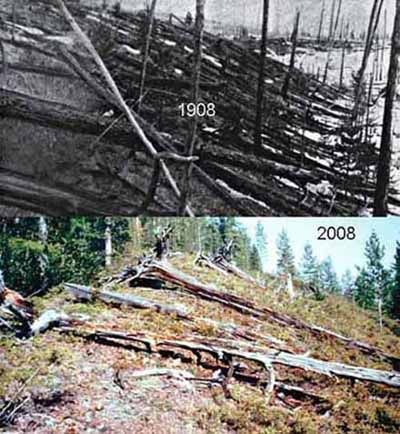
© UnknownTrees felled by the Tunguska airblast
1910 - 27 April - Mexico - Giant meteor bursts, falls in mountains, starts forest fire.
1911 - 16 June - Kilbourn, Wisconsin - Meteorite struck barn
1911 - 28 June - Nakhla, Egypt - Dog struck and killed by meteorite
1912 - 19 July - Holbrook, Arizona - Building struck; 14,000 stones fell; man missed by a few meters
1914 - 9 Jan. - W. France - Meteor explosions break windows
1914 - 22 Nov - Batavia, New York - Meteorites damage farm
1916 - 18 Jan. - Baxter, Missouri - Building struck
1917 - 3 Dec - Strathmore, Scotland - Building struck
1918 - 30 June - Richardton, N. Dakota - Building struck
1919 - 26 Nov. - Southern Michigan, Northern Indiana - Airburst: A gigantic meteor was seen approaching from the east. A brilliant flash of light, thunder and an earthquake lasting 3 minutes were reported. Considerable damage to property and broken windows were reported over a very large area as well as disruption to telegraph, telephone and electrical power systems. [entry added 3/12/13, source]
1921 - 15 July - Berkshire Hills, Mass. - Meteor starts fire in Berkshires
1921 - 21 Dec. - Beirut, Syria - Building hit
1922 - 2 Feb. - Baldwyn, Mississippi - Man missed by 3 meters
1922 - 24 April - Barnegat, New Jersey - Rocked buildings, shattered windows, clouds of noxious gas - overhead explosion of comet fragment.
1922 - 30 May - Nagai, Japan - Person missed by several meters
1924 - 6 July - Johnstown, Colorado - Man missed being hit by 1 meter
1927 - 28 April - Aba, Japan - Girl struck and injured by "dubious" (?) meteorite
1929 - 8 Dec. Zvezvan, Yugoslavia - Meteor hits bridal party, kills 1
1930 - 13 Aug. - Brazil - Airburst (yield: 0.1-5.0 kt): The "Rio Curaca event." Brazlilian "Tunguska event"; fire and "depopulation" - "An ear-piercing "whistling" sound, which might be understood as being a manifestation of the electrophonic phenomena which have been discussed in WGN over the past few years; the sun appearing to be "blood-red" before the explosion. The event occurred at about 8h local time, so that the bolide probably came from the sunward side of the earth. If the object were spawning dust and meteoroids-- that is, it was cometary in nature--then, since low-inclination, eccentric orbits produce radiants close to the sun, it might be that the solar coloration (which, in this explanation, would have been witnessed elsewhere) was due to such dust in the line of sight to the sun. In short, the earth was within the tail of the small comet. There was a fall of fine ash prior to the explosion, which covered the surrounding vegetation with a blanket of white. [entry updated 3/12/13]
1931 - 10 July - Malinta, Ohio - Blast, crater, smell of sulfur, windows broken in farmhouse; four telephone poles snapped, wires down; overhead cometary fragment explosion
1931 - 8 Sept. - Hagerstown, Maryland - Meteor crashes through roof in Hagerstown
1932 - 4 Aug. - Sao Christovao, Brazil - Fall destroys warehouse roof
1932 - 10 Aug - Archie, Missouri - Homestead struck, person missed by less than 1 meter
1932 - 8 Dec. - Arroyomolinos de León, Spain - Airburst (yield: 190 kt, height: 15.7 km) [entry added 3/12/13, source]
1933 - 24 Feb. - Stratford, Texas - Bright fireball, 4-lb metallic mass falls, grass burned
1933 - 8 Aug. - Sioux Co., Nebraska - Man missed by a few meters.
1934 - 16 Feb. - Texas - Pilot swerves to avoid crash with fireball
1934 - 18 Feb - Seville, Spain - House struck, burned.
1934 - 28 Sept. - California - Pilot escapes fireball shower (one assumes this means he performed evasive maneuvers)
1935 - 11/12 March - Lowicz, Poland - Sighting of of a very bright fireball, sound of loud thunderclaps, and meteorite falls (total weight estimated at 60 kg). Two fragments fell into the yard of one man, 30-40 m away from him. [Entry added 3/4/2013]
1935 - 11 Aug. - Briggsdale, Colorado - Man narrowly missed by meteorite
1935 - 11 Dec. - 21h local time - British Guyana - Lat: 2 deg 10min North, Long: 59 deg 10 min West, close to Marudi Mountain. A report from Serge A. Korff of the Bartol Research Foundation, Franklin Institute (Delaware, USA) suggested that the region of devastation might be greater than that involved in the Tunguska event itself. Eye-witness accounts were n accord with a large meteoroid/small asteroid entry, with a body passing overhead accompanied by a terrific roar (presumably electrophonic effects), later concussions, and the sky being lit up like daylight. A local aircraft operator, Art Williams, reported seeing an area of forest more than twenty miles (32 kilometers) in extent which had been destroyed, and he later stated that the shattered jungle was elongated rather than circular, as occurred at Tunguska and would be expected from the air blast caused by an object entering away from the vertical (the most likely entry angle for all cosmic projectiles is 45 degrees).
1936 - 14 Mar. - Red Bank, New Jersey - Meteorite through shed roof
1936 - 2 Apr. -Yurtuk, USSR - Building struck
1936 - 19 Oct. - Newfoundland - Fisherman's boat set on fire by meteorite
1938 - 31 Mar. - Kasamatsu, Japan - Meteorite pierces roof of ship
1938 - 16 Jun. - Pantar, Phillipines - Several buildings struck
1938 - 24 Jun. - Chicora, Pennsylvania - Airburst: A cow struck and injured. The fireball, enveloped in a huge 'cloud' produced thunder-like sounds. The meteorite weighed an estimated 625 tons and exploded approximately 12 miles above the Earth's surface. [Entry updated 3/9/2013]
1938 - 29 Sep. - Benld, Illinois - Garage and car struck by 4-lb stone
1941 - 9 Apr. - Ural mountains, near Chelyabinsk, Russia - Airburst: Katavsky bolide. Residents of several localities had seen a fireball flying at a high speed in the dark sky, followed by roaring likened to the sound of a speeding steam locomotive. Fragments were left as a result of the event. [entry added 3/12/13, source]
1941 - 10 Jul. - Black Moshannon Park, Pennsylvania - Person missed by 1 m
1942 - 6 Apr. - Pollen, Norway - Person missed by 1 m
1940s - Qatar - A crater, believed to have been created by the impact of a falling meteor, found near Dukhan. Sheikh Salman bin Jabor al-Thani, head of the astronomical department at Qatar Scientific Club, said yesterday the club believed that the meteor had hit Qatar in the 1940s. The club started a search for evidence three years ago because of stories of a "falling star" told by people of that era. The club took the help of Google Earth in the search. They succeeded in locating five craters, which were just visible on the surface.
1946 - 16 May - Santa Ana, Nuevo Leon - Meteorite destroys many houses, injures 28
1946 - 30 Nov. - Colford, Gloucestershire, UK - Telephones knocked out, boy knocked off bicycle
1947 - 12 Feb. - Sikhote Alin Mountains, Vladivostok (eastern Siberia) - Airburst (yield: 10 kt): An iron meteorite that broke up only about 5 miles above the earth rained iron. It produced over 100 craters with the largest being around 85 feet in diameter. The strewnfield covered an area of about 1 mile by a half mile. There were no fires or similar destruction like that found at Tunguska. Shredded trees and broken branches mostly. A total of 23 tons of meteorites were recovered and it's been estimated it's total mass was around 70 tons when it broke up. [entry updated 3/12/13]
1949 - 21 Sep. - Beddgelert, Wales - Building struck
1949 - 20 Nov. - Kochi, Japan - Hot meteoritic stone enters house through window
1950 - 23 May. - Madhipura, India - Building struck
1950 - 20 Sept. -Murray, Kentucky - Several buildings struck
1950 - 10 Dec. - St. Louis, Missouri - Car struck
1953 - 03 Mar. - Pecklesheim, FRG - Person missed by several meters
1954 - 07 Jan. - Dieppe, France - Meteorite-building explosion, smashed windows
1954 - 28 Nov. - Sylacauga, Alabama - Mrs. Annie Hodges struck by 4-kg meteorite that crashed through roof, destroyed radio
1955 - 17 Jan. - Kirkland, Washington - Two irons break through amateur astronomer's observatory dome; one sets a fire.
1955 - one of the few documented case of a person being hit by a meteorite occurred. (Source - need more details)
1956 - 29 Feb. -Centerville, S. Dakota - Building hit
1959 - 13 Oct. -Hamlet, Indiana - Building hit
1961 - 23 Feb. -Ras Tanura, Saudi Arabia - Loading dock struck
1961 - 6 Sept. -Bells, Texas - Meteorite strikes rook of house
1962 - 26 Apr. -Kiel, FRG - Building hit
1963 - Massachusetts - meteorite fell (need more details on this one.)
1963 - 3 Aug. - 1,900 km south of South Africa - Airburst (yield 176-356 kt): A bolide was detected infrasonically approximately 1,100 kilometres (680 mi) west-south-west of the Prince Edward Islands off the coast of South Africa by a U.S. government instrument network designed to detect atmospheric explosions. [entry added 3/12/13, source]
1965 - 31 Mar. - Revelstoke, BC - airburst (yield: 0.6 kt, height: 13 km): 1 gram fragment found. [entry added 3/12/13, source]
1965 - 24 Dec. - Barwell, England - Two buildings struck and a car struck
1966 - 17 Sept. - Lake Huran, Michigan-Ontario - airburst (yield: 0.6 kt, height: 13 km) [entry added 3/12/13, source]
1967 - 5 Feb. - Vilna, Alberta - Airburst (yield: 0.6 kt, height: 13 km): Two very small fragments found - 48 milligrams (0.0017 oz) and 94 milligrams (0.0033 oz). Stored at University of Alberta, in Edmonton. [entry added 3/12/13, source]
1967 - 11 Jul. - Denver, Colorado - Building struck
1968 - 12 Apr. - Schenectady, New York - House hit
1969 - 25 Apr. - Bovedy, N. Ireland - Building hit
1969 - 7 Aug. - Andreevka, USSR - Building hit
1969 - 16 Sept. - Suchy Dul, Czechoslovakia - Building hit
1969 - 28 Sept. - Murchison, Australia - Building hit
1971 - 8 Apr. - Wethersfield, Connecticut - House struck by meteorite
1971 - 2 Aug. - Havero, Finland - Building hit
1972 - 10 August - Utah, U.S., Alberta, Canada - The Great Daylight 1972 Fireball (or US19720810) - an Earth grazer meteoroid passed within 57 km of the surface of the Earth at 20:29 UTC on August 10, 1972, or 1.01 Earth radii from the centre of the Earth. It entered the Earth's atmosphere in daylight over Utah, United States (1430 local time) and passed northwards leaving the atmosphere over Alberta, Canada. It was seen by many people, recorded on film and by space borne sensors. Analysis of its appearance and trajectory showed it was a meteoroid about 2 to 10 metres in diameter in the Apollo asteroid class in an orbit that would make a subsequent close approach to Earth in August 1997. In 1994 Zdenek Ceplecha re-analysed the data and suggested the passage would have reduced the meteoroid's mass to about a third or half of its original mass. The meteoroid's 100 second passage through the atmosphere reduced its velocity by about 800 metres per second and the whole encounter significantly changed its orbital inclination from 15 degrees to 8 degrees.
1973 - 15 Mar. -San Juan Capistrano, California - Building hit
1973 - 27 Oct. -Canon City, Colorado - Building hit
1974 - 18 Aug. -Naragh, Iran - Building hit
1977 - 31 Jan. -Louisville, Kentucky - Three buildings and a car struck
1979 - 7 Jun. -Cilimus, Indonesia - Meteorite fell in garden
1979 - 22 Sept. - The Vela Incident (sometimes known as the South Atlantic Flash) - The flash was detected on 22 September 1979, at 00:53 GMT, by a US Vela satellite that was specifically developed to detect nuclear explosions. The satellite reported the characteristic double flash (a very fast and very bright flash, then a longer and less-bright one) of an atmospheric nuclear explosion of two to three kilotons, in the Indian Ocean between Bouvet Island and the Prince Edward Islands at 47° S 40° E. Hydrophones operated by the U.S. Navy detected a signal which was consistent with a small nuclear explosion on or slightly under the surface of the water near the Prince Edward Islands. The radio telescope at Arecibo, Puerto Rico, also detected an anomalous traveling ionospheric disturbance at the same time. "There remains uncertainty about whether the South Atlantic flash in September 1979 recorded by optical sensors on the U.S. Vela satellite was a nuclear detonation and, if so, to whom it belonged."
1981 - 13 Jun. -Salem, Oregon - Building hit
1982 - 8 Nov. -Wethersfield, Connecticut - Pierced roof of house
1984 - 15 Jun. - Nantong, PRC - Man missed by 7 m
1984 - 30 Jun. -Aomori, Japan - Building struck
1984 - 22 Aug. -Tomiya, Japan - Two buildings hit
1984 - 30 Sept. - Binnigup, Australia - Two sunbathers missed by 5 m
1984 - 5 Dec. -Cuneo, Italy - Strong explosion, building flash; windows broken; daytime fireball "bright as Sun"
1984 - 10 Dec. -Claxton, Georgia - Mailbox destroyed by meteorite
1985 - 6 Jan. -La Criolla, Argentina - Farmhouse roof pierced, door smashed; 9.5-kg stone misses woman by 2 m
1985 - 26 June - Hartford, Conn. - a 1,500-pound slab of ice, six feet long and eight inches thick flattened a picket fence. The ground shook with the impact. A 13-year-old boy and his friend were standing 10 feet away.
1986 - 29 Jul. -Kokubunji, Japan - Several buildings hit
1988 - 1 Mar. -Trebbin, GDR - Greenhouse struck by meteorite
1988 - 18 May -Torino, Italy - Building struck
1989 - 12 Jun. -Opotiki, New Zealand - Building hit
1989 - 15 Aug. -Sixiangkou, PRC - Building hit
1990 - 7 Apr. -Enschede, Netherlands - House hit by believed fragment of Midas
1990 - 2 Jul. -Masvingo, Zimbabwe - Person missed by 5 m
1991 - Tahara, Japan - Meteorite struck deck of car-transport ship; made crater
1991 - 31 Aug. - Noblesville, Indiana - Meteorite fall missed two boys by 3.5 m
1992 - 14 Aug. - Mbale, Uganda - Forty-eight stones fall; roofs damaged, boy struck on head
1992 - 9 Oct. - Peerskill, New York - Car trunk, floor pierced by meteorite
1993 - 19 Jan. - Lugo, Northern Italy - airburst (yield >10 kt, height: 30 km): Assumed to be a meteoroid airburst caused by the breakup of a low density meteroid travelling approximately 26 km/s. [entry added 3/12/13, source]
1994 - 18 Jan. - Cando, Spain - Airburst: An explosion that occurred in the village of Cando, Spain, in the morning of January 18, 1994. There were no casualties in this incident, which has been described as being like a small Tunguska event. Witnesses claim to have seen a fireball in the sky lasting for almost one minute. A possible explosion site was established when a local resident called the University of Santiago de Compostela to report an unknown gouge in a hillside close to the village. Up to 200 m³ of terrain was missing and trees were found displaced 100 m down the hill.
1994 - 1 Feb. - 300 km south of Kosrae, Micronesia - Airburst (yield: 11 kt, height: 21-34 km): Marshall Islands fireball. Two fragments exploded at 34 km and 21 km of altitude. This impact was observed by space based infrared (IR) sensors operated by the U.S. Department of Defense (DOD) and by visible wavelength sensors operated by the U.S. Department of Energy (DOE). [entry added 3/12/13, source]
1994 - 16 July - Fragments of Comet Shoemaker-Levy begin impacting Jupiter.
1994 - 20 Oct. - Coleman, Michigan - Meteorite penetrated roof of house (1997)
1995 - Neagari, Japan - Meteorite penetrated car trunk
1996 - 26 Nov. - Honduras - According to the Associated Press: "A meteorite slammed into a sparsely populated area of Honduras last month, terrifying residents and leaving a 165-foot-wide crater, scientists confirmed Sunday. Near San Luis, in the western province of Santa Barbara.
1997 - 11 Apr. - Chambrey, France - Meteorite penetrated roof of car; set fire
1997 - 9 Dec. - 150 km south of Nuuk, Greenland - Airburst (yield: >0.064 kt, height: >25 km): One airburst at 46 km, three more breakups detected between 25 and 30 km. No remains found so far. Yield only based on luminosity, i.e. the total energy might have been considerably larger. [entry added 3/12/13, source]
1998 - 13 Jun. - Portales, New Mexico - Meteorite penetrated barn roof
1998 - 12 Jul. - Kitchener, Ontario - Meteorite falls 1 m from golfer
2000 - January - Canada - a 150-tonne meteoroid lit the skies over Whitehorse, and exploded over a lake about 100 kilometres south of the city. The Tagish Lake meteor produced a treasure of information about a rare kind of meteorite.
2000 - January - Iberian peninsula - ice chunks weighing up to 6.6 pounds rained on Spain for 10 days causing extensive damage to cars and an industrial storage facility. At first, scientists thought the phenomenon was unique to Spain. During the past three years, however, they've accumulated strong evidence that megacryometeors are falling all around the globe. More than 50 falls have been confirmed, and researchers believe that's a small fraction of the actual number, since others may hit unoccupied areas or melt before discovery. Most megacrymeteor falls occur in January, February and March. Megacryometeors show the telltale onionskin layering seen in hailstones. They also contain dust particles and air pockets found in hail. But they are formed in cloudless skies, a notion that defies research on hail formation.
2001 - 25 July to 23 Sept. - Kerala, India - red rain sporadically fell; staining clothes with an appearance similar to that of blood. Yellow, green, and black rain was also reported. The rains were the result of the atmospheric disintegration of a comet, according to a study conducted at the School of Pure and Applied Physics of the MG University by Dr Godfrey Louis and his student Santosh Kumar. The red rain cells were devoid of DNA which suggests their extra-terrestrial origin. The findings published in the international journal Astrophysics and Space Science state that the cometery fragment contained dense collection of red cells.
2002 - 6 June - asteroid/comet explosion (airburst) over the Mediterranean, 230 km NNE of Benghazi, Libya (yield: 12-20 kt). Estimated at five to 10 meters in diameter, it released a burst of energy comparable to the nuclear bomb dropped on Hiroshima, Japan. Had it exploded over Pakistan or India, which would have devastated both regions and caused over 10 million deaths. [entry updated 3/12/13]
2002 - 25 Sept. - near Bodaibo (Bodaybo), near Irkutsk, Siberia - 1:50 am - Airburst (yield: 0.2-0.5 kt): Eye-witness accounts of the event reported a large luminous object falling to Earth near Bodiabo in Siberia. Hunters in the region have also reported the existence of a crater surrounded by burnt forest suggesting that an impact event had occurred. The event was detected by near-by geophones as a moderate-earthquake. The event was also detected by a U.S. anti-missile defense military satellite. Some attempts were made to define the magnitude of the explosion. US military analysts calculated it was between 0.2 - 0.5 kilotons, while Russian physicist Andrey Olkhovatov estimates it at 4 - 5 kilotons. Information about the event appeared in the mass media and among scientists after only a week. Another report says it occurred on the 25th of September at 10:00 p.m. [entry updated 3/12/13]
2004 - June - Auckland, New Zealand - Meteor crashes through roof of home, damages sofa. The meteorite was a four billion-year-old 1.3 kg rock. "There was this huge bang and a cloud of dust and debris went through the front room. I thought a car had hit the house." In the only account in New Zealand of a meteorite crashing into a house, the chunk of space rock punched a hole through the roof of the Archers' home, bounced off their couch, ricocheted off the ceiling and back on to the couch before ending up on the floor.
2004 - 4 Sept. - Airburst (yield: 12 kt, height: 28-30 km): A small asteroid exploded in the stratosphere above Antarctica depositing sufficient micron-sized dust particles to cause 'local cooling, and much speculation as to the possible effects on the ozone layer. Event was observed by military satellites and by infrasound stations. [entry updated 3/12/13, source]
2004 - 26 December - Southeast Asia - an undersea earthquake occurred at 00:58:53 UTC with an epicentre off the west coast of Sumatra, Indonesia. It has been said that the earthquake was caused by subduction and triggered a series of devastating tsunamis, however, a comet/asteroid strike cannot be ruled out. Along the coasts of most landmasses bordering the Indian Ocean, more than 225,000 people in eleven countries were killed. Coastal communities were inundated with waves up to 30 meters (100 feet) high. It was one of the deadliest natural disasters in history. Indonesia, Sri Lanka, India, and Thailand were hardest hit. See: Mega-tsunami hit southeast Asia 700 years ago and compare with the events of 1430 above.
2006 - 1 Feb. - Canada - In Calgary on February 1st, 20 people reported seeing a fireball, an exceptionally bright meteor, streak across the sky just before 7 a.m., lasting for several seconds before breaking up into fragments. It was estimated that remnants of the meteorite landed about 400 km south of Calgary somewhere in Montana about two minutes after it appeared as a ball of fire.
2006 - 1 Feb. - Bangladesh - A 'meteor' from outer space fell with a big bang on a field in Singpara village of sadar upazila yesterday afternoon creating panic and curiosity among people. No one was reported hurt. On information Superintendent of Police Khandker Golam Farooq rushed to the spot and asked his companions and villagers to dig the earth near the house of one Fazlur Rahman from where smoke was still emitting. To their amazement they found a lead-like black material three feet below the earth. Hot and weighing 2.5kg, the triangular material looked like a mortar shell, witnesses said. The meteor was kept in custody of the Thakurgaon Police Station.
2006 - 17, 20 Feb. - Scotland - The hunt is on for the crash sites of two meteors near Stirling Castle. Scientists have been spurred into action by reports of spectacular "balls of fire" falling in the area. If discovered, they would be the first meteorites confirmed to have hit north of the Border for almost 100 years. The incidents, reported by several witnesses, were on the evenings of Friday, February 17 and the following Monday, February 20. "Although meteorite falls are rare everywhere, Scotland seems to have escaped remarkably lightly. There have only been four meteorites recovered from Scotland, compared with more than 18 from England and Wales. Statistically, we are overdue another one."
2006 - 12 April - Australia - A Perth astronomer says a spectacular light show in the sky 12/3 was a meteor. Sightings were made as far south as Albany and inland through the Wheat Belt. It lit up the countryside for hundreds of kilometres around the south-west of Western Australia." Witnesses say the the sky lit up about 9:00pm AEDT, and the light was followed by a thundering sound that shook buildings.
2006 - 4 May - TEXAS - Astronomers said a large meteor shower crossed straight over El Paso just before 9:45 p.m. Thursday the 4th of May. One meteor was so large that it cast an orange glow against the mountain. "The animals were going wild, the horses were bucking and dogs were barking and howling and then, all of a sudden right above my house, there was a big bright light and then just 'Bang!' And it lit up the five acres that are around us, and then I covered my eyes like this because it was bright and when it got past I saw there was a tail and it just went 'Shhhh' toward the Hueco Mountains."
2006 - 2 June - Minnesota, Wisconsin, North Dakota and Canada - a fireball was spotted estimated to be some 20 miles above the Earth's surface. A sonic boom was heard in the Lake of the Woods area of Minnesota, so there may be some pieces of the meteor that survived the fall.
2006 - 25 June - Pennsylvania - Residents of the Tuscarawas Valley who heard a deafening boom about 12:40 a.m. Monday the 19th and stepped outside likely saw what one person described as "a marvelous fireball with red streaks in the sky." It probably was a meteor falling through the atmosphere. Numerous callers reported a large red fireball. Several said their homes shook. New Philadelphia police said they received reports from several callers who witnessed the fireball or heard the boom. One woman described it as "a blue light that lit up the sky and went down." Police in Dover said multiple callers reported they heard a loud bang and something rattled their windows. Air Traffic Command in Washington, D.C. confirmed that Cleveland's control center was checking into a meteor shower that occurred within its air space.
2006 - 10 July - South Africa - An ice ball that landed in Douglasdale, South Africa, might be one of the first 'megacryometeors' recorded in Africa. The ice ball, which landed on the pavement in suburban Douglasdale last week, was about the size of a microwave oven. The impact of the ice ball's fall created a small crater on the pavement, which was covered with pieces of broken ice. Despite sharing many chemical characteristics with hail, ice balls are formed under clear-sky conditions. Ice balls have been recorded since the 19th century. They have the potential to damage people, buildings and cars, but no injuries were reported as a result of this one.
2006 - 14 July - Norway - At 10:20am a bus driver from Ås, south of Oslo, was sitting in the outhouse at his holiday cabin near Rygge on the 14th of July when he heard an enormous blast. Right after that, some particles from a meteor that exploded over the Oslo area rained down just outside. He said he didn't think too much about the surprising blast at first, dismissing it as probably coming from an exercise at a nearby military air station at Rygge. But he said the blast and the rumbling it caused was terrible. He was just hooking the door when he heard a new noise, a whistling sort of sound, followed by a new bang on some aluminum plates lying near the outhouse. Sure enough, it was particles from a meteor that exploded somewhere over the Oslo Fjord area on Friday morning. Astronomers confirm Martinsen's remarkable discovery of meteorite particles on his property. "This is Norway's 14th meteorite, but we've never heard about a meteorite landing so close to a person before." -- A family from Moss, south of Oslo, came home from their summer holidays to find a meteorite in their garden. It's another remnant of the meteor that exploded over the Oslo Fjord area on the 14th of JUly. Astronomers in Norway are calling the discovery of meteorites around southeast Norway "incredible," and urge local residents to keep looking for more. "Two branches on our plum tree were broken. I lifted them up and there lay this stone." It had made a hole measuring about seven centimeters in his lawn.
2006 - 12 Sept. - New Zealand - A small piece of rock that has been found in a paddock in New Zealand may be a piece of the meteorite that streaked across the sky there Tuesday the 12th, panicking residents who flooded emergency hotlines. A farmer found a 10cm by 5cm piece of "almost weightless" rock in his field today near the town of Dunsandel, south of Christchurch. It has been sent to New Zealand's National Radiation Laboratory for analysis. The meteorite tore across the sky over the northern half of the South Island in the afternoon, leaving a bright, burning trial behind it and causing a sonic boom that rattled houses and shook the ground. It then apparently erupted into a fireball, sending forth a thick puff of smoke. People were sent running from the homes and offices when they heard the boom, fearing buildings could collapse. The sonic boom was registered on earthquake-detecting equipment. The boom meant the meteorite was probably travelling "very low". It was probably about the size of a basketball as it shredded through the sky and became a "terminal fireball" at a speed of about 40,000kph. "If this had happened at night, it would have lit up the whole countryside."
2006 - 10 Oct. - A fire that destroyed a cottage near Bonn and injured a 77-year-old man was probably caused by a meteor and witnesses saw an arc of blazing light in the sky, German police said on Friday. Burkhard Rick, a spokesman for the police in Siegburg east of Bonn, said the fire gutted the cottage and badly burnt the man's hands and face in the incident on October 10.
2006 - 1 Dec. - NASA reports - Meteoroids are smashing into the Moon a lot more often than anyone expected. - That's the tentative conclusion of Bill Cooke, head of NASA's Meteoroid Environment Office, after his team observed two Leonids hitting the Moon on Nov. 17, 2006. "We've now seen 11 and possibly 12 lunar impacts since we started monitoring the Moon one year ago," says Cooke. "That's about four times more hits than our computer models predicted."
2007 - January - Altai Region, Russia - Another expedition arrived to the Altai Republic to search for meteorite, which has fallen this January, and to talk with people, who witnessed this event. Expedition crew will visit Uglovsky and Egorievsky districts, where an unknown celestial body has fallen. - Later report: Russian social science and research expedition "Kosmopoisk" has sent four meteorite fragments found in Altai to Moscow laboratory. Research, carried out in field, showed that there exists high probability that two stones out of four are real meteorite fragments. The expedition found a meteorite crater 1.5 kilometer away from their camp, but nasty weather prevented them from detailed studying of said crater.
2007 - January - Tampa, Florida - a 200-pound chunk of ice streaked through the clear Florida sky and landed in the back seat of a really nice red Ford Mustang. The car was totaled.
2007 - 4 Jan - Authorities were trying to identify a mysterious metallic object that crashed through the roof of a house in eastern New Jersey. Nobody was injured when the golf-ball sized object, weighing nearly as much as a can of soup, struck the home and embedded itself in a wall Tuesday night. ... Approximately 20 to 50 rock-like objects fall every day over the entire planet, said Carlton Pryor, a professor of astronomy at Rutgers University. "It's not all that uncommon to have rocks rain down from heaven," said Pryor, who had not seen the object that struck the Monmouth County home. "These are usually rocky or a mixture of rock and metal."
2007 - 10 January - Russia - a meteorite fell in January in the Altai Territory in southern Siberia and searchers found an extraterrestrial substance which could be meteorite fragments. "We have collected about 50 samples, and vitreous threads (traces of comet substance) were discovered in the first of them using a microscope." Local motorists and residents witnessed the impact of a fiery ball, which eventually ended in a loud sound resembling an explosion.
2007 - 24 Jan. - Virginian, U.S. - Giles County residents were a little shaken after a tremor-like event, others say they heard a loud "thunder-like" sound. Virginia Tech researchers say they received several calls about a meteor sighting the same time of the tremors. The bizarre incident took place around 8pm. Researchers say the seismic station in Giles County did get a very short but intense seismic signal.
2007 - 1 Feb. - Turkey - Many persons from Bodrum, Milas and Didim cities heard an enormous explosion followed by dozens of sounds like gunshots, several in a short interval. Other people as far as 200 km from Didim saw a fireball indicating that the meteorite fell in a southerly direction in the vicinity of the southwestern coastline on the Aegean Sea. Many rocks probably fell into the sea. One (D1) weighing about 500 g fell about ten meters from Mr Abdullah Aritürk at Yesilkent, a small district of Didim. He kept about half of it and gave 210 g to Prof. Mehmet Emin Özel of Çanakkale Onsekiz Mart University, Physics Department. Two other samples (D2 = 846 g and D3 = 2340 g) were found one after the other by Mr Hayati Ertugrul and collected by Ms Özlem Kocahan, PhD student, and Prof. Özel. Two small pieces of D1 and D2 were brought to the MNHN in Paris by Mr Mesut Kasikci, the only Turkish collector, living in France, who first informed academic research institutions of the recent fall. [entry corrected 8/4/22, source]
2007 - 4 Feb. - Midwestern U.S. - Scores of people all over the Midwest and Upper Midwestern United States reported seeing flames and fiery explosions in the sky Sunday night. From southeastern Wisconsin to as far as Des Moines, Iowa and St. Louis, people reported seeing balls of fire, possibly meteors, streaking across the sky on Sunday night. "We had a pilot reporting seeing a meteor". Reports came from residents in central Missouri, Illinois, Kansas, Wisconsin and Minnesota.
2007 - 15 Feb. - Ohio - Something happened at around 9 p.m. that a lot of people heard. But nobody seems to have any idea what it was. "It" was a loud bang, something loud enough to be heard all over the county, and loud enough to make small objects move in houses. Rumors range from an earthquake to a meteor strike, a sonic boom to something ice-related. While we may never know for sure, at least one scientist believes the meteor could be the answer. There's no evidence to suggest an earthquake could have caused the bang, especially not over the range specified. One man said he saw a meteor with a relatively long trail, with red, green and gold coloration. It was headed east to west and lasted about three seconds; after it faded, the sonic boom washed over him. "I saw it first. It was the most eerie, cool, scary, wonderful thing. You just see this dragon tail going across the sky. All of a sudden, everything goes boom."
2007 - 22 Feb. - Rajasthan, India - Three people were killed and four injured in a mysterious blast in a village in India's northern Rajasthan state Thursday that villagers claim was caused by a meteorite, news reports said. Residents of Banchola village in Bundi district, about 200 kilometres south of Rajasthan capital Jaipur, said the victims were sitting with some iron scrap in an open field when an "object" fell from the sky and hit them, IANS news agency reported.
2007 - 23 Feb. - Panama - Panamanian geologists found a meteorite at Rio Hato, a coastal town west of the capital Panama City. The meteorite fell onto Rio Hato's beach on Friday. The landing was witnessed by a security guard, who described it as a ball of fire crashing down from the sky onto the sand. The 4.2 kg red object, measuring 20 cm in diameter, was to be X-rayed for more details. The meteorite shows burn marks on its exterior, and appears to be mainly carbon-based, in contrast to most meteorites, which mainly contain iron.
2007 - 15 Mar. - What Richard Yip-Chuck saw fall into a farmer's field Sunday evening looked like a long, white ball with orange sparks shooting off the back. The Holland Landing resident was driving along Hwy. 7 with his wife, Ele, and sons Kyle, 12, and 10-year-old Dylan, when they saw what looked like a fireball plummet to earth.
2007 - 29 Mar - Flaming debris of a possible meteor almost hit a plane - The pilots of a Chilean passenger jet reported seeing flaming debris fall past their aircraft as it approached the airport at Auckland, New Zealand. The captain "made visual contact with incandescent fragments several kilometres away". The pilots reported the near-miss to air traffic controllers, reportedly saying the noise of the debris breaking the sound barrier could be heard above the roar of his aircraft's engines.
2007 - 10 May - Spain - Fireball spotted across central Spain. Scientists think some fragments may have fallen to earth in the Ciudad Real area. A fireball fell across the centre of the country on Thursday night with sightings in Cuenca, Toledo, Ciudad Real and Valladolid. Scientists believe it was a meteorite and say it's quite a normal phenomenon, possibly a fragment from a comet which fell from earth orbit.
2007 - 14 May - Hubbardton, Vermont - Recorded as a 2.1 temblor on the Richter scale, a quake hit at 4:10 a.m. One Hubbardton resident who said he was wide awake at 4 a.m. said he not only felt the earthquake, he saw what caused it. He said he saw something in the sky to the northeast of Lake Hortonia. He believes he saw a meteorite and that's what triggered the earthquake. "It was like a streak of fire. I've heard meteorites hit before and that was what it sounded like. It was no earthquake, it was a meteor."
2007 - 26 May - Woburn, Mass. - Meteorite punched a hole through a warehouse roof.
2007 - 7 June - Norway - A large meteorite struck in northern Norway this week, landing with an impact an astronomer compared to the atomic bomb used at Hiroshima. The meteorite appeared as a ball of fire just after 2 a.m. Wednesday, June 7th, visible across several hundred miles in the sunlit summer sky above the Arctic Circle. 'I saw a brilliant flash of light in the sky, and this became a light with a tail of smoke. I heard the bang seven minutes later. It sounded like when you set off a solid charge of dynamite a kilometer (0.62 miles) away.' The meteor struck a mountainside in Reisadalen. The country's leading astronomer said he expects the meteor to prove to be the largest to hit Norway in modern times, even bigger than the 198-pound Alta meteorite of 1904. 'If the meteorite was as large as it seems to have been, we can compare it to the Hiroshima bomb. Of course the meteorite is not radioactive, but in explosive force we may be able to compare it to the bomb.'
2007 - 10 June - Sri Lanka - The strange objects that lit the night skies on June 10 have now been confirmed as meteors. "This is the first time that meteors of such magnitude have fallen in Sri Lanka. The shockwaves and vibrations have been heard throughout the country, from Galle to Puttalam. A Senior Consultant believes that two large meteoroids entered the atmosphere, the larger one splitting into two and the smaller one into about 25 fragments. The loud explosions were some of the particles exploding, probably about 50 to 100 km above the ground. In Kovinna, Andiambalama, at 9.05 p.m. on the 10th, a woman had noticed something unusual in the western sky. A bright light, almost as large as the full moon, appeared to be moving towards her in a wide arc. Alarmed by thoughts of terrorist air attacks, she called out to her neighbour. Together they watched fearfully as the glowing object drew closer, landed on the roof and vanished completely. A few minutes later the air vibrated with a loud explosion. The next day they discovered that parts of the asbestos sheets on the roof were charred and cracked. A few pieces of rock and sand were scattered around the damaged area. Similar incidents were reported around the country that night. Several people in areas such as Puttalam, Maho and Bingiriya also noted the appearance of the bright light in the sky as well as the loud explosion. In Kimbulapitiya a woman watched a flaming object land on a house and heard the booming sounds soon afterwards. In Campbell Place, Dehiwala, the roofs of two buildings were damaged, and a loud noise was heard. "24 asbestos sheets were broken."
2007 - 6 July - Cali, Colombia, S. America - an incoming object broke apart in the lower atmosphere with a trio of ferocious explosions that shattered windows and shook the ground violently. Moments later, stones rained from the sky and pelted homes in the poor barrios surrounding the city. Some smashed through the roofs of homes. Recovered objects were chondritic (rocky) meteorite.
2007 - 26 July - Iowa - 5:30AM - A Dubuque woman said she is lucky to be alive after a 50 pound chunk of white ice crashed through the roof of her home, landing about 15 feet away from where she was standing. She said it sounded like a bomb exploded when the massive ball of ice hit her roof. Other large chunks of ice fell from the sky in this northeast Iowa city, tearing through nearby trees. Dubuque had clear skies at the time the ice fell.
2007 - 1 August - India - Hotipur (Sangrur) village near Khanauri hit the headlines when a meteorite fell in the fields on Wednesday night, leaving many villagers baffled. The police have taken possession of the 8-cm meteorite to hand it over to a three-member team of Geological Survey of India. Curious villagers queued up in the fields to see the "heavenly object", while the farmer, who was the only witness to the fall of the "fireball", said, "I got scared of the big fireball that was coming my way at 8:45 pm on Wednesday night. I ran for cover as I felt that it will fall on me." (May be hoax.)
2007 - 11 Aug. - 12:09 am - Representatives with the Sonora Police Department and both the Tuolumne and Calaveras County Sheriff's Departments say they fielded numerous calls early in the morning in regards to a "loud boom," and "structures shaking." There were several calls from residents who reported seeing "a blue light," just before the "loud boom." The incident reportedly occurred at 12:09am. The Police Department notes that it also received a call from a resident in Tuolumne, in which a female reported seeing what she thought was fireworks, and then something spiraling over her house. Early indication from the law enforcement agencies is that the loud boom was somehow the result of a meteor shower.
2007 - 15 Sept. - Peruvian Highlands - The meteorite's impact sent debris flying up to 820 feet (250 meters) away, with some material landing on the roof of the nearest home 390 feet (120 meters) from the crater. Nearby residents who visited the impact crater complained of headaches and nausea.
2007 - 28 Sept. - Northern Ostrobothnia, Finland - Airburst: Observed as far as northern Lapland. [entry added 3/12/13, source]
2007 - 3 Oct. - Minnesota - Shortly after 2 p.m., people across the Twin Cities reported seeing a "metallic" object or "flaming ball" falling from the sky. Broadcasters and emergency dispatchers got hundreds of calls from people who saw the object traveling from the northeast to the southwest. Residents of Lyon County in far southwestern Minnesota reported a loud boom that might have been connected with the sightings in the Twin Cities. A man who lives near the town of Amiret says it shook his house and sounded like a sonic boom from an F-14 breaking the sound barrier at close range. Coincidentally, at the same time, drivers in the Twin Cities metro were dodging debris in the middle of Interstate 94. Some drivers said the debris fell from the sky shortly after 2:00 p.m. Wednesday.
2008 - 19 Feb. - U.S. Northwest - An apparent meteor streaked through the sky over the Pacific Northwest early Tuesday, drawing reports of bright lights and sonic booms in parts of Washington, Oregon and Idaho. Although a witness reported seeing the object strike the Earth in a remote part of Adams County, in southeast Washington, it still has not been found. People in Washington, Oregon, Idaho, Montana and British Columbia reported seeing the bright fireball streaking across the sky about 5:30 a.m. At least one person said the object exploded on impact in eastern Washington and another report from southeastern Washington said someone felt tremors from the blast.
2008 - 5 Mar. - Ontario, Canada - The Physics and Astronomy Department at Western has a network of all-sky cameras in Southern Ontario that scan the sky monitoring for meteors. Associate Professor Peter Brown, who specializes in the study of meteors and meteorites, says that Wednesday evening (March 5) at 10:59 p.m. EST these cameras captured video of a large fireball and the department has also received a number of calls and emails from people who actually saw the light.
2008 - 8 Mar. - Turkey - A resident of Yaka said he heard a loud roaring noise at around 11:20 a.m. on the day the meteorite fell, sounding as if "a plane had crashed."
"We were amazed to find such a small stone after that thunderous sound. It was black and about 40 centimeters in diameter, weighing three kilograms at most," another said, adding that the meteorite opened a small crater in the ground and created a cloud of dust.
2008 - 10 Mar. - Sudbury, Canada - great balls of fire were seen falling from the sky - While most sightings were reported around 1:30 p.m. near Sudbury, Hagar, Highway 69 North and North Bay, Wayne Lachance spotted something in the sky earlier in the morning. Lachance was driving home to Massey after a night shift at Vale Inco Ltd. when something caught his eye around 7:30 a.m. "I thought it was a real bright star," he said. "It was getting brighter and coming down with sparks." Lachance arrived home and looked outside his bedroom window to see "spirals of smoke" falling.
2008 - 13 Mar. - Moon - Meteorite videotaped hitting the Moon.
2008 - 6 April - Argentina - The space rock reportedly crashed late Sunday somewhere in Entre Rios Province, some 260 miles northwest of Buenos Aires, reports the daily Clarin, which quoted a witness, Milton Blumhagen, a student and astronomy buff: "For three or four seconds I saw an object in flames, changing color until it turned blue when it approached the ground.'' A fire department source said the impact was felt for miles around. No damage was reported.
2008 - 15, 16, 18 April - Illinois - Maybe we had a comet fragment impact or two or three over a period of several nights? Perhaps a couple of overhead explosions and then, later, a ground impact. Read the following stories and judge for yourself:
That would explain booms and earthquake and lights in the sky spread out over three days. Damage Control: Mysterious booms, lights over Indiana were just F-16s
A sonic boom and fireballs and flaming debris that Kokomo-area residents reported seeing in the sky Wednesday night prompted Howard County's police agencies to conduct a two-hour search for what many residents thought was a crashed aircraft.5.4 earthquake rocks Illinois; felt 350 miles away
As it turned out, the fireballs were flares fired by F-16s that are part of the 122nd Fighter Wing, an Indiana Air National Guard unit based at Fort Wayne International Airport. ...
Staff Sgt. Jeff Lowry with Indiana National Guard's headquarters in Indianapolis said the jets taking part in the training are not supposed to exceed the speed of sound, which is about 760 mph, because supersonic speeds produce sonic booms.
He said the 122nd's commander, Col. Jeff Soldner, will investigate why at least one jet reached supersonic speeds Wednesday night over Howard and Tipton counties, and also on Tuesday night over the Logansport area, shaking the ground below. ...
He said F-16 training often involves the aircraft dropping flares from more than 10,000 feet above the ground, a technique that can allow the jets to evade heat-seeking missiles in combat. ...
Logansport Police Chief A.J. Rozzi said he heard a loud sonic boom on Tuesday night, and then heard the sound of a jet high overheard. He said residents also reported seeing fire streaks in the sky.
He said it is common for the 122nd to conduct missions in the area and believes F-16 training almost certainly explains the sights and sounds.
"They've been doing that training for quite a while. I don't know what maneuvers they're actually doing, but they do shoot out streaks of light," he said.
A 5.4 earthquake that appeared to rival the strongest recorded in the region rocked people awake up to 350 miles away early Friday, surprising residents unaccustomed to such a powerful Midwest temblor.UPDATE! 4.5 Magnitude Earthquake Hits Illinois Continuing Series
The quake just before 4:37 a.m. was centered 6 miles from West Salem, Ill., and 66 miles from Evansville, Ind. It was felt in such distant cities as Chicago, Cincinnati and Milwaukee, 350 miles north of the epicenter, but there were no early reports of injuries or significant damage. ....
"You could hear a roaring sound and the whole motel shook, waking up the guests,'' Vibha Ambelal, manager of the Super 8 Motel in Mount Carmel, Illinois, near the epicenter, said in a telephone interview."
A 4.5-magnitude tremor struck southern Illinois on Monday continuing the series of aftershocks initiated by the 5.2 earthquake which hit the region Friday morning, the U.S. Geological Survey (USGS) informed.2008 16 April - Argentina - The Asociación Entrerriana de Astronomía (AEA) [Entre Ríos Astronomy Society, Argentina] has announced that on Wednesday 16th April 2008, at approximately 19:30 hours, was observed a highly luminous object that had all the characteristics of a bolide. This object was sighted from Paraná, Oro Verde and San Benito. According to witnesses, the bolide was intensely bright, with colours fluctuating between green, yellow and red.
This was the 18th earthquake in that series and its epicenter was approximately six miles below ground and about 37 miles (60 km) north-northwest of Evansville, Indiana, or about 131 miles (211 km) east of St. Louis, the USGS revealed. [...]
The 18 aftershock earthquakes which followed Friday's tremor haven't measured more than 3.9 on the Richter scale, but the first one was the biggest to hit shake the region called the Illinois basin-Ozark dome in over 40 years.
It followed a roughly north-east trajectory towards the south-west, with an angle of 75 degrees. One observer has stated that the bolide exploded before disappearing.
It is not possible to discount the idea that this meteor relates to a similar fall which occurred last week over central Entre Ríos province, and which was observed across a wide part of Argentina. The AEA has also received over the past few days many reports of sightings of very luminous objects in different parts from the country, e.g. from Mar del Plata, Tucumán, Zárate, Concordia, Ituzaingó (Prov. de Corrientes), etc.
2008 - 17 April - Argentina - (This may be the same as the previous report on 16 April) A fireball fell somewhere in or nearby Entre Rios, 260 miles northwest of Buenos Aires. Mariano Peter from the Entrerriana Astronomy Association said there were reports from 4 witnesses. One of them described, "a strong light that passed at a high speed through the sky and at a low altitude, going towards the south and then it fell in the distance." Another witness said, "it was very bright and it changed color between green and red."
The first fireball was reported in Entre Rios on April 6th, 2008 (see above). A witness said: "For three or four seconds I saw an object in flames, changing color until it turned blue when it approached the ground.'' A fire department source said the impact was felt for miles around. The next day a fragment of the space rock was recovered.
And now: Smoke chokes Argentina's capital
Buenos Aires, Argentina -- Smoke blanketed the Argentine capital Friday as brush fires apparently set deliberately consumed thousands of acres in the provinces of Buenos Aires and Entre Ríos.2008 - 20 April - Russia - Another overhead explosion? Two killed, 300 left homeless in Russian Far East fires
The smoke, from about 300 fires, is blamed for at least two fatal traffic accidents this week that left eight people dead.
Sections of major highways and the Buenos Aires port, among the busiest in the world, have been closed. Incoming flights to the city's domestic airport, Jorge Newbery Airpark, have been diverted.
The Argentine government has blamed farmers looking to clear their land for crops and grazing for the fires, which are estimated to cover 173,000 acres (70,000 hectares).
"This is the largest fire of this kind that we've ever seen," Argentine Interior Minister Florencio Randazzo said Thursday.
Randazzo called the situation a "disaster."
As of Friday morning, little progress had been made extinguishing the blazes. [...]
Two people have died and 325 people including 18 children have been left homeless by fires that ripped through the Amur Region in Russia's Far East, local emergency services said.Curious how this report is similar to what happened several days ago in Argentina. And again, farmers - they all decided to set fires on the same day - burning grass and high winds are blamed for the vast damage and considerable destruction. We wonder what kind of excuse authorities will invent when this kind of event will happen in a non agricultural area.
The fires began on Sunday evening and continued until Monday morning in seven districts of the region. Locals had set light to dry grass to free land for farming and other purposes, and the flames were spread by high winds, a police source told RIA Novosti.
A total of 104 houses have been destroyed. One of those who died in the fires was a disabled man who was unable to leave his home.
A total of 50 rescuers have been involved in the firefighting operation. People injured in the fires will receive 20,000 rubles ($900) in compensation, local authorities said.
Over 11,000 hectares have been destroyed in an estimated 59 forest fires currently burning in Russia's Far East, the Natural Resources Ministry said.
2008 (April 29) - Willow Creek, California: A magnitude 5.2 earthquake 11 miles ease-southeast of Willow Creek was preceded by a sonic boom. Brenda Simmons, of SkyCrest Lake resort in Burnt Ranch, described it as "a very loud noise [that] lasted 10 seconds max."
2008 (May 23) - Hoshiarpur, India: At 8:45 p.m., petrol pump staff watched a fireball fly through the sky and land in a nearby field, setting the bushes ablaze, after which they rushed to extinguish the fires. A month earlier, a similar object had reportedly fallen in Sangrur district, prompting a Geological Survey of India team to visit and examine the site.
2008 (June 8) - Winsford, U.K: Graham Brooks reported a small meteorite impacted his garden at approximately 10:30 p.m. After hearing a large bang, he and his partner found a golf-ball-sized hole in the ground and a pile of rocky debris that caused an estimated £1,000 worth of damage to their caravan.
2008 (July 1) - San Bernardino Mountains, California: Dozens of witnesses across Southern California saw a glowing yellowish-green object with streaks of debris "moving very fast across the northern sky" and falling near the mountains. Perhaps not coincidentally, the 527,000-acre wildfires of 2008 had been burning since May 22, with several starting up to a month later (June 20), all of which were attributed to lightning and dry thunderstorms. One such fire was in the San Bernardino Mountains, but it is difficult to determine if the fire had been burning before the fireball sighting or not.
2008 (July 31) - Yellowknife, Canada: An unexplained explosion in the Northwest Territories left several whales dead on the shore under a cloud of black smoke.
2008 (August 12) - Orlando, Florida: Between 10 and 10:30 p.m., witnesses heard a loud explosion described as a sonic boom. The sound was followed by a fast-moving fire that destroyed at least four town homes.
2008 (September 9) - Eastern U.S: NASA's SENTINEL all-sky camera picked up 25 bright meteors in a shower lasting four hours. Also known as the delta-Aurigids, the September Perseids come from an unknown comet and have been caught bursting only four times in the last century: 1936, 1986, 1994 and now 2008.
2008 (September 25) - Caltech scientist Paul Bellan was quoted as saying that "The incidence of noctilucent clouds seems to be increasing ..." These luminous clouds are coated with a thin film of sodium and iron, which collect in the upper atmosphere after being blasted off incoming micrometeors, suggesting that the increase of noctilucent clouds may be tied with an increase in micrometeors.
2008 (October 7) - Sudan: NASA scientists at Ames Research Center accurately predicted that a car-sized asteroid would enter the atmosphere 12 hours before it did, the first prediction of its kind. As it entered the Earth's atmosphere, the heat created a spectacular fireball, which was photographed, releasing huge amounts of energy as it disintegrated and exploded in the atmosphere, dozens of kilometers above ground. The asteroid exploded with the energy of around one kiloton, equal to the power of a small nuclear bomb. Remnants of the asteroid were discovered on December 8. Later analysis discovered the presence of amino acids.
2008 (October 8) - Pennsylvania, U.S: At approximately 5:30 a.m. several pieces of ice crashed through the roof of Mary Ann and Perry Foster in their York Township home. One of the pieces had hit Mary Ann's head. Six pounds of ice had created a hole 12 inches in diameter through their roof and ceiling.
2008 (October 12) - India: Over 200 trees were mysteriously felled after a deafening roar was heard near the Sindh Forest Range in Baltal. Earlier that morning, 79 residential houses, 58 cowsheds, eight shops and a local Masjid were reduced to ashes in mysterious fire, which broke out in Chui Draman village of Marwah tehsil. The fire was unexplained.
2008 (October 15) - Ontario, Canada: At 5:28 a.m., all seven cameras of Western University's Southern Ontario Meteor Network recorded a bright, slow fireball. As the Science Daily report put it: "For the second time this year, The University of Western Ontario Meteor Group has captured incredibly rare video footage of a meteor falling to Earth. The team of astronomers suspects the fireball dropped meteorites in a region north of Guelph, Ontario, Canada, that may total as much as a few hundred grams in mass."
2008 (October 28) - Kansas, Nebraska, Colorado, and Maryland, U.S: All four states had reports of a comet in the evening, at approximately 7:00 p.m. Witnesses in Kansas reported that the object sped across the sky and was followed by a loud explosion. The meteor broke the sound barrier, producing a sonic boom that shook homes in Osborne. Cloudbait observatory in Colorado videotaped the fireball, and received over 100 reports from various states.
2008 (November 13) - Ohio, U.S: After reports of a bright light with a trail of smoke and a loud crashing sound, authorities spent four hours searching for what they initially thought to be a crashed plane. After finding no wreckage, they concluded it was probably a meteor.
2008 (November 17) - Colorado, U.S: NASA astronomers reported a Leonid meteor outburst of as many as 100 meteors per hour. As NASA reported, "Almost no one expected the old stream to produce a very strong shower, but it did."
2008 (November 20) - Alberta and Saskatchewan, Canada: After an enormous fireball was seen and videotaped streaking across the sky from Edmonton, university student Ellen Milley found the fist-sized fragments of the 10-tonne meteorite in a small pond 40 km from Lloydminster, Saskatchewan.
2008 (December 6) - Colorado: A superbolide 100 times brighter than the full moon was seen and videotaped at 1:06 a.m. Astronomer Chris Peterson, who photographed the event, said that "In seven years of operation, this is the brightest fireball I've ever recorded." Radio astronomer Thomas Ashcraft also recorded the radio echoes produced by the superbolide's ion trail. University of Calgary researchers has since recovered over 100 meteorite fragments from the site, and speculates that thousands more exist, perhaps setting a new Canadian record.
2008 (Summary) - Worldwide: In addition to the above reports, the SOTT.net archives have reports of 67 fireballs that were observed all over the world, including several that accompanied sonic booms; as well as 25 unexplained explosions or sonic booms, one of which (Alabama, Aug. 18) accompanied a 2.6-magnitude earthquake.
2009 (January 17) - Sweden and Denmark: A spectacularly bright fireball lit up southern Sweden and eastern Denmark at 8:15 p.m. Over 400 people registered their reports with the official Danish meteor website. The event baffled Henning Haack, curator of the Geological Museum's meteorite collection, who told reporters: "What was most unusual was the boom, together with the fact that it was so powerful. I've never personally experienced something like that in Denmark in the 10 years that I have been working with meteors."
2009 (January 31) - India: A meteorite landed in open ground at 11:25 p.m. in the Akhnoor area in Jammu.
2009 (February 24) - Dallas, Texas: A six-pound chunk of charred metal blasted through the roof of a house and onto the ground floor of the kitchen.
2009 (March 1-2) - Savo, Finland: A fist-sized meteorite was photographed and probably landed along the border between Kangasniemi and Hankasalmi.
2009 (March 29) - East Coast, U.S: Thousands of people from Maryland to Hampton Roads saw brilliant, streaking lights in the sky at 9:44 p.m. One or two minutes later, the display was followed by a loud sonic boom, which shook the ground and houses. The fireball(s), which were described as white, green and orange in color, also produced flashes of light and electrical problems. Joe Butler of Suffolk saw where it landed, telling reporters: "The sky was light all of a sudden, like it was daytime. There it was, coming right at my car. It was so fast that I didn't even have time to think that I might have been in danger. It shot right over my car, it went down in the water right between the two bridges."
2009 (May 28) - India: A 1-kilogram stony meteorite landed in the hamlet of Karimatti in the Hamirpur district at noon.
2009 (June 1) - Mid-Atlantic Ocean: Air France Flight 447 en route from Rio de Janeiro to Paris broke up over the Mid-Atlantic, not having sent a mayday signal. The media provided conflicting reports of the cause (first focusing on weather then pilot tubes and instrumentation problems) and whether or not the flight was destroyed in flight. One report said that 30 recovered bodies were fully clothed and 'relatively well preserved', while earlier reports had said they had multiple fractures, and some were found with little to no clothing, suggesting a mid-flight breakup. Hinting at a possible cause, a Spanish pilot reported seeing a flash of white light descend in the direction of the plane, which he was too far away to directly observe. An editorial for Discover asked the question: "Did a meteor bring down Air France 447?" If so, the shockwave and EMP produced by the explosion would account for the total failure of the plane's instrumentation, as well as the damage and mid-flight destruction.
2009 (June 6) - Dhenkanal, India: Hemant Mohapatra was awakened from his sleep at around midnight to several 'stone pieces' blasting through his roof. One of the larger stones had hit Mr. Mohapatra and caused visible injuries to his body.
2009 (June 11) - Germany: A pebble-sized meteorite struck 14-year-old Gerritt Blank on his way to school, leaving a 10-cm burn mark on the back of his left hand. He said, "At first I just saw a large ball of light, and then I suddenly felt a pain in my hand. Then a split second after that there was an enormous bang like a crash of thunder. The noise that came after the flash of light was so loud that my ears were ringing for hours afterwards. When it hit me it knocked me flying and then was still going fast enough to bury itself into the road." News reports claimed the meteorite had been traveling 30,000 mph.
2009 (June 20) - Queensland, Australia: A fireball was observed to land on a mountain hear the town of Gin-Gin, setting nearby trees on fire. The fire, which was on the property of Mrs. Hazle Marland, was still burning 3 days later.
2009 (July 20) - Jupiter: Fifteen years after Shoemaker-Levy 9, an object left an earth-sized impact on the surface of the planet. The discoverer of the impact, Anthony Wesley, was quoted as saying, "If anything like that had hit the Earth it would have been curtains for us..." Scientists at Sandia estimated the explosive yield to have been between three and five megatons. Astronomers believe the object was a few hundred meters in diameter. (Two lesser impacts, which did not produce visible debris, later occurred on June 3, 2010 and August 20, 2011.)
2009 (September 3) - Ireland: A huge 'sky explosion' occurred at approximately 9:00 p.m., prompting reports from west Cork, Kerry, Cavan and as far north as Donegal. An Irish astronomy group investigating the blast was quoted as saying: "In the past two decades there have been two major explosions in the skies over Ireland." One had been satellite wreckage, the other a meteorite which was later recovered.
2009 (September 25) - Grimsby, Ontario: Shortly after 9:00 p.m. an unusually bright fireball was observed and tracked by the University of Western Ontario's physics and astronomy department 100 kilometres above Guelph as the fireball streaked southeastward at a speed of about 75,000 km/h. Astrophysicist Doug Welch said, "it's very rare for them to be this bright." Initially, scientists were fairly certain that at least a small portion of the beachball-sized object had fallen near Grimby. About three weeks later, they found it. The golfball-sized fragment had smashed through the windshield of a Grimsby family's sport utility vehicle.
2009 (September 28) - Argentina: During the afternoon, a large fireball was seen by residents in Mendoza, La Pampa, San Luis, and Cordoba. It disintegrated with a large explosion before hitting the earth in a large, uninhabited field.
2009 (October 7) - Nubian desert, Sudan - Airburst (yield: 0.9-2.1 kt, height: 37 km): The Times, however, reported that the meteoroid's "light was so intense that it lit up the sky like a full moon and an airliner 1,400 km (870 mi) away reported seeing the bright flash."A search of the impact zone that began on December 6, 2008, turned up 10.5 kilograms (23 lb) of rock in some 600 fragments. [entry added 3/12/13, source]
2009 (October 8) - Indonesia - Airburst (yield: 31-50 kt, height: 25 km): At around 11:00 a.m., an asteroid detonated 15-20 km in the atmosphere above South Sulawesi, Indonesia, releasing about as much energy as 50,000 tons of TNT, according to a NASA estimate, about three times more powerful than the atomic bomb that leveled Hiroshima, making it one of the largest asteroid explosions ever observed. The amount of energy released suggests the object was about 10 metres across, a size thought to hit Earth about once per decade. The blast was heard 10,000 miles away, and the fact that it was not spotted before entering the earth's atmosphere prompted fears that earth's defense against cosmic threats is woefully inadequate. However, the explosion received little to no coverage in the Western media.
2009 (October 13) - Belgium, Germany, Netherlands: A spectacular fireball display was photographed by Robert Mikaelyan showing the breakup of a fireball that was observed by hundreds of people from Belgium, Germany and the Netherlands. The bright, white fireball, with orange trail, broke into three large fragments (and several smaller ones), following which there was a rumble that shook houses. As with the Grimsby fireball, scientists were quoted as saying that a fireball of this size and brightness "is likely seen anywhere in the world only every 20 to 25 years."
2009 (October 29) - Latvia: After reports of a meteorite landing hear the Estonian border, scientists found a 27-foot diameter and 9-foot deep crater with smoking debris in its center. The rock would have had to have been at least 3 feet in diameter to cause a crater of this size. Unlike the Indonesian event, this one did receive plenty of news coverage. However, despite some of the original scientists who were on the scene professing it was a genuine crater, the last media reports quoted experts labeling it a hoax because the crater was "too tidy" and had fresh grass in it (as if the grass couldn't have been placed into the crater after the fact). We suspect this event was a genuine meteor impact, but that damage control went into overdrive to cover it up.
2009 (November 14) - Colorado, U.S: A basketball-sized chunk of ice crashed through the roof of a family's Colorado home after apparently falling from an airplane passing overhead. Danelle Hagan and her 9-year-old daughter were at home in Brush when they heard the kitchen ceiling come crashing down. They were not injured. Investigators suspected it to be ice built up on an airplane. However, University of Denver astronomy professor Robert Stencel believes it may have been a megachryo meteorite, probably produced high in the atmosphere (although he does not completely rule out an extraterrestrial source).
2009 (November 17) - Kansas, U.S: Chandler Harp, 10, was playing in the backyard of his Liberal home when he heard what sounded like an explosion about 15 feet from where he was standing. He looked over to see a plume of dirt and debris shoot 5 feet high. At the bottom of a foot-deep hole, he found a 2-inch rock. Biophysicist Don Stimpson confirmed the validity of the meteorite.
2009 (November 18) - Idaho and Utah, U.S: A massive fireball that "turned night into day" over 500,000 square miles of land was observed all over Idaho and Utah, even as far as Las Vegas. In some areas, the flash of light was so bright it caused light sensor street lamps to shut off. In addition to the dramatic visuals, a rumble and sonic boom were heard as it detonated 100 miles mid-air with an energy equivalent to 0.5-1 kilotons of TNT. In the hours after, it left an iridescent blue dust cloud in the sky. Scientists speculated the object was between the size of a toaster oven and a washing machine. It prompted at least one witness to fear a nuclear strike.
2009 (December 15) - Maryland, U.S: Early in the morning, Ocean City cab driver Derrick Miller saw a glowing hot object fall from the sky and land on the beach 20 yards away from him. The 20-gram, 1.5-inch long rock was red hot and had sparks coming out of two holes and had made a whole in the sand 18 inches wide and 6 deep.
2009 (Summary) - Worldwide: In addition to the above reports, the SOTT.net archives have reports of 114 fireballs that were observed all over the world, including at least three 'extremely rare' daytime sightings, seven that accompanied sonic booms (several of which shook houses, and one of which accompanied a 3.5 magnitude earthquake), four extremely bright 'night to day' flashes, and three multiple fireball/fragmentation sightings. 26 unexplained explosions or sonic booms were heard, one of which (Louisiana, Jan. 8) accompanied a bright flash, and another (South Korea, mid-April) was accompanied by flames and smoke, suggesting a possible impact.
2010 (January 18) - Eastern U.S: Over 100 reports of a "huge ball of bright white light" was made in the eastern states, including Pennsylvania, Delaware, Maryland and Virginia. The mango-sized meteorite left behind a snaking smoke trail before punching a hole through the ceiling of a dentist's office in the Williamsburg Square Family Practice Office in Lorton, Virginia, at 5:45 p.m., narrowly missing patients and staff. Dr. Marc Gullani said, "Literally an explosion went off."
2010 (February 11) - Mexico: A meteorite crashed into Central Mexico, between Puebla and Hidalgo, at around 6:30 p.m., leaving a 30-meter crater and causing damage to a local road and bridge. The impact was so massive it shattered windows several kilometers away and swayed buildings. Soon after these reports, however, articles were posted denying the existence of the crater (which was previously reported as being cordoned off by military units), and ascribing the fireball to Russian space junk. Russian authorities denied the connection. The satellite's last orbital element was after the Mexico impact.
2010 (March 29) - Colorado, U.S: A ten-pound rock landed just ten feet from the rural home of Roger Hebbert, on his birthday. His wife had heard a loud swooshing sound and felt a gust of wind travel through the house. It had created a funnel in the ground where it landed, and was surrounded by smaller rocks and holes.
2010 (April 10) - Ontario, Canada: Jack Steenhof was driving to Kitchener for a meeting when something shattered his sunroof. "I thought someone shot at me", he told reporters. He was traveling under 10 km/h at the time, and found the inch-long meteorite on his roof after hearing it clatter (presumably between the roof and broken glass).
2010 (April 14) - U.S: A giant green fireball seen over Indiana, Wisconsin, Iowa and Illinois was also seen to explode, producing a loud sonic boom just after 10:00 p.m. Other witnesses reported secondary explosions. The blast started 9 fires over a 1-mile stretch in southern Wisconsin. Scientists later found a 0.3 lb fragment with a fusion crust.
2010 (April 29) - East Jakarta, Indonesia: Six months after the blast in South Sulawesi, a meteorite was believed to be responsible for an explosion that damaged three homes in Duren Sawit. A deep crater was found in one of the houses, with melted items and a residual heat footprint.
2010 (July 19) - Bosnia: Radivoke Lajic's house has been hit by meteorites six times since November 2007. He has since reinforced his roof with steel to prevent any further damage.
2010 (July 21) - Sussex, U.K: Jan Marszel narrowly missed being struck by a meteorite. The five-centimeter object landed 5 yards away from Marszel, who was struck by one of the bouncing fragments.
2010 (August 8) - Ohio, U.S: Pat Foraker of Quaker City claimed he was hit in the shoulder by a meteorite. Foraker heard a whistling noise, after which the object hit him, cutting his shoulder, and landed in a swimming pool. The rock was still hot when he recovered it from the pool.
2010 (October 4) - Central Java, Indonesia: Six months after the blast in East Jakarta, and one year after the one in South Sulawesi, another home was allegedly struck by a meteorite in Karanganyar, damaging its roof, kitchen and dining room. An egg-sized rock was recovered at the site, which had melted plastic and heated metal tableware.
2010 (Summary) - Worldwide: In addition to the above reports, the SOTT.net archives have reports of 132 fireballs that were observed all over the world and reported for the most part in major media. These included at least: 8 sightings of multiple fireballs or dramatic mid-air fragmentation; 11 sightings that were seen by multiple witnesses over several states or territories; 3 daytime fireballs; 3 'night to day' fireballs; 4 that accompanied explosions, booms and/or shockwaves, 2 of which resulted in fires. One fireball seen in Alabama on March 19 was described by experts as "unusually low flying". 18 unexplained explosions or sonic booms were heard. Also, there were 8 stories of meteorites that were close enough to witnesses to be either heard or seen, and then recovered. One nearly hit a man in Tennessee, landing ten feet from him; one was found in a farmer's field in New Deal; one was seen and recovered by a young child in Texas; and one caused damage to a roof in Pennsylvania.
2011 (April 1) - Arizona, U.S: A Southwest Airlines flight from Phoenix to Sacramento had to make an emergency landing in Yuma, AZ, after a three-foot hole 'opened up' in the roof of the plane. While the cause was not known, passengers reported hearing an explosion. At the end of the month, the FBI investigated another 'hole', this time in a plane at the Charlotte/Douglas International Airport in NC. They suspected a bullet hole. Small, sub-surface cracks were then found in three more Southwest Airlines planes in what Southwest's executive vice-president called "a new and unknown issue."
2011 (April 1) - Arizona, U.S: A Southwest Airlines flight from Phoenix to Sacramento had to make an emergency landing in Yuma, AZ, after a three-foot hole 'opened up' in the roof of the plane. While the cause was not known, passengers reported hearing an explosion. At the end of the month, the FBI investigated another 'hole', this time in a plane at the Charlotte/Douglas International Airport in NC. They suspected a bullet hole. Small, sub-surface cracks were then found in three more Southwest Airlines planes in what Southwest's executive vice-president called "a new and unknown issue."
2011 (May 3-5) - Croatia: Dumitru Zvanca was planting potatoes when a poolball-sized meteorite thought to be from the tale of Halley's Comet landed just inches away from him. Zvanca told reporters: "I heard a brief whoosh of air and then something hit the ground just to one side of me with an enormous thud. I didn't see a meteor, but I saw the small crater of earth it made and whatever had hit the ground had sunk into the earth." The round, black ball had buried itself 50-70 cm into the ground.
2011 (May 4) - Poland: A 1-kg meteorite crashed through the roof of a farmhouse in the village of Soltmany.
2011 (May 6) - New Jersey, U.S: At around 11:35 a.m., a suspected meteorite landed in the front lawn of a Basking Ridge resident, digging a trench and spewing dirt over a 100-foot area of the lawn, driveway, and street.
2011 (June 4) - Long Stratton, U.K: Removal man James Barber heard a large bang as he returned to his 18-ton Mercedes Benz Axor lorry. He found a cell phone-sized hole that had been punched through the thick metal corner joint. While he did not find the object, brown soil-like specks were on the jagged edges of the cut metal.
2011 (July 16) - Kenya: Residents of villages near Thika heard a loud explosion and witnessed a fireball that rained down several meteorites. Over 30 pounds of meteorites were recovered after the blast, including one fragment that weighed 11 pounds. A 70-gram fragment had punched a hole through a corrugated metal roof in Muguga, and one allegedly landed only five feet from a girl working in a coffee field.
2011 (Summer) - France: An egg-sized meteorite smashed through the roof of the Comette family home outside of Paris some time during the summer, while the family was on holiday. Mineral expert Alain Carion called the event "extremely rare", saying that France had had only 50 or so meteorites in the past 400 years.
2011 (September 1) - U.S: A report commissioned by NASA says the quantity of hazardous 'space junk' orbiting the earth in the form of meteoroids has reached a 'tipping point'. The increase in material was suggested to be manmade, and NASA did not raise the possibility that this increase could be due to a greater amount of cometary debris in our immediate environment.
2011 (August 13) - California, U.S: Mike Gibson of Sacramento was awakened by a loud boom to find a large 4.5-6-foot 'impact zone' on his roof, causing thousands of dollars of damage. The recovered fragment was just larger than a quarter.
2011 (September 27) - Argentina: Just before 2 a.m. in Monte Grande, witnesses saw a blue fireball falling from the sky, followed by a large explosion. The explosion killed one woman, 43-year-old Silvina Espinoza, and injured nine others, destroying two houses, one business and several cars. In the days following, the government pinned the explosion on a pizza oven's poorly connected gas canister, despite the fact that chief of firefighters Guillermo Pérez had ruled out a gas-related incident and stated that the causes remained unknown. Additionally, a young man who claimed to photograph the fireball was arrested for giving false testimony and forced to 'admit' to hoaxing the photograph.
2011 (Summary) - Worldwide: In addition to the above reports, the SOTT.net archives have reports of 109 fireballs that were observed all over the world, 11 of which were visible over multiple states or territories (two were visible from six states each on January 11 and February 14), 10 of which had accompanying explosions or sonic booms, and 4 of which started forest or grass fires (in Croatia, Peru, Texas and India). There were 3 daytime sightings, 4 clusters/breakups, and 2 smoke/debris spirals. The May 20, Georgia sighting was of a human-sized meteor, the brightest on record for NASA's fireball-observing network and the multi-state February 14 daytime sighting was 5 tons, producing an explosion of approximately 100 tons of TNT. 24 unexplained explosions or sonic booms were heard, 5 with probable fireball or 'flash' sightings, and 2 with accompanying earthquakes (2.7 in Georgia on November 9 and 1.7 in Philadelphia on May 28). Also, there were 8 stories of meteorites that were close enough to witnesses to be either heard or seen, one of which produced a 3-foot deep hole in an Alabama backyard and shot up flames six feet high.
A flaming object seen over Oswego, Illinois in March 2011
2012 (February 27) - NE U.S: A green fireball was seen from New England and Canada between 10:00 and 10:30 p.m. One witness, Aidan Ulery of Exeter, found where it had landed, making a dent in the middle of the road. He said, "I could smell it." He recovered several fragments. (This report was probably the same one seen by multiple witnesses throughout the northeastern U.S. and Canada but reported as taking place at 10:12 p.m. on the 28th.)
2012 (February and April) - U.S: In response to the many accounts of fireballs in February, NASA called the phenomenon the 'Fireballs of February', as if it were a regular phenomenon. According to NASA's Bill Cooke, these fireballs are distinguished by their 'appearance and trajectory', and "There is no common source for these fireballs, which is puzzling." Meteor expert Peter Brown cited contradictory research from the '60s, '70s and '80s that either confirmed or denied such a peak of 'February Fireballs'. One article suggesting such a peak was 'a 1990 study by Ian Halliday', where he also found peaks in late summer and fall. However, as one article on the subject said: "The results are controversial, however. Even Halliday recognized some big statistical uncertainties in his results." And yet two months later, another previously unheard of phenomenon was introduced by the media and NASA: 'April Fireballs'. Bill Cooke was quoted as saying, "There are two peaks: one around February and the other at the end of March and early April." Even Holliday, whose paper was cited as confirmation for 'February Fireballs', didn't find a peak in April. Seeing as how these terms were unheard of before 2012, it looks like NASA is reinventing history to make the increasing number of fireballs seem normal.
2012 (April 22) - La Grange, CA - Airburst (yield: 4 kt, height: 30-47 km): Sutter's Mill meteorite. Numerous fragments from object recovered. Analysis determined it was a Carbonaceous chondrite. [entry added 3/12/13, source]
2012 (May 22) - Nagpur, India: Fireballs were sighted in the evening, accompanied by "huge, blast-like sounds" and a 2.1-magnitude earthquake. At least six houses were damaged by fragments. The object was estimated to be 30 metres in diameter, breaking up and hitting the surface of the Earth at over 17 km/s.
2012 (June 7) - Middle East and Central Asia: On the night of June 7th thousands of people in Middle East and Central Asia observed a spectacular night-time meteor trail along with another cone-shaped object that moved like object with a cometary tail that abruptly went spiral before dissipation. The trail of light seen in Israel was also reported in Armenia, Turkey, Cyprus, Lebanon, Jordan and other countries in the region. Initially, the media reported it as UFO and then speculated that it was a "probable" Russian missile. In fact, the Russians confirmed that they launched a Topol strategic intercontinental ballistic missile from Kasputin Yar in Southern Russia eastwards to a simulated target in Kazakhstan on the night of 7th June, 2012, but the altitude and missile path given by the Russians didn't corroborate the observations or Israeli explanations. Interestingly, Iranians too claimed it to be their own missile test. It is extremely unlikely that the reported missile was the same object that was seen 2,000 km to the southwest in Lebanon and Israel due to the distance between the launch site and the Middle Eastern countries involved. SOTT.net covered the event and seeming cover-up in this editorial.
2012 (July 8) - Teaneak, NJ: At 10:23 pm, a dime-sized meteorite landed a few feet in front of Pedro Dominguez as he was walking off a baseball field.
2012 (July 8) - Reno, NV: Witnesses saw a probable meteorite and explosion, which caused a fire to break out.
2012 (August 11) - Sioux City, IA: A meteorite hit the car of Steve Bell while he was driving at night, breaking glass and denting the vehicle. Fifteen minutes later, when he retrieved the meteorite, it was still too hot to touch.
2012 (August 30) - Honduras: Ten days after a fireball and possible meteorite landing in Honduras, a meteorite crashed into the house of a woman on Comayagua.
2012 (September 13) - Southwestern United States: Many early risers from all over the California, Nevada, Utah, Colorado and New Mexico observed a vivid luminescent trail high up in the atmosphere on 13th September, closely resembling the trails of other, confirmed airburst phenomena. Folks contacted law enforcement in northern New Mexico and southern Colorado to report "a crash". A sheriff's deputy in northern New Mexico said he witnessed "an explosion" and part of the object breaking apart from the main body. Damage control went over drive trying to explain it as the U.S. army test firing of a seemingly nonexistent "Juno Ballistic missile" and changed the story to suit its agenda to cover it up.
2012 (October 15) - Northwest Louisiana: Many people from the Dixie Inn, Minden, area in Northwest Louisiana reported seeing something coming down from the sky and exploding around 11:40 PM on Monday, October 15th. Other reports indicated a loud boom, shaking, rattling, broken windows, and the falling of black sooty ashes "like sleet" on the surrounding area several miles away from the explosion. There are reports of many people across Mississippi, Texas and Louisiana seeing this object. KSLA News 12 viewer Shana Levick reported that she was driving on I-20 by Dixie Inn when she saw the sky light up a bright orange color. She said she could see what appeared to be small fire sparks above the tree line. The Webster Parish Sheriff's Office initially stated that there was a "possibility that a meteor did hit the ground" in the area, but later tried to explain it as a planned underground bunker explosion at Camp Minden base. However, authorities failed to explain the long scorch path consistent with a projectile hitting the earth from above at a fairly acute angle and wide visible area across three states. SOTT.net covered the apparent cover-up in this editorial.
2012 (October 17) - Novato, CA: A meteorite, part of a fireball that was sighted from Bay Area residents, hit the roof of Lisa Webber. Another fragment was found by Sacramento amateur meteorite hunter Brien Cook, followed by two additional fragments in the weeks following the event.
2012 (October 18) - Devon, UK: The sonic boom of an exploding meteor blew open the doors of a police station in South Devon.
2012 (December 29) - Sri Lanka: Hot, sparkling fragments of a fireball rained down across the countryside of Polonnaruwa, and witnesses reported the strong odour of tar or asphalt. Researchers at Cardiff University found fossilized algae-like structures in some of the recovered fragments. [entry added 3/14/13, source]
2012 (Summary) - Worldwide: In 2012, SOTT.net archived 136 fireball reports, 24 unexplained sonic booms (at least 3 of which were accompanied by ground tremors or earthquakes), and 16 recovered meteorites. The biggest meteorite fragment was found in China in February and weighed 12.5 kg. The fireball reports contained a remarkable number of multi-state sightings - at least 21 - twice the yearly totals for both 2010 and 2011, including one in Australia which was called 'unprecedented' by experts. Eighteen exploded mid-air and/or were accompanied by sonic booms, including one in India that produced a 2.1 magnitude earthquake on May 22, and one daytime sighting in Nevada and California that was estimated to be the size of a minivan before breaking up, both of which fireballs left several meteorite fragments. 2012 also saw 7 daytime events in these six months, more than doubling the yearly totals for 2009, 2010 and 2011. Mark Gilmer reported 11 meteorites fitting his own criteria (he notes that "since the year 2000, we have averaged about 5 recovered meteorite falls per year that are either officially accepted by the Meteoritical Society or verified by reliable sources"--the next highest year was 2008, with 10 falls). 2012 also saw several seeming cover-ups of celestial events, notably in Israel and Turkey, Louisiana, and the Southwestern U.S.
2013 (January 7) - Saudi Arabia: A man from the western Saudi town of Raniya Mashari Al Subai reported a semi-transparent hazel color object impacting the ground behind his house creating a small pit in the ground. Date of impact is not known.
2013 (February 13) - Cuba: According to the morning news report on a Cuban TV channel from Rodas, Cienfuegos, a region in the center of the country, a very bright light about the size of a bus was seen in the sky and then exploded. A fisherman told the news channel that "about 8 pm local time on Wednesday, I saw a light that crossed the sky and then turned into a very large flame, bigger than the sun and after about 3 or 4 minutes we heard an explosion". One witness reported her roof shaking due to the explosion.
2013 (February 15) - Russia - Airburst (yield: 500 kt, height: 30-50 km):- On February 15th, a 17-meter-diameter meteoroid (dubbed the Cherabrkul meteorite) with an estimated size of 10 tons entered earth's atmosphere over Russia at 03:20 UTC, becoming a brilliant fireball. Moving at a speed of 18km/s, it passed over the southern Ural region and exploded in an airburst over Chelyabinsk, 15 to 25 km above the ground, releasing the equivalent energy of 500 kilotons of TNT (20-30 times more power than the atomic bombs detonated at Hiroshima and Nagasaki). The shock wave damaged approximately 3000 buildings, collapsed the roof of a zinc factory, and injured approximately 1500 people. The estimated cost of damage is 1 billion rubles (approx. USD$33 million) The meteor created a dazzling light bright enough to cast shadows during daylight in Chelyabinsk and to be observed in Sverdlovsk, Tyume and Orenburg Oblast, the Republic of Bashkortostan and in Kazakhstan. The infrasound waves given off by the explosion were detected by 17 monitoring stations run by CTBT, including the station at Antarctica. This meteor is thought to be biggest space object to hit earth since the 1908 Tunguska event. Although it is not yet clear if the 6-meter-wide hole in Lake Chebarkul's frozen surface is a result of impact, scientists collected 53 samples from around the hole. The initial laboratory analysis shows they are ordinary chondrite meteorites with 10% iron. See SOTT.net's coverage here.
2013 (February 15): Just 16 hours after the Cherabrkul meteorite impacted the Russian Ural region, this near earth asteroid with an estimated diameter of 45 meters passed between earth and the moon at 27,700 km above the earth's surface, closer than satellites in geosynchronous orbit. This is a record close approach for an object of this size. The close approach to earth reduced the orbital period of 2012 DA14 from 368 days to 317 days. Radar observations have shown it to be an elongated asteroid with dimensions of 20 by 40 meters. "This one will miss us by about 15 minutes -- 15 minutes difference and that's it," said science educator Bill Nye.
2013 (March 22) - Northeastern U.S: Major meteorite event, seen from 14 states, from Virginia to Boston. See here for details.
Other Data (Summaries): The Cloudbait observatory in Colorado recorded 516 meteors from February 2004 to December 2012 (2004: 10, 2005: 19, 2006: 10, 2007: 57, 2008: 91, 2009: 98, 2010: 86, 2011: 55, 2012: 90). The American Meteor Society has collected American fireball reports from 2005 to the present. To give an idea of just how many fireball sightings there are just in the U.S. that aren't necessarily reported in the media (i.e., those that make up the bulk of the SOTT archives), here are their yearly totals: 463 (2005), 517 (2006), 588 (2007), 726 (2008), 694 (2009), 951 (2010), 1628 (2011), 2220 (2012), 377 (to February 18, 2013; by this time in 2012 there were just 244 reports).
The last few years also saw an alarming number of 'close call' flybys from asteroids and meteoroids passing earth from within the distance of the moon, and often spotted with only days' notice. These occurred on 2009/03/02, 2009/11/06, 2010/01/13, 2010/04/09, 2010/09/08, 2010/10/12, 2011/02/11, 2011/03/16, 2011/06/02, 2011/06/27 (the fourth closest meteoroid on record, passing just 12,300 km from earth), 2011/11/08 (the fourth closest asteroid, i.e. greater than 50 meters in diameter, passing 324,900 km away), 2012/01/27 (one day's notice), 2012/04/01, 2012/05/13, 2012/10/12, 2013/02/15 (the sixth closest meteoroid on record, on the same day as the asteroid explosion/impact over Chelyabinsk).
~~~
As I said, this list is not exhaustive, though I am exhausted from transcribing and pulling the data together! In addition to updating this list from other sources over the next few days, I hope that readers will send in their finds and we can have the most complete list available anywhere, excluding, of course, the classified data that we won't be getting from our governments.
Meanwhile, of course, we begin to understand why Bill Gates - formerly a regular guy turned elitist - has invested in his Seed Bank.
Ah, the joys of being at the top and the perils of being at the bottom of the pyramidal hierarchy on this planet!































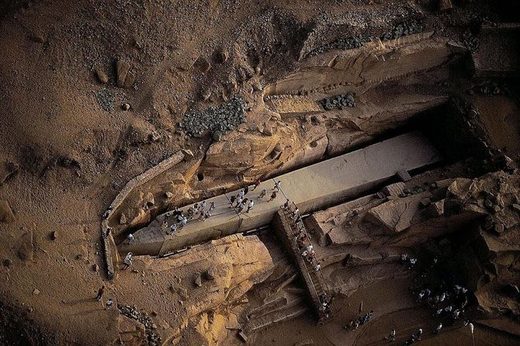
Back in history, hundreds of thousands of years ago, the order of the inner planets was different, with mercury, earth and then Venus, with it's moon Mars. Now as a result of the interaction between two colliding galaxies the Milky Way and Canis Major, a very high speed object struck Venus, with sufficient impact to stop it's natural rotation and set it rotating in the opposite direction and, also slowed the planet forcing it into a lower orbit. During Venus's passage into a lower orbit it passed in front of Earth, and as a result of that interaction Venus was further decelerated and proceeded into an even lower orbit and of course the earth was accelerated, went into a higher orbit, and as a side effect had it's axis and rotation and year lengthened.
The impact created a large ejecta stream, some of which coated Venus's now ex-moon Mars, giving it it's red, oxidised iron colouring, as Mars was sling shotted into it's higher now lonely orbit, with a bright new coat, and an almost atmosphere, to replace the atmosphere it's planet was stripped away in it's earlier life. Now whilst Mars did catch a significant portion of the ejecta it did not get it all, as the majority shot off into space in a large elliptical orbit spanning thousands of years. Now this ghost of a planet, a reminder of life utterly extinguished has not finished it's journey and returns to haunt another planet at regular intervals. So every few thousand years this cloud of debris, returns from the Oort cloud where it picks up a coating of pre-stellar matter, which upon re-entry into the solar system bleeds off taking with it a stream of red oxidised particles, and announcing it's return to the inner solar system as the winged harbinger of doom.
So this cloud of debris is both blessing and a curse to the planet it interacts with. Whilst the initial interaction promoted the evolution of a more intellectual species one that could more readily adapt to the extreme changes in climate and create advanced societies, it also brings those societies crashing down when the orbits intersect. Sometimes the passage swing and miss, or sometimes it is only a glancing blow but of course on other occasion it will be a direct hit. So human society at irregular intervals, suffers a fire storm raining down from the heavens and the sky darkens and appears as if on fire in a haze of red dust. Of course with the fiery sunsets and sunrises comes no heat but the chill of a long harsh winter, a winter that remains until the last spectral remnants from the winged demon world descends to earth and the skies clear. Of course the return of warm brings no great blessing, as it creates a flood, of melting ice water, ice water that creates a continuously rising tide of oceans, and of rivers flooded beyond all recall, a nightmare deluge of flood created debris and new tropical storms.