
Comment: To better set the tone of the new perspective that SOTT is taking, and in consideration of the current state of the planet, we are re-running this prescient article written by Laura Knight-Jadczyk back in 2007. We hope that our readers realize that what is happening on Earth in the Cosmic sense, is far more important than politics.
You can get the politics here, too, but it is no longer our focus. There has been a One World Government running the show for many years now, the conflicts are just the "bread and circuses" they use to control the masses.
Political change may still happen, but it is no longer possible for it to prevent Earth Changes that are significant and cataclysmic. If the only thing that happens is global cooling, that, alone, can bring about the deaths of billions of people. Global warming, on the other hand, would have been a boon to mankind. But that was all a fraud, a distraction, a cruel game played by psychopaths on you, humanity.
So, read on and see what it is that is on our minds: preparing you for what is to be - what is already happening.
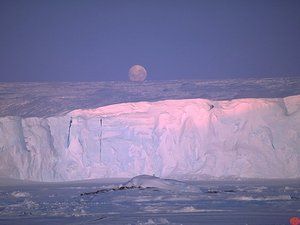
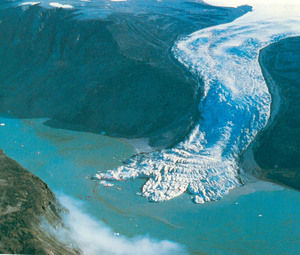
© UnknownMoonrise over a glacier
Tropical Ice Cores Shows Two Abrupt Global Climate ShiftsWarning: I'm going to talk about "channeled material" here, so if you don't like it or think it is whacky, you can stop reading now and not be contaminated by such far-out, fringe nonsense..
For the first time, glaciologists have combined and compared sets of ancient climate records trapped in ice cores from the South American Andes and the Asian Himalayas to paint a picture of how climate has changed - and is still changing - in the tropics.
Their conclusions mark a massive climate shift to a cooler regime that occurred just over 5,000 years ago, and a more recent reversal to a much warmer world within the last 50 years.
The evidence also suggests that most of the high-altitude glaciers in the planet's tropical regions will disappear in the near future. The paper is included in the current issue of the journal Proceedings of the National Academy of Science.
Lastly, the research shows that in most of the world, glaciers and ice caps are rapidly retreating, even in areas where precipitation increases are documented. This implicates increasing temperatures and not decreasing precipitation as the most likely culprit. [...]
"Approximately 70 percent of the world's population now lives in the tropics so when climate changes there, the impacts are likely to be enormous," explains Lonnie Thompson, professor of geological sciences at Ohio State. [...]
"We have a record going back 2,000 years and when you plot it out, you can see the Medieval Warm Period (MWP) and the Little Ice Age (LIA)," Thompson said. During the MWP, 700 to 1000 years ago, the climate warmed in some parts of the world. The MWP was followed by the LIA, a sudden onset of colder temperatures marked by advancing glaciers in Europe and North America."And in that same record, you can clearly see the 20th Century and the thing that stands out - whether you look at individual cores or the composite of all seven - is how unusually warm the last 50 years have been.© UnknownGlaciers are the most destructive and powerful things on Earth
"There hasn't been anything in the record like it - not even the MWP," Thompson said.
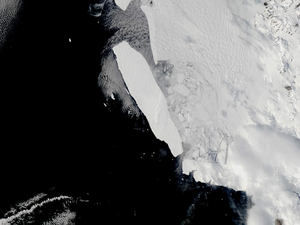
"The fact that the isotope values in the last 50 years have been so unusual means that things are dramatically changing. That's the real story here." [...]"The take-home message is that global climate can change abruptly, and with 6.5 billion people inhabiting the planet, that's serious."© NASAThe huge 75-mile long iceberg seems to have run aground barely 2.5 miles from the giant ice block into which it was about to collide.
Everybody settled down now? Good. To continue. The forum member, "Appollynon", added some comments as follows:
The thing that really gets my attention here, is how this article is very, very close to the sort of information the C's [Cassiopaean Experiment] transcripts were talking about in terms of abrupt Global Climate change occurring in our near future. ...I responded to these comments as follows:
For me the only details really missing from this article are that our Big Blue Marble isn't the only planet in the solar system to be affected by global warming. Which makes me wonder "How could us pesky li'l humans be doing all this"? I don't think we can, and I'm leaning more and more to believing through study and observation the information presented by Laura in The Wave series and her articles on site that hint at all of this warming activity as a precursor to the coming Wave...
My current thinking is that there seems to be a flood of new energy entering our planet which is affecting both the global climate, and tectonic movements (meaning earthquake activity as well as volcanic and magmatic activity). The only explanation for this new energy entering our solar system would be one of four possibilities as far as my research seems to suggest.
1 - A large influx in potential energy coming from the swarming of comets in ... our Solar system and imparting massive amounts of energy (though this would have to be a huge number of comets as I don't believe they can account for the sheer amounts of new energy bombarding our planet system if unless their numbers are scarily high).
2 - A massive upsurge in activity from the Sun (although as I'm aware we are now in somewhat of a solar minimum according to the experts I've been reading up on).
3 - A previously unknown or undeclared sister star to our own sun bringing a whole gamut of of gravitational wave anomalies and energies (which I don't think we have experienced for a very long time in this area of the cosmos).
4 - The Wave phenomenon that is talked about in the Wave series of books on site and maybe being affected by "the ripples in the pond" so to speak. [...]
Maybe some scientists can claim ignorance of the objective and easily seen facts as they are [subjected to] social programming or [are] pressured or coerced into looking in different areas for lack of funding in these distinct areas of research.
However I do believe that there is some level of knowledge about the effects of the coming Wave, comets and companion star in the scientific community, or at least those who are knowingly working for "The Man Behind the Curtain".
I say this due to the large number of bunkers and underground bases that have been found and talked about over the past few decades. If the powers that be were really in the dark, then why would they make such a concerted effort to hide the truth and to build these types of structures to hide out in when the sky comes crashing down around them. I think they have a good idea what this all means for us here on the Big Blue Marble, and that it may be part of a greater plan to programme the masses into thinking us humans are responsible for all of this. ...
That may sound to some like a very absurd thought I know, but it would explain all this programming vis-a-vis the MSM about how we are all at fault for not doing enough to save our planet. ...
Does anyone have any other theories on why there is so much of a hullabaloo being made about human induced global warming?
Well, let's face it, back before 911, we were just having a good time on Saturday nights drinking coffee and eating cookies and chatting with the C's about this stuff; it wasn't real, it was all just theoretical. Of course we were pretty sure that dark and ugly deeds were being done behind the scenes, there was enough evidence for it; but the scenario the C's presented - that things would be like they were in Nazi Germany, only globally, was just "out there."After that, the thread went quiet for awhile until just the other day when another forum member, Lynne, posted a follow-up:
I don't think anybody was able to really imagine how we would get from there... to here.
But we sure know NOW how they did it: 9/11. It was all over in a couple of hours, all the rest is just detail.
I think the rest of the stuff is going to be like that. One day it will all be theoretical and we will have no idea HOW it could possibly get from here to there, and then the next day, we will be THERE.
C's said "sudden glacial rebound..." Nobody seems to be thinking about that. They just talk about it getting hotter and hotter. Well, what if hotter just precedes suddenly colder? I think of the mammoth in Siberia that was found with undigested buttercups in its mouth. It was flash frozen almost instantly.
The thing is, the evidence that it has happened (and more than once) is available all around us not only in the geological and archaeological record, but also in myths and legends. But for most people, it is so easy to just brush all that off and interpret it bass-ackwards, and that's what they do. The problem is, I don't believe that the "experts" are that stupid.
Meanwhile, the C's tell us stuff - no hard dates because there are too many variables and the future IS open - and it happens just as they say, so we get the idea that the rest of it is probably gonna happen also, we just don't know when.
We live in probably the most interesting times of the past 6 thousand years.
There is a man, named Robert Felix, a former architect, that has been researching the ice age cycle, full time, since 1991. He claims that an ice age could start at any time. He cites the fact that as the ice melts at the poles the fresh water mixes with the salt water of the oceans. This can stop the Gulf Stream from flowing as far north as it does now. If that happens, the temperate climate being experienced by the northern latitudes would be gone and an ice age would start. Of course, I am just remembering this from what I heard on a radio show. There is, naturally, a lot more to it than that.After reading the post, I decided to check the "iceagenow" link just to see what it was all about. I didn't know I was going to uncover an odd mystery. The first thing I found was the following:
He has a website here: http://iceagenow.com/
And he keeps repeating, "It's a cycle, it's a cycle, it's a cycle." So maybe he is on to the same thing that the C's were talking about?
So there is at least one [other] person going with this idea, and I think I have heard other comments here and there about it, too.
Global-warming skeptics continue to punch awayActually, that is not exactly what Bill Gray is saying. He is only saying that it is a hoax the way it is presented.
By Joel Achenbach,
The Washington Post
June 05, 2006
WASHINGTON - It should be glorious to be Bill Gray, professor emeritus. He's the guy who predicts the number of hurricanes that will form during the coming tropical-storm season. He works in the atmospheric-science department of Colorado State University. He's mentored dozens of scientists.
But he's also outraged.
Much of his government funding has dried up. He has had to put his own money, more than $100,000, into keeping his research going. If none of his colleagues comes to his funeral, he says, that'll be evidence that he had the courage to say what they were afraid to admit.
Which is this: Global warming is a hoax.
He has testified about this to the U.S. Senate. He has written magazine articles, given speeches, done everything he could to get the message out.Now, notice that this Washington Times reporter writes so casually "the world will begin to cool again," as though he was talking about a fresh breeze that wafts gently over the sweat beaded forehead. If that is the case, if it is just a breeze, why is Bill Gray so desperate to be heard? Why has he spent 100 K of his own money on his research? Well, let's continue with the article:
"I've been in meteorology over 50 years. I've worked damn hard, and I've been around. My feeling is some of us older guys who've been around have not been asked about this. It's sort of a baby-boomer, yuppie thing."
Gray believes in observations. Direct measurements. Numerical models can't be trusted. Equation pushers with fancy computers aren't the equals of scientists who fly into hurricanes.
"Few people know what I know. I've been in the tropics, I've flown in airplanes into storms. I've done studies of convection, cloud clusters and how the moist process works. I don't think anybody in the world understands how the atmosphere functions better than me."
In just three, five, maybe eight years, he says, the world will begin to cool again.He is almost desperate to be heard. His time is short. He is 76 years old.© UnknownIce everywhere in the next 3, 5 or 8 years at the most?
"The case for warming"Now, notice that, in the above scenario, we have some definite problems laid out - but most of it will happen gradually, and we have about 90 years to see it all play out: until 2100. It's all rather "iffy," too, even if they are certain that things are going to warm up. Now the journalist goes on the attack:
Human beings are pumping greenhouse gases into the atmosphere, warming the planet in the process.
Since the dawn of the industrial era, atmospheric carbon dioxide has risen from about 280 to about 380 parts per million. In the past century, the average surface temperature of Earth has warmed about 1 degree Fahrenheit. Much of that warming has been in the past three decades.
Regional effects can be more dramatic: The Arctic is melting at an alarming rate. Arctic sea ice is 40 percent thinner than it was in the 1970s. Glaciers in Greenland are speeding up as they slide toward the sea. A recent report shows Antarctica losing as much as 36 cubic miles of ice a year.
The permafrost is melting across broad swaths of Alaska, Canada and Siberia. Tree-devouring beetles, common in the American Southwest, are suddenly ravaging the evergreens of British Columbia. Coral reefs are bleaching, scalded by overheated tropical waters. There appear to have been more strong hurricanes and cyclones in recent decades.
The 1990s were the warmest decade on record. The year 1998 set the all-time mark. This decade is on its way to setting a new standard. The United Nations' Intergovernmental Panel on Climate Change (IPCC), a global effort involving hundreds of climate scientists, projected in 2001 that, depending on the rate of greenhouse-gas emissions and general climate sensitivities, the global average temperature would rise 2.5 to 10.4 degrees Fahrenheit between 1990 and 2100. Sea levels could rise just a few inches, or nearly three feet.
All of the above is part of the emerging, solidifying scientific consensus on global warming.
The skeptics' viewOnly in the last sentence does this journalist come anywhere close to the truth. But notice how cleverly he has concealed the problem?
When you step into the realm of the skeptics, you find yourself on a parallel Earth.
It is a planet where global warming isn't happening - or, if it is happening, isn't happening because of human beings. Or, if it is happening because of human beings, isn't going to be a big problem. And, even if it is a big problem, we can't realistically do anything about it other than adapt.
There is no consensus on global warming, they say. There is only abundant uncertainty. The IPCC process is a sham, a mechanism for turning vague scientific statements into headline-grabbing alarmism. Drastic actions such as mandated cuts in carbon emissions would be imprudent.More twisting and distortion.
Alternative sources of energy are fine, they say, but let's not be naive. We are an energy-intensive civilization. To obtain the kind of energy we need, we must burn fossil fuels. We must emit carbon. That's the real world.Well, in this sense, the journalist is repeating the view taken by the Bush Reich Science which has little or nothing at all to do with the real science! Interesting how he mixes it all together.
Since the late 1980s, when oil, gas, coal, auto and chemical companies formed the Global Climate Coalition, industries have poured millions of dollars into a campaign to discredit the emerging global-warming consensus. The coalition disbanded a few years ago, but the skeptic community remains.Notice how this journalist has lumped the scientists in with the political skeptics as though they were all saying the same thing. They are not, and that is what this is all about. There is a huge difference between saying that "Global Warming as it is being presented to the public is a hoax" and "there is no Global Warming. There definitely IS Global Warming and Bill Gray has never said that things weren't getting warmer.
Many skeptics work in think tanks, such as the George C. Marshall Institute or the National Center for Policy Analysis. They have the ear of leaders in the White House and on Capitol Hill. The skeptics helped scuttle any possibility that the United States would ratify the Kyoto treaty that would have committed the nation to cuts in greenhouse-gas emissions. (Conservatives object to the treaty for, among other things, not requiring reductions by developing nations such as China and India.)
The skeptics point to the global-temperature graph for the past century. Notice how, after rising steadily in the early 20th century, in 1940 the temperature suddenly levels off. No - it goes down! For the next 35 years! If the planet is getting steadily warmer because of Industrial Age greenhouse gases, why did it get cooler when industries began belching out carbon dioxide at full tilt at the start of World War II?Did you catch those last remarks? The journalist is quoting - out of context, I should add - several results of scientific studies. But we are going to discover that these admissions he has made above - that the Antarctic Ice was getting THICKER and the sea-level is actually dropping - concern information that is going to get very tricky!
Now look at the ice in Antarctica: Getting thicker in places!
Sea-level rise? It's actually dropping around certain islands in the Pacific and Indian oceans.
There are all these ... anomalies. [...]
Notice also that this article, quite critical of the "no global warming" stance that has been taken by the Bush Administration, was published in the clearly Right-wing Washington Post, one of the most Administration sychophantic rags on the market! What is up with that?!
I also noticed that Robert Felix, the "iceagenow.com" guy, added a comment about this article accusing the Post writer of being a LEFTY!!!
Unfortunately - and despicably - this article, which supposedly reports the skeptics arguments, now veers off to the left, accusing Dr. Gray of being on the "fringe," and dismissing him and M.I.T. professor Richard Lindzen as being just simply part of the minority "Old Guard." The article conveniently ignores the fact that 60 international climate-change experts recently signed an open letter to Canada's Prime Minister disavowing the "fact" of global warming.Sometimes I think we've really lost the idea of what the Right and the Left actually represent. Seems to me that the terms have been severely ponerized and even have become "doublespeak."
Anyway, next there is this from the iceagenow site:
I first published this forecast by Dr. Landscheidt in 2003. However, with the recent reported cooling of the Atlantic Ocean, and with the first reversed sunspot of what may be the beginning of the next solar cycle, and with Russian scientists predicting a new Little Ice Age, I thought it would be an appropriate time to give more credit to Dr. Landscheidt. He had been predicting this scenario for years. Here's what Dr. Landscheidt had to say:New Little Ice Age by 2030!
Analysis of the sun's activity in the last two millennia indicates that, contrary to the IPCC's speculation about man-made global warming, that we could be headed into a Maunder minimum type of climate (a Little Ice Age).
The probability is high that the minima around 2030 and 2201 will go along with periods of cold climate comparable to the nadir of the Little Ice Age, and La Ninas will be more frequent and stronger than El Ninos through 2018 (Landscheidt, 2000).
We need not wait until 2030 to see whether the forecast is correct, however. A declining trend in solar activity and global temperature should become manifest long before then. The current 11-year sunspot cycle 23 with its considerably weaker activity seems to be a first indication of the new trend, especially as it was predicted on the basis of solar motion cycles two decades ago. As to temperature, only El Nino periods should interrupt the downward trend, but even El Ninos should become less frequent and strong.
The total magnetic flux leaving the Sun has risen by a factor of 2.3 since 1901 while global temperature on earth increased by about 0.6°C. Energetic flares increased the Sun's ultraviolet radiation by at least 16 percent. There is a clear connection between solar eruptions and a strong rise in temperature.
Lake bottom cores from the Yukatan Peninsula covering more than 2,000 years show a similar correlation between recurrent droughts and the Sun's eruptional activity. These results and many earlier ones (Landscheidt, 1981-2001) document the importance of the Sun's eruptional activity on climate.
Energetic solar eruptions do not accumulate around the sunspot maximum. In most cycles they shun the maximum phase and can even occur close to a sunspot minimum.
I (Landscheidt) have shown for decades that the sun's varying activity is linked to cycles in its irregular oscillation about the centre of mass of the solar system (the solar retrograde cycle). As these cycles are connected with climate phenomena and can be computed for centuries, they offer a means to forecast phases of cool and warm climate.
Researchers need to take the sun seriously as a factor in climate change, including warming, droughts, and cold snaps.

© UnknownThis is how the Ice Age will be affecting North America.
I'm sorry to report that Dr. Theodor Landscheidt passed away on May 20, 2004. Founder of the Schroeter Institute for Research in Cycles of Solar Activity in Waldmuenchen, Germany, Dr. Landscheidt was a giant in the field of climatology. Here's what I published in 2003This last surprised me. I was under the impression that the last sunspot cycle was considerably stronger and more active than predicted. Again, a forum member dug up some data. You can read it HERE.Dr. Landscheidt, author of "Sun - Earth - Man: A Mesh of Cosmic Oscillations", and "Cosmic Cybernetics: The Foundations of a Modern Astrology," based his forecast on the Gleissberg cycle of solar activity.This confirms what I've been saying all along; that our climate is controlled by magnetic activity on the sun.
"Contrary to the IPCC's speculation about man-made global warming as high as 5.8° C within the next hundred years," said Landscheidt, "a long period of cool climate with its coldest phase around 2030 is to be expected."
It can be seen," added Landscheidt, "that the Gleissberg minimum around 2030 and another one around 2200 will be of the Maunder minimum type accompanied by severe cooling on Earth." (Posted 19 Sep 2003)
It also makes my assertion that "we'll be admitting that we're headed into an ice age by the year 2012" seem a lot more plausible.
Landscheidt's forecasts include the end of the great Sahelian drought; the last five extremes in global temperature anomalies; the last three El Ninos; and the course of the last La Nina. He predicted extreme River Po discharges beginning in October 2000, some seven months before they began.
This forecast skill, says Landscheidt, solely based on solar cycles, is irreconcilable with the IPCC's allegation that it is unlikely that natural forcing can explain the warming in the latter half of the 20th century.
The current 11-year sunspot cycle 23 with its considerably weaker activity seems to be a first indication of the new trend, especially as it was predicted on the basis of solar motion cycles two decades ago.
Anyway, let me continue. The main thing that grabbed my attention in all of the above was the claim that the ice sheet on Antarctica was actually growing since all we have heard via the media is "melting, melting, melting". Along with this was the surprising claim that the sea levels were falling instead of rising as was predicted by the Global Warming Scenario. Where did these things come from? Sez who?
I went digging.
One of the first things I found was the following:
Antarctic Ice Sheet Mass BalanceNotice the date: last November. Notice what it says: the Antarctic Ice Sheet is actually growing!!! What's more, it is doing this at the expense of the global sea level! Aside from the fact that all we are hearing is "melting ice! melting ice!", how can the ice sheet be growing if it is getting hotter? And we ALL KNOW IT IS! So, how can this be?
Reference
Wingham, D.J., Shepherd, A., Muir, A. and Marshall, G.J. 2006. Mass balance of the Antarctic ice sheet. Philosophical Transactions of the Royal Society A 364: 1627-1635.
What was done
The authors "analyzed 1.2 x 10⁸ European remote sensing satellite altimeter echoes to determine the changes in volume of the Antarctic ice sheet from 1992 to 2003." This survey, in their words, "covers 85% of the East Antarctic ice sheet and 51% of the West Antarctic ice sheet," which together comprise "72% of the grounded ice sheet.""
What was learned
Wingham et al. report that "overall, the data, corrected for isostatic rebound, show the ice sheet growing at 5 ± 1 mm year-1." To calculate the ice sheet's change in mass, however, "requires knowledge of the density at which the volume changes have occurred," and when the researchers' best estimates of regional differences in this parameter are used, they find that "72% of the Antarctic ice sheet is gaining 27 ± 29 Gt year-1, a sink of ocean mass sufficient to lower global sea levels by 0.08 mm year-1." This net extraction of water from the global ocean, according to Wingham et al., occurs because "mass gains from accumulating snow, particularly on the Antarctic Peninsula and within East Antarctica, exceed the ice dynamic mass loss from West Antarctica."
What it means
Contrary to all the horror stories one hears about global warming-induced mass wastage of the Antarctic ice sheet leading to rising sea levels that gobble up coastal lowlands worldwide, the most recent decade of pertinent real-world data suggest that forces leading to just the opposite effect are apparently prevailing, even in the face of what climate alarmists typically describe as the greatest warming of the world in the past two millennia or more.
Reviewed 8 November 2006
Well, there's an answer:
Global warming boost to glaciersOn the NASA website, I discovered that the scientists there have been mapping this for some time now. The data is published, it's just not promoted actively. And, in many cases, it is phrased so that the important factors are minimized, if not actually buried..
Global warming could be causing some glaciers to grow, a new study claims.Researchers at Newcastle University looked at temperature trends in the western Himalaya over the past century. They found warmer winters and cooler summers, combined with more snow and rainfall, could be causing some mountain glaciers to increase in size. [...]© Unknown
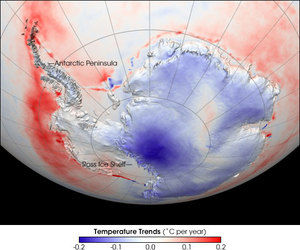
Antarctic Temperature Trend 1982-2004Then, from Nature.com comes a piece that gives an excellent example of talking out of both sides of the mouth at once:
Cold, snowy, and stuck at the "bottom of the Earth, Antarctica might seem like a dull place. But this big continent can produce a surprisingly dynamic range of conditions. One example of this range is temperature trends. Although Antarctica warmed around the perimeter from 1982 to 2004, where huge icebergs calved and some ice shelves disintegrated, it cooled closer to the pole.This image shows trends in skin temperatures - temperatures from roughly the top millimeter of the land or sea surface - not air temperatures. The data were collected by the Advanced Very High Resolution Radiometer (AVHRR) sensors that were flown on several National Oceanic and Atmospheric Administration (NOAA) satellites. The data come from the AVHRR's thermal infrared channel - a portion of the light spectrum we can sense as heat but that human eyes cannot see. This image shows temperature trends for the icy continent from 1982 to 2004. Red indicates areas where temperatures generally increased during that period, and blue shows where temperatures predominantly decreased.© NASANotice which portion of Antarctica is the coldest, and the small surface that is really heating up.
The area of strongest cooling appears at the South Pole, and the region of strongest warming lies along the Antarctic Peninsula. In some instances, bright red spots or streaks along the edge of the continent show where icebergs calved or ice shelves disintegrated, meaning the satellite began seeing warmer ocean water where there had previously been ice. One example of this is the bright red line along the edge of the Ross Ice Shelf.
Why is Antarctica getting colder in the middle when it's warming up around the edge?
One possible explanation is that the warmer temperatures in the surrounding ocean have produced more precipitation in the continent's interior, and this increased snowfall has cooled the high-altitude region around the pole. Another possible explanation involves ozone. Ozone in the Earth's stratosphere absorbs ultraviolet radiation, and absorbing this energy warms the stratosphere. Loss of UV-absorbing ozone may have cooled the stratosphere and strengthened the polar vortex, a pattern of spinning winds around the South Pole. The vortex acts like an atmospheric barrier, preventing warmer, coastal air from moving in to the continent's interior. A stronger polar vortex might explain the cooling trend in the interior of Antarctica.
Increased snowfall could slow sea-level riseNotice how they give with one hand and take with the other: "scientists FEAR..." Never mind that they have just said that the East Antarctic ice sheet gained 45 billion tons of ice.
Mark Peplow
19 May 2005
Increased snowfall over a large area of Antarctica is thickening the ice sheet and slowing the rise in sea level caused by melting ice.
A satellite survey shows that between 1992 and 2003, the East Antarctic ice sheet gained about 45 billion tonnes of ice - enough to reduce the oceans' rise by 0.12 millimetres per year. The ice sheets that cover Antarctica's bedrock are several kilometres thick in places, and contain about 90% of the world's ice. But scientists fear that if they melt in substantial quantities, this will swell the oceans and cause devastation on islands and coastal lands.
The Intergovernmental Panel on Climate Change (IPCC) has reported that sea level is currently rising at about 1.8 millimetres per year, largely through melting of the Greenland and Antarctic ice sheets as a result of global warming. But the panel also expected that climate change would trigger an increase in snowfall over the Antarctic continent, as increased evaporation from the oceans puts more moisture into the air.Yeah, it sure is amazing. And notice how, just above, the "small changes" are supposed to be responsible for the reported rise of the sea levels by 1.8 millimetres per year. I think we just caught them in a lie. But we'll come to that.
"This is a phenomenal piece of research, but it is what we expected, " comments David Vaughan, a glaciologist at the British Antarctic Survey in Cambridge, UK. "These effects have been predicted for a long time, it's just that no one has measured them before."
Although the results of the satellite survey are in line with the predictions of global-warming models, the thickening of the ice sheet could still be explained by natural weather variability, warns Curt Davis of the University of Missouri, Columbia, a member of the research team. He and his colleagues present their results in the online edition of Science.
Remote view
The team used data from the European Space Agency's radar satellites ERS-1 and ERS-2, which measured changes in altitude over about 70% of Antarctica's interior - more than 8.5 million square kilometres, roughly the same size as the United States.
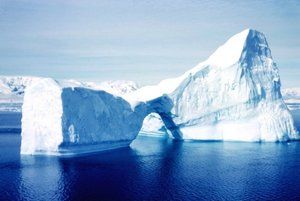
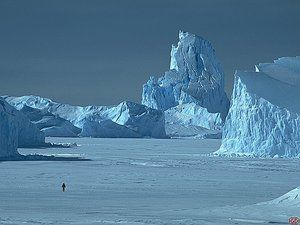
East Antarctica thickened at an average rate of about 1.8 centimetres per year over the time period studied, the researchers discovered. The region comprises about 75% of Antarctica's total land area - but as its ice is thicker, it carries about 85% of the total ice volume. "It is the only large terrestrial ice body that is gaining mass rather than losing it," says Davis.In contrast, smaller West Antarctica showed an overall thinning of 0.9 centimetres per year. "It's amazing that they can measure such small changes," says Vaughan.© unknownOn top of an iceberg.
Thick skinThe reader should already understand how totally absurd the above remarks are. If you don't, you soon will.
The thickening of the eastern ice sheet should not be seen as a long-term protection against a rise in sea level, warns Vaughan. Glaciers in West Antarctica are accelerating, releasing more and more icebergs into the sea. And the Antarctic Peninsula, which stretches towards South America, now regularly hits temperatures above 0 °C in the summer, leading to direct melting of the ice there.
What's more, snowfall over East Antarctica will not continue to increase indefinitely in a warming world, Vaughan adds. Conversely, every extra degree of temperature rise will continue to accelerate glaciers and cause more melting on the western side of Antarctica, swelling the world's oceans further.Notice above that, even though they say that increased warming increases precipitation (snowfall), that somehow, there is a "cut-off point"??!! That it will not increase indefinitely? Where is the logic here?
Scientists have already estimated that Antarctic melting may be responsible for up to a third of the overall sea-level rise. But the instruments on ERS-1 and 2 only work over very flat areas, and tend to lose track of the radar echo over steeper areas around the continent's coast, so a vital piece of the puzzle is still missing, says Vaughan. And because Antarctica is so vast, it is also impossible to measure snowfall comprehensively on the ground, he adds.Notice how the above article is not just a "spin" on the situation, but seems to contain outright lies - direct contradictions of other facts already presented. Notice also the remark about the coming CryoSat. This did not initially grab my attention. It was only after I continued to dig that this remark about the possibility of knowing the truth about Antarctica's ice became important - and even scary!
However, the European Space Agency satellite CryoSat, due to be launched later this year, should be able to make very accurate altitude measurements around the coast, providing evidence of exactly how much ice is being lost there. Only when scientists put all these measurements together will the full truth about Antarctica's ice become clear, says Vaughan.
The next item directly contradicted the above article's claims about the melting of the Greenland Ice Sheet. It was posted, in part, on the iceagenow website.
Greenland icecap growing thickerThis is where things began to get very squirrelly. The first link is to a Reuters article which, for some reason, has completely disappeared. I mean, there's not even a google cache of it. Nothing.
20 Oct 2005 - Greenland 's ice-cap has thickened slightly in recent years despite wide predictions of a thaw, scientists said today. Satellite measurements show that more snowfall is thickening the ice-cap, especially at high altitudes, according to the report in the journal Science.
"The overall ice thickness changes are ... approximately plus 5 cms (1.9 inches) a year or 54 cms (21.26 inches) over 11 years," according to the experts at Norwegian, Russian and U.S. institutes led by Ola Johannessen at the Mohn Sverdrup center for Global Ocean Studies and Operational Oceanography in Norway. [...]
See more of this article HERE.
See also HERE.
The second link is to a CNN report on the Reuters article. It also has disappeared. Go ahead, click the links...
Doing a search for the articles missing from Reuters and CNN I found only a blog mention:
October 23, 2005The last link is to "newsclipping.co.uk". Wow! It looked like I might actually find the whole article!
Greenland ice cap thickens slightly
Thought you'd like this one:
Greenland's ice cap has thickened slightly in recent years despite wide predictions of a thaw triggered by global warming, a team of scientists said on Thursday.
Read more from this blogger: Greenland ice cap thickens slightly
Guess again.
Error 404It really bugs me when I think somebody is hiding something. I know it might be "conspiracy minded" of me, but I can't get over the feeling that there is an attempt to sideline or seriously minimize particular (and important) information here.
The page you are looking for does not exist; it may have been moved, or removed altogether. You might want to try the search function. Alternatively, return to the front page.
I was, finally, able to read the original article. Go HERE to read a version of the Science Journal article which one of our forum members obtained and posted.
Another forum member found a copy of the article on an Australian news site. Funny that this didn't show up on google when I was searching!!
Greenland icecap thickens despite warmingSo far, so good. But then, the article veers off into the disinformation that suggests that all we are going to have to deal with is WARMING.
Reuters
Friday, 21 October 2005
Greenland's icecap has thickened slightly in recent years despite concerns that it is thawing out due to global warming, says an international team of scientists.
A team led by Professor Ola Johannessen, at the Nansen Environmental and Remote Sensing Center in Norway, report their findings online ahead of print publication in the journal Science.
The 3,000-metre thick Greenland icecap is a key concern in debates about climate change because a total melt would raise world sea levels by about 7 metres. And a runaway thaw might slow the Gulf Stream that keeps the North Atlantic region warm.
Glaciers at sea level have been retreating fast because of a warming climate, making many other scientists believe the entire icecap is thinning.
But satellite measurements showed that more snowfall is falling and thickening the icecap, especially at high altitudes, say Johannessen and team.
"The overall ice thickness changes are ... approximately plus 5 centimetres a year or 54 centimetres over 11 years."
But, they say, the thickening seems consistent with theories of global warming, blamed by most experts on a build-up of heat-trapping gases from burning fossil fuels in power plants, factories and cars.
Warmer air, even if it is still below freezing, can carry more moisture. That extra moisture falls as snow below 0°C.
And the scientists say that the thickening of the icecap might be offset by a melting of glaciers around the fringes of Greenland. Satellite data is not good enough to measure the melt nearer sea level.
Ice sheetsYes, we know that Greenland is presently melting like crazy around the edges. And that's the BIG problem as we see from the following BBC special that was broadcast two years earlier:
Most models of global warming indicate that the Greenland ice might melt within thousands of years if warming continues.
Oceans would rise by about 70 metres if the far bigger icecap on Antarctica melted along with Greenland.
Antarctica's vast size acts as a deep freeze likely to slow any melt of the southern continent.
The panel that advises the United Nations has predicted that global sea levels might rise by almost a metre by 2100 because of a warming climate.
Such a rise would swamp low-lying Pacific islands and warming could trigger more hurricanes, droughts, spread deserts and drive thousands of species to extinction.
Separate study supports sea level rise due to ice melt
A separate study in today's issue of Science reports that sea levels are probably rising slightly because of a melt of ice sheets.
"Ice sheets now appear to be contributing modestly to sea level rise because warming has increased mass loss from coastal areas more than warming has increased mass gain from enhanced snowfall in cold central regions," the report by a team led by Professor Richard Alley of Pennsylvania State University in the US says.
"Greenland presently makes the largest contribution to sea level rise."
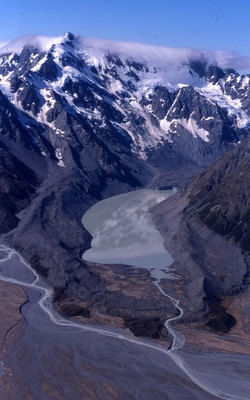
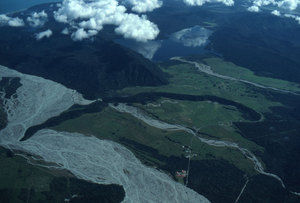
Greenland glacier advancing 7.2 miles per year! The BBC recently ran a documentary, The Big Chill, saying that we could be on the verge of an ice age. Britain could be heading towards an Alaskan-type climate within a decade, say scientists, because the Gulf Stream is being gradually cut off. The Gulf Stream keeps temperatures unusually high for such a northerly latitude.What is important is that there IS a heating up of the planet, a Global Warming, which is causing a lot of ice to melt. It is also causing a lot of evaporation which then falls as snow in certain areas, and this put pressure on the ice sheets and squeezes them outward so that they actually melt faster around the edges. This adds a LOT of fresh water to the oceans. In the Antarctic regions, it may not be so bad, but in the Arctic, it is a building cataclysm.One of Greenland's largest glaciers has already doubled its rate of advance, moving forward at the rate of 12 kilometers (7.2 miles) per year. To see a transcript of the documentary, go to© unknownWaiho-glacier
The Big Chill
The implications are so huge that it is really no wonder that the Bush Reich and others of the ruling elite are trying to shush it up and convince people that it's just going to get hotter and we all have to make sacrifices to try to slow it down. As if! Bush is certainly right when he goes his merry way acting as if Global warming is nothing. He might as well because he, and the rest of them, know that there is nothing that anyone can do about it to stop it. That's a fact. And so, they continue to do the one thing that they believe will save their own skins: continue to follow the plan of imposing total control over everyone and everything so that when the disasters fall fast and hard - as they will - the masses will be controllable. And it certainly doesn't hurt to kill off as many as they can get away with killing in advance; that many fewer mouths to feed, doncha know?
In short, the economic, political and national security implications of sudden cataclysm are what is driving the political machine these days. Britain is headed for a climate worse than Alaska's. And it could be here sooner than anyone expects.
An ice age is one of the Great Forces of Nature. They are dynamic and destructive. Massive glaciers form and begin to march across the land destroying and grinding up everything in their path. They can fill valleys, grind rocks to nothing and reduce the height of mountains. They wipe the land clean. Vast stretches of the earth are buried in a literal tomb of ice.
Preserved in the ice of Greenland is an ancient thermometer, a record of the climate of the earth for a very long time. The ice records traces of disasters and pollution, acids from volcanoes, lead refining residue from Roman times, and so on. But most important of all there is a record of the temperature which can be read by determining how much heavy water is locked in the ice. The rule is: the more heavy water, the warmer the climate.
And so, researchers obtained cores of the Greenland ice and began to examine and analyze them. Based on the conventional rules about climate change that are being promoted as Global Warming due to human activities, they should have seen slow changes in the heavy water evidence in the ice cores as the world warmed and cooled.
But that's not what they found.
Instead, they found that temperatures can drop suddenly and catastrophically. And it has happened many times.
The change can come as fast as turning off a light.
Professor Wally Broecker of Columbia University became convinced that the driver was the ocean. Because of the profound climate changes that had been recorded in Britain, Broecker focused on the gulf stream. Britain's mild climate is due to the heat of the Gulf Stream. Without the Gulf Stream, it would be like the frozen North of Alaska.
The Gulf Stream begins south of the equator and as it flows around the gulf of Mexico it absorbs heat from the tropics which it then carries with it North, to Britain. Scientists estimate that the Gulf Stream carries the heat of a million power stations. This heat enables Brits to swim in waters at the same latitudes that Canada has polar bears.
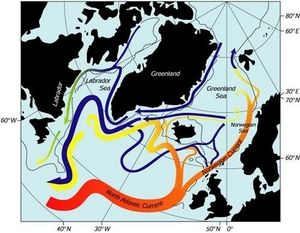
© unknownA diagram of the Gulf Stream conveyor and related currents.

|
| © |
| This image shows how England, Western Europe and Scandinavia are bathed in the heat of the Gulf Stream |
The question that Wally Broecker asked himself was: "What would happen if this conveyor stopped?
Although many scientists had never thought about this, and believed that the established currents of the oceans never changed, other evidence was forthcoming that this had happened - more than once. This evidence was found in mud core samples from the bottom of the ocean. In other words, at various times in the past the conveyor switched off. And when the conveyor switched off, Britain - and the whole northern region that benefits from the Gulf Stream - froze.
So, what does the shutting off of the conveyor have to do with Global Warming?
Climate experts are predicting temperatures to rise faster than at any time since the last ice age. The models that scientists are using (as described above), all suggest that in a hundred years, we'll experience warming of about 1.5 to 6 degrees. The Earth hasn't been that warm in hundreds of thousands - or millions - of years! We can all see and feel the effects of global warming. Everyone is talking about how to prepare for hotter weather and all the attendant extremes.
For example, among the main topics covered by the "experts" are that Global Warming will increase winter rains in Britain causing flooding. There will be things like tropical cyclones much further north. It is this sort of thing that the governments are preparing people to consider and expect.
But all of these experts are not considering the factor that Global Warming may very well be the switch that turns the conveyor - the Gulf Stream - OFF.
Greenland is one of the biggest ice-cubes in the world. It consists of enough water to raise the sea level by about six or seven metres if it melted completely.
And indeed, it IS melting. The equivalent of fifty cubic kilometres of ice and snow disappear from Greenland each year - around the edges, that is. That is the same as fifty gigo-tons of water. And it is accelerating. Less than five years ago, one of the Greenland glaciers was moving at about six, seven kilometers per year. And that was more or less in balance with the snowfall. Now in the five years since then the speed is almost doubled. It was advancing at 12 kilometers per year in 2003. In 2005, it was moving 15 kilometers per year. And certainly, the increase is due to "Global Warming."
The problem is that the increase means that a hundred cubic kilometres of fresh water is being dumped into the ocean per year and that fresh water is flowing towards the sinking zone of the conveyor.
Wally Broecker and his associates began to wonder just what could be the effect of all that fresh water on the conveyor. They began to realise that because the conveyor was driven by the salty water sinking, too much fresh water would dilute the salt and if the salt was diluted too much the conveyor would not sink. The possibility is that a 1 percent change in the salinity of the water - at the moment that point is reached - could tip the balance; the water would be too fresh to sink and the conveyor - the Gulf Stream - would stop. Just like that.

|
| © |
| Gulf Stream Temps and Chlorophyll Concentration |
What's worse is that it isn't just the Greenland ice sheet that is pouring fresh water into the ocean where the conveyer sinks and reverses direction: Global warming leads to a wetter world because warm air holds more moisture. When that moisture heads north and cools, there will be more rain. And if that rain accompanies a big system such as a hurricane, it can be a very great amount indeed!
At the same time, there are some very big rivers in Siberia dumping fresh water into the polar regions. If those rivers increase in size due to increased rainfall in Siberia, there can be an increase in annual discharge of a hundred and twenty eight cubic kilometers of fresh water per year. With the current rate at which the atmosphere is heating, we are facing a horrifying prospect of a fifty percent increase in some of the world's biggest rivers. A "vast wall of fresh water will soon come flooding through northern Siberia. An extra thousand cubic kilometres a year more could flow in to the salty waters of the conveyor."
Dr. Bill Turrell has been monitoring the saltiness of the Gulf Stream as it flows past the Faro Isles north of Scotland. If the saltiness of the water decreases, that is a sign that the driver of the conveyor is weakening.
Until the 1970s the salinity had been almost constant. But then it began to drop. Dr. Bill Turrell tells us:
"After the late seventies we began to see a freshening of the bottom water. So much so that we, we began to doubt our own results. We took further samples, we checked with other countries who are sampling the same water, until eventually we became convinced that this change was actually happening."Turrell had measured the fact that the flow of the Gulf Stream return had fallen by a massive twenty percent. Turrell says:
Now we really do know that fresh water input to the Arctic is increasing. The Siberian rivers are pumping out more fresh water. The Arctic ice sheets are melting and there is more release of fresh water. It, it's the most fundamental change I've observed in my career.In short, the process that could shut off the Gulf Stream conveyor began in the 1970s. No one knows where the absolute shut-off point is. We only know we are getting closer day by day.
Let's recap the facts. Science indicates that a shut off of the Gulf Stream is closely connected to ice ages. The mechanism of the conveyor function of the Gulf Stream is generally understood and the effect of fresh water on same is theorized - with strong evidence. We know that the temperature of the Earth is increasing and that this is increasing the amount of moisture in the air, general precipitation, as well as the zone of precipitation. This is dumping the fresh water into the zone of conveyor return. Measurements have been taken showing that the salinity of the ocean in the critical area is decreasing. So it is safe to say that it is a certainty that the result will be a shutting off of the Gulf Stream conveyer resulting in an ice age. You can pretty well take that to the bank.
The remaining two questions are: when? and how bad will it be?
The scientists analyzing the data can only say that the implications are huge, the results will be catastrophic, but we we will come back to this soon enough. For now, let us continue with the little discoveries I was making as I dug into the issues.
Notice that all the information about the anomalies in the melting/growing ice problem are coming from European sources. The articles on Reuters and CNN about the anomalous increase of ice in the center of Greenland and Antarctica were scrubbed from the U.S. web. This brings us back to the CryoSat issue. Remember in the article above entitled "East Antarctica puts on weight," there is the following remark:
However, the European Space Agency satellite CryoSat, due to be launched later this year, should be able to make very accurate altitude measurements around the coast, providing evidence of exactly how much ice is being lost there. Only when scientists put all these measurements together will the full truth about Antarctica's ice become clear...Now, read the excerpts of the following article:
Earth - melting in the heat?Notice that they are referring to the Greenland Ice Sheet in this last remark about "getting thicker." They fail to note that the most important factor is the massive amount of fresh water being dumped into the ocean.
By Richard Black,
Environment Correspondent, BBC News website
Predictions vary from the catastrophic to the cataclysmic.
Glaciers are melting, the ice caps disappearing into the oceans. Sea levels may rise by many metres as a consequence.
Indigenous Arctic peoples will find their food stocks gone, while fresh water supplies in Asia and south America will disappear as the glaciers which provide them melt away; penguins, polar bears and seals will find their habitats gone, their traditional lives unlivable.
But how realistic is this picture? Is the world's ice really disappearing, or is it unscientific hot air?
A European satellite named CryoSat was designed to provide definitive answers to some of these questions.
A launcher fault destroyed the mission in October 2005, but the European Space Agency has approved a replacement. In the meantime, here is our global snapshot.
THE ANTARCTIC
Huge, pristine, dramatic, unforgiving; the Antarctic is where the biggest of all global changes could begin.
There is so much ice here that if it all melted, sea levels globally would rise hugely - perhaps as much as 80m. Say goodbye to London, New York, Sydney, Bangkok, Rio... in fact, the majority of the world's major cities.
But will it happen? Scientists divide the Antarctic into three zones: the east and west Antarctic ice sheets; and the Peninsula, the tongue of land which points up towards the southern tip of South America.
"Everybody thinks that the Antarctic is shrinking due to climate change, but the reality is much more complex," says David Vaughan, a principal investigator at the British Antarctic Survey in Cambridge, UK.
"Parts of it appear to be thickening as a result of snowfall increases. But the peninsula is thinning at an alarming rate due to warming.
"The West Antarctic sheet is also thinning, and we're not sure of the reason why."
On the up
Temperatures in the Peninsula appear to be increasing at around twice the global average - about 2C over the last 50 years. Those figures are based on measurements made by instruments at scientific stations.
Earlier this year, David Vaughan's group published research showing that the vast majority of glaciers along the Peninsula - 87% of the 244 studied - are in retreat.
The ice dumped into the ocean as the glaciers retreat should not make much difference to global sea levels - perhaps a few cm.
More worrying, potentially, are the vast ice sheets covering the rest of Antarctica.
Making temperature measurements for the continent as a whole is difficult; it is a vast place - more than 2,000km across - there are few research stations, and temperatures vary naturally by 2-3C from year to year.
But measurements indicate that in the west, melting is underway.
"About one-third of the West Antarctic ice sheet is thinning," says Dr Vaughan, "on average by about 10cm per year, but in the worst places by 3-4m per year." [...]
Eastern mass
And what of the big monster, the much larger east Antarctic sheet?
A recent study using altimeter data suggested it is getting thicker, by about 1.8cm/yr; another, using the gravity satellite mission Grace indicates its mass remains stable.
But could rising temperatures in time drain the ice away?
"It is not going to happen on any realistic human timescale," says David Vaughan.
"It's so cold that you could raise temperatures by 5-10C without having much of an impact; it's on rock above sea level, so warming in the ocean can't affect it."
Largely insulated from global trends and so big as to generate its own climatic systems, most of Antarctica appears to be immune to the big melt for now, though answers to what is happening in the west are eagerly awaited.
THE ARCTIC
At the top of the world, the Arctic is a region built on water.
Around the North Pole is ocean, with ice floes crowding in each winter and thinning again in the summers.
In September, we learned from scientists at the US National Snow and Ice Data Center that the extent of ocean covered by ice is getting smaller each year; the current rate of shrinkage they calculate at around 8% per decade.
Their projection is that within about 60 years, there will be no summer ice at all on the Arctic Ocean.
"Overall, the extent has been declining, with some oscillations, since the 1970s when satellites were able to map it," comments Peter Wadhams, Professor of Ocean Physics at Cambridge University, UK, and currently at the Laboratoire Oceanographique in Villefranche-sur-mer, France.
"There's been a slow decline, but now the thinning appears to be more rapid.
"In the last two decades, not only has the area shrunk but the ice has got thinner by about 40%; the prediction is that it will vanish altogether during summers in the second half of this century."
Military records
Measurements of thickness come mainly from military submarines, which spent long periods under the Arctic ice during the Cold War.
Peter Wadhams was one of the scientists who afterwards persuaded the authorities in Britain and the United States to de-classify their data.
But as a method of measurement, it is far from perfect; and satellites have given only limited help.
The existing satellite fleet gives good measurements of ice extent, but is not so good at detecting thickness, partly because the orbits of satellites with radar altimeters do not cover every portion of the ocean.
This data deficit has led to a rival theory; that the ice is not melting at all, it is simply piling up in another part of the ocean, perhaps along the north Canadian coast. ...
Great expanse
Temperatures, meanwhile, show a similar pattern to that seen along the Antarctic Peninsula; an average warming of about 2C in the last 50 years, about twice the global average, albeit with significant variations between different parts of the Arctic.
This is reflected in changes to ice cover on land as well as on sea.
The Greenland ice sheet is, after Antarctica, the second biggest expanse of ice in the world.
Its fringes expand and contract with the seasons; but images show it is melting more each summer now than a decade ago.
In February 2006 researchers discovered glaciers in Greenland were moving much faster than before, meaning that more of its ice was entering the sea.
In 1996, Greenland was losing about 100 cubic km per year in mass from its ice sheet; by 2005, this had increased to about 220 cubic km.
A complete melt of the ice sheet would cause a global sea level rise of about 7m; but the current picture indicates that while some regions are thinning, others are apparently getting thicker. [...]
We now come back to the remark:
A European satellite named Cryosat was designed to provide definitive answers to some of these questions. A launcher fault destroyed the mission in October 2005...Considering the disappearance of the articles about Greenland on the U.S. controlled websites, this just sort of gives me the willies. What do they mean a "launcher fault destroyed the mission" ???
CryoSat crashes into the seaIs it just me, or does anyone else think it is strange that the Cryosat crashed in the same month that the Journal Science articles about the build-up of ice in Greenland sort of disappeared from Reuters and CNN?
By Team Register,
8th October 2005
The European Space Agency's latest satellite has broken up and crashed into the sea.
The 135 million euro satellite, called Cryosat, blasted off this evening from Russia's Plesetsk Cosmodrome, aboard a modified intercontinental ballistic missile, called Rockot. But it went missing a couple of hours later, around the time it should have shot into final orbit.
Cryosat was supposed to examine the effects of global warming on the polar ice caps. Instead it did its own little bit for global warming as it plunged into the icy Arctic Sea.
In a statement this evening, The European Space Agency said that Russian authorities blamed the crash on "an anomaly in the launch sequence".
The second stage performed nominally until main engine cut-off was to occur. Due to a missing command from the onboard flight control system the main engine continued to operate until depletion of the remaining fuel. As a consequence, the separation of the second stage from upper stage did not occur. Thus, the combined stack of the two stages and the CryoSat satellite fell into the nominal drop zone north of Greenland close to the North Pole into high seas with no consequences to populated areas.
A joint Russian-ESA team will investigate the cause of failure and expects to report back within a few weeks.
BBC gives an update on the crash:
Cryosat rocket fault laid bareSo, it was a software flight control problem; probably one of the easiest ways to sabotage a mission via remote control. We next see that ESA is not giving up, but the work may not be done in time based on all of the above information:
By Helen Briggs
BBC News science reporter
27 October 2006
Russian space officials have identified the rocket fault that led to the loss of Europe's Cryosat satellite.
A problem with the onboard flight-control system of the newly built upper stage of the rocket was to blame.
The Russian state commission report clears the launcher for future use.
It was grounded on 8 October when the mission to map the Earth's ice sheets fell into the ocean shortly after lift-off from Plesetsk in Russia.
The (135m euro) satellite was riding atop a Rockot launch vehicle, a former military rocket modified by the addition of a newly manufactured third stage.
The Russian Failure Investigation State Commission says a set of measures is being implemented to prevent a recurrence of the incident.
"We confirm from the information we have from the State Commission that there was a problem with the software flight-control system in the Breeze upper stage of the launcher," European Space Agency spokesperson, Simonetta Cheli, told the BBC News website.
"This problem led to a failure of the Breeze upper stage to generate the command to shut down the second stage engine."
The error meant that separation of the rocket's second and third stages did not occur, denying the satellite the final boost it needed to reach orbit and causing it to nosedive into the sea.
A board set up by the rocket operator, Eurockot, is to review the findings of the State Commission next week.
The British scientist who proposed the mission, Prof Duncan Wingham, is calling for the spacecraft to be re-built.
Workshop on Antarctic sea-ice highlights need for CryoSat-2 missionRyan, the Australian forum member found a couple more interesting pieces of this puzzle:
9 August 2006
Sea-ice thickness is an important parameter in modelling global climate, and moreover, long-term changes are considered to be a reliable indicator of climate change. However, estimates of sea-ice thickness trends around Antarctica are currently very limited. An international workshop held recently made it clear that these essential data can only be obtained from satellite missions such as CryoSat-2. [...]
Over the three-day event, which was held on 5 - 7 July 2006, talks highlighted the fact that ice-thickness trends around Antarctica are still largely unknown and that information on seasonal, inter-annual and decadal thickness variations is very scarce. [...]
ESA's ice mission CryoSat-2
07-Jan-2007
The question of whether global climate change is causing the polar ice caps to shrink is one of the most hotly debated environmental issues we currently face. By monitoring precise changes in the thickness of the polar ice sheets and floating sea ice, CryoSat-2 aims to answer this question.
The go-ahead to build and launch the CryoSat-2 mission came in February 2006 after the loss of the first CryoSat last October due to a launch failure. The mission's objectives remain the same as before - to measure ice thickness on both land and sea very precisely to provide conclusive proof as to whether there is a trend towards diminishing polar ice cover, furthering our understanding of the relationship between ice and global climate. CryoSat-2 is due for launch in 2009.
It is now generally agreed that the Earth's atmosphere is getting warmer, and although the impact of climate change is expected to be amplified at the poles, it is extremely difficult to predict what effect this is having on the polar ice cover. On one hand, recent years have already seen record summer reductions, in extent and concentrations, of sea ice in the Arctic. In Antarctica, giant icebergs have calved and part of the Larsen ice shelf has disintegrated. However, on the other hand, ships have recently been trapped for weeks in unusually heavy Antarctic pack ice conditions. [...]
Considerations Over the Loss of CryoSat ESA SatelliteThis remark becomes even more interesting when we read the ESA Chairman's introduction to the bulletin:
On 8th October 2005, following a successful preparation of the satellite by the joint ESA and industrial teams, the launch of CryoSat satellite on board a Rockot launch vehicle ended in failure. Due to an anomaly towards the end of the planned 2nd stage operations and approximately five minutes after lift-off, at a height of 230 km, the launch vehicle automatically interrupted its mission and began to fall. The combination of the re-entry heat and the explosion of the fuel tanks completely destroyed CryoSat. Debris of the launch vehicle (2nd, 3rd stage) and of the satellite impacted into the Arctic Ocean.
Formed in 1995, the launch services provider Eurockot Launch Services GmbH, is a joint venture between EADS Space Transportation (DE) and Krunichev (Russia) that provides commercial launch services with the Rockot launch system to operators of Low Earth Orbit (LEO) satellites and operates from launch facilities in Plesetsk Cosmodrome, northern Russia. [...]
The root cause of the CryoSat failure has been unambiguously identified and corrective measures for Rockot's return-to-flight are now under way. A Russian State Commission was convened immediately after the accident. The conclusions of its investigation work have been issued in a report including subsequent recommendations, and its main conclusion is that human error and not an inherent design flaw of the launch vehicle caused the failure. [...]
"A Word from the Chairman"Next, let's look at what the Cassiopaeans had to say about all of this 10 years or so ago which is now proving to be astonishingly accurate. And if their remarks about the Global Climate changes have support in science, maybe we ought to consider the other things they have said with a bit more attention? If you read the following in the context of 9/11 and the Global Warming issue, it all begins to make sense.
Space Law Games
Some of you may well have seen the American film in which a supercomputer takes control and directs the fighting between the two superpowers, resulting in the annihilation of the armed forces of the two opposing camps. It turns out that it's only a game with the battle, entirely virtual, won by the computer, which has been brilliantly programmed by a young boy. Proof, if any is needed, that games can be your downfall. ...
22 Feb 97Here, I wonder if the "nippy" wasn't a clue?
Q: (Laura) Ok, we have several things that we discussed earlier, is there anything you wish to say before we launch into questions?
A: Underground bases see dramatic budget increase.
Q: (Laura) Ok, why do they have a budget increase?
A: Because there is much more activity to come.
Q: (Laura) Ok, what kind of activity?
A: Broad range.
Q: (Laura) Can you list, say, the top three?
A: Experimentation, utilization and implementation.
Q: (Laura & Terry) Of what?
A: Human "resources." Plan falling into place for "harvest."
Q: (Terry) The new underground bases, along with all the old ones are for the coming harvest?
A: And other purposes of STS forces' plans.
Q: (Terry) And other STS plans... (Laura) What is this thing called 'The Harvest'?
A: What do you think?
Q: (Laura) Well, is that harvest in a negative event, or harvest in a positive one? I mean, as in the harvesting of the wheats and the tares...
A: Either/or.
Q: (Laura) Ok, now you say the plans are falling into place. What specific events of the past, say, several weeks, or months, whatever period of time set aside, are these plans that are falling into place? I mean, what's the key in the lock?
A: Have you been paying attention, as we have always suggested you should?
Q: (Laura) Of course! I just asked you because I wanted you to enumerate! Of course I'm paying attention!
A: Lately, there has been diversion for you.
Q: (Laura) Well, it doesn't mean I'm asleep!
A: V*** mentioned the weather. Was that a bit "nippy" for you in central Europe in December and January, Arkadiusz?
Q: (Terry) V*** mentioned the weather, and the changes in it. What was the name of that movie we watched up in Tallahassee, I forgot the name of it...Like I said earlier, when the C's were talking about this sort of thing we simply could not even imagine how such a scenario might be initiated and play out. It was all just theoretical fun and games for us. We listened, took notes, and said, basically, "yeah, right!" That 9/11 could be planned and carried out, and all that has followed it was simply out of the range of our limited imaginations!
[Terry then spoke about a science fiction. Aliens were here among us, and were plotting to affect the weather in such a way as to make the planet uninhabitable for us, but perfect for them. Naturally, there was secrecy and coverups. Then the subject moved to the cell phone towers that were noted in rural areas of North Florida. This then lead to a question about the cell phone towers. First part of question lost.]
Q: (Terry)...transmit to us and back... what can be transmitted? Can the negative energy be focused through these microwave towers?
(V***) And what was the correlation between the strange weather and the harvesting?
(Laura) Because we were told that the weather changes were due to the energy buildup of the wave. That was two years ago. And it had nothing to do with the 'harvest.'
(Terry) But it could also be that HAARP adds to it.
(Jan) Ok, well, let's ask...
(Laura) Well, they would love for us to think that HAARP has something to do with weather. 'Yes, we're having bizzare weather. Let's blame it on HAARP!' because we're going to think about HAARP... What a perfect...
(Terry) Well, HAARP has a lot more to do than just the weather. They can put all the energy-based stuff that they've been experimenting on in one place, because they can do whatever they want, just by changing the frequencies...
(Jan) Or, even just continue to mess the weather up, to continue to create negative vibrations, worry and uncertainty...
(V***) I guess the point I'm trying to get at is, are these weather changes promoting some changes in the physical body, that's making the physical body more 'harvestable?'
(Terry) Could very well be.
(Laura) Well, it's all interconnected, but I wouldn't say that one is the cause of the other, just to say that they occur...
(Terry) But why, as we were talking about earlier, is all this weird stuff going on all through the media?
A: We told you that "HAARP" was being designated for capturing and modulating electromagnetic fields for the purpose of total control of brainwave patterns in order to establish a system of complete"order on the surface of the planet" in either 3rd or 4th density.
Q: (Laura) Is HAARP in operation at the present time?
A: Yes, in its early stages.
Q: (Terry) Is the spreading of all these communication towers out across the country the equivalent of a HAARP program on a continental scale?
A: Back up system.
Q: (Laura) So, they don't need the towers to operate the HAARP system, but they are there as the backup?
A: Towers serve dual and lateral purposes.
Q: (Terry) Local and regional authorities can use the towers to track people, amongst other things. (Laura) Is the weather being controlled or changed or in any way affected by HAARP?
A: Climate is being influenced by three factors, and soon a fourth.
Q: (Laura) All right, I'll take the bait; give me the three factors, and also the fourth!
A: 1) Wave approach. 2) Chloroflorocarbon increase in atmosphere, thus affecting ozone layer. 3) Change in the planet's axis rotation orientation. 4) Artificial tampering by 3rd and 4th density STS forces in a number of different ways. ...
Q: (Laura) All right, were those given in the order in which they are occurring? The fourth being the one that's coming later?
A: Maybe, but remember this: a change in the speed of the rotation may not be reported while it is imperceptible except by instrumentation. Equator is slightly "wider" than the polar zones. But, this discrepancy is decreasing slowly currently. One change to occur in 21st Century is sudden glacial rebound, over Eurasia first, then North America. Ice ages develop much, much, much faster than thought.
[Discussion of new scientific theory recently presented that the earth is expanding.]
Q: (Terry) Is the Earth expanding? That's just putting it bluntly, but, is the Earth expanding, how did you put that? (Ark) Yes, that's the theory: the idea is that the continents move away because the Earth is expanding, and this is much faster than you know, than geologists were thinking.
A: Continental "drift" is caused by the continual though variable, propelling of gases from the interior to the surface, mainly at points of magnetic significance.
Q: (Jan) What causes the change in the axis?
A: By slow down of rotation. Earth alternately heats up and cools down in interior.
Q: (Laura) Why does it do that? What's the cause of this?
A: Part of cycle related to energy exerted upon surface by the frequency resonance vibrational profile of humans and others. [...]
Q: (Terry) Ok, let's go back to the beginning of the session, when we were talking about the acceleration/expansion on underground bases in preparation for the harvest. Is that world-wide, we're talking here?
A: Yes, but United States is focus, due to particularly cooperative power structure profile.
Q: (Terry) Do we want to ask about the power structure profile?
(Laura) No, we know what that is; they agreed to work with them. But, what I would like to know is what particular steps are being taken, what particular activities are being stepped up?
A: Acquisition, staging, testing of planned activity.
Q: (Laura) And what is the planned activity?
A: Control of absolutely everything.
Q: (Laura) Well, swell! (Terry) That's the one world government! That's what they want! (Laura) OK, is there anything in particular that we can do to...It took us another 5 years to figure that one out: psychopaths, and then later, ponerology. This next exchange gives some additional clues and insight:
A: Knowledge protects, ignorance endangers. Awareness makes you less vulnerable, both directly and indirectly. Heard anything about synthetic blood, and blood and plasma alteration lately?
Q:(Laura) There's a can of worms for you! All right, I'll bite! Go ahead, tell us about the synthetic blood and the blood plasma.
A: Less "mutes" needed.
Q: (Laura) Cattle Mutilations. They don't need as many cattle mutilations.
[...]
A: Bio and cyber/genetic humanoid types now increasing exponentially in general population. You may have already encountered one or two during the past 10 days.
Q: (Laura) You, who? You, as in me, you as in F***, who?
A: Reflect upon activities, and power and influence centers for answer.
9 May 1998So, let's put those two things together: How does global warming cause glaciers and lead to an Ice age?
Q: ... I would like to know what the geographic coordinates, according to our current grid system, that would frame Atlantis. I don't need the exact shape, just a general box shape... the perimeter...
A: Like asking: "What are the geographic coordinates of the North Atlantic Treaty Organization?"
Q: Okay, let me get more specific: the Atlantean land that was supposed to have existed in the Atlantic Ocean... what was the farthest north of any any part of Atlantis that was in the ocean, that no longer exists?
A: It is "time for you" to know that Atlantis was not a nation, land, Island, or continent, but rather, a civilization!
Q: All I wanted was to have an idea of a land mass in the Atlantic ocean that people talk about - where did it sit?
A: Where do you think?
Q: Well, I sort of think that the Azores and the Canary Islands are sort of...
A: Yes, but many other places too. Remember, the sea level was several hundred feet lower then...
Q: Why was the sea level several hundred feet lower? Because there was ice somewhere or because there was not as much water on the earth at that time?
A: Ice.
Q: Was the ice piled up at the poles? The ice sheet of the ice age?
A: Yes.
Q: So, Atlantis existed during the ice age?
A: Largely, yes. And the world's climate was scarcely any colder away from the ice sheets than it is today.Q: Well, how could that be? What caused these glaciers?© unknownThe World during the Ice Age
A: Global warming.
Q: How does global warming cause glaciers?
A: Increases precipitation dramatically. Then moves the belt of great precipitation much farther north. This causes rapid buildup of ice sheets, followed by increasingly rapid and intense glacial rebound.
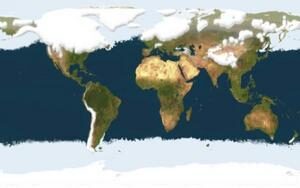
Increases precipitation dramatically. Then moves the belt of great precipitation much farther north. This causes rapid buildup of ice sheets, followed by increasingly rapid and intense glacial rebound. ... One change to occur in 21st Century is sudden glacial rebound, over Eurasia first, then North America. Ice ages develop much, much, much faster than thought.There is, of course, those two worrying questions to consider: how fast and how bad can it be?
Just the other day we published a news item on SOTT that read, in part:
Over 4.5 Billion people could die from Global Warming-related causes by 2012Meanwhile, a strong natural gas odor was reported a few days ago in Manhattan, Brooklyn, Jersey City, Weehawken, and Newark. As Wayne Madsen pointed out, last August, a similar unexplained gas odor sent people to the hospital in Staten Island and Queens. Although methane is odorless, natural methane venting is often accompanied by the venting of acrid hydrogen sulfide, a byproduct of bacterial decomposition. One does, of course, wonder about outgassings in relation to flocks of dead birds falling to the ground as also happened at the same time as the horrible smells in the Northeast, though the bird kills were in other locations. Then there are also fish kills that have no other explanation that could be a result of underwater outgassing..
A recent scientific theory called the "hydrate hypothesis" says that historical global warming cycles have been caused by a feedback loop, where melting permafrost methane clathrates (also known as "hydrates") spur local global warming, leading to further melting of clathrates and bacterial growth.
In other words, like western Siberia, the 400 billion tons of methane in permafrost hydrate will gradually melt, and the released methane will speed the melting. The effect of even a couple of billion tons of methane being emitted into the atmosphere each year would be catastrophic.
By the way, the "hydrate hypothesis" is a weeks old scientific theory, and is only now being discussed by global warming scientists. I suggest you Google the term.
There are enormous quantities of methane trapped in permafrost and under the oceans in ice-like structures called clathrates. The methane in Arctic permafrost clathrates is estimated at 400 billion tons.
Methane is more than 20 times as strong a greenhouse gas as CO2, and the atmosphere currently contains about 3.5 billion tons of the gas. [...]
Releases of methane from melting oceanic clathrates have caused severe environmental impacts in the past. The methane in oceanic clathrates has been estimated at 10,000 billion tons.
55 million years ago a global warming chain reaction (probably started by volcanic activity) melted oceanic clathrates. It was one of the most rapid and extreme global warming events in geologic history.
Methane can be deadly in other ways, too since it is highly flammable. The following is about a different type of gas, but one must consider the consequences if the gas in question had been methane.
THE LAKE NYOS GAS EXPLOSION, CAMEROON 1986As it happens, the claim in the above article "By the way, the "hydrate hypothesis" is a weeks old scientific theory, and is only now being discussed by global warming scientists. I suggest you Google the term." is not entirely correct. John Barnes, in his fiction novel, "Mother of Storms," described the release of vast quantities of methane as the trigger for a global superstorm that nearly destroys the earth.
Lake Nyos is one of only three lakes in the world known to be saturated with carbon dioxide -- the others are Lake Monoun, also in Cameroon about 100 km away, and Lake Kivu in Rwanda. A magma chamber beneath the region is an abundant source of carbon dioxide, which seeps up through the lake bed, charging the waters of Lake Nyos with an estimated 90 million tonnes of CO2
Lake Nyos is thermally stratified, with layers of warm, less dense water near the surface floating on the colder, denser water layers near the lake's bottom. Over long periods, carbon dioxide gas seeping into the cold water at the lake's bottom is dissolved in great amounts.
Most of the time, the lake is stable and the CO2 remains in solution in the lower layers. However, over time the water becomes supersaturated, and if an event such as an earthquake or volcanic eruption occurs, large amounts of CO2 may suddenly come out of solution.
Although a sudden outgassing of CO2 had occurred at Lake Monoun in 1984, killing 37 local residents, a similar threat from Lake Nyos was not anticipated. However, on August 21, 1986, a limnic eruption occurred at Lake Nyos which triggered the sudden release of about 1.6 million tonnes of CO2. The gas rushed down two nearby valleys, displacing all the air and suffocating up to 1,800 people within 20 km of the lake, mostly rural villagers, as well as 3,500 livestock. About 4,000 inhabitants fled the area, and many of these developed respiratory problems, burns, and paralysis as a result of the gases.
It is not known what triggered the catastrophic outgassing. Most geologists suspect a landslide, but some believe that a small volcanic eruption may have occurred on the bed of the lake. A third possibility is that cool rainwater falling on one side of the lake triggered the overturn. Whatever the cause, the event resulted in the rapid mixing of the supersaturated deep water with the upper layers of the lake, where the reduced pressure allowed the stored CO2 to effervesce out of solution.
It is believed that up to a cubic kilometre of gas was released. Because CO2 is denser than air, the gas flowed off the mountainous flank in which Lake Nyos rests and down two adjoining valleys in a layer tens of metres deep, displacing the air and suffocating all the people and animals before it could dissipate. The normally blue waters of the lake turned a deep red after the outgassing, due to iron-rich water from the deep rising to the surface and being oxidised by the air. The level of the lake dropped by about a metre, representing the volume of gas released. The outgassing probably also caused an overflow of the waters of the lake. Trees near the lake were knocked down.
Mother of Storms takes place about thirty years from now. The UN has become dominant and at the start of the book the US President is maneuvering desperately to avoid losing any more sovereignty to the UN. The UN undertakes a nuclear strike against the Siberian Republic's secret--and illegal--nuclear weapons caches buried in the Arctic seabed. The explosions result in the release of a huge amount of methane from the methane clathrates buried there. The methane causes a near-runaway greenhouse effect with global temperatures going up by 10 degrees F in a matter of months.Obviously, if such a scenario were to play out at present, the roles would be reversed to what Barnes imagined: it would be the U.S. undertaking a nuclear strike that unleashes the methane that triggers the Global Superstorm. It would probably only be in such a manner that enough methane would be released fast enough to make such an impact.
The hot, wet oceans are perfect breeding grounds for hurricanes which rapidly develop into storms of unprecedented strength, duration and number.
Methane hydrates and global warmingIn other words, if there is a Global Superstorm, it probably won't be an ocean sized hurricane that leaps the Isthmus of Panama and reduces Florida to a limerock reef in a matter of hours!
There is an enormous amount of methane (CH4) on earth frozen into a type of ice called methane hydrate. Hydrates can form with almost any gas and consist of a 'cage' of water molecules surrounding the gas. (The term 'clathrate' more generally describes solids consisting of gases which are trapped within any kind of cage while hydrate is the specific term for when the cage is made of water molecules). There are CO2 hydrates on Mars, while on Earth most of the hydrates are filled with methane. Most of these are in sediments of the ocean, but some are associated with permafrost soils.
Methane hydrates would seem intuitively to be the most precarious of things. Methane hydrate melts if it gets too warm, and it floats in water. Methane is a powerful greenhouse gas, and it degrades to CO2, another greenhouse gas which accumulates in the atmosphere just as fossil fuel CO2 does. And there is a lot of it, possibly more than the traditional fossil fuel deposits. Conceivably, climate changes could affect these deposits. So what do we know of the disaster-movie potential of the methane hydrates? [...]
The Future.
The juiciest disaster-movie scenario would be a release of enough methane to significantly change the atmospheric concentration, on a time scale that is fast compared with the lifetime of methane. This would generate a spike in methane concentration. For a scale of how much would be a large methane release, the amount of methane that would be required to equal the radiative forcing of doubled CO2 would be about ten times the present methane concentration. That would be disaster movie. Or, the difference between the worst case IPCC scenario and the best conceivable 'alternative scenario' by 2050 is only about 1 W/m2 mean radiative energy imbalance. A radiative forcing on that order from methane would probably make it impossible to remain below a 'dangerous' level of 2 deg above pre-industrial. I calculate here that it would take about 6 ppm of methane to get 1 W/m2 over present-day. A methane concentration of 6 ppm would be a disaster in the real world. [...]
The methane is oxidized to CO2, another greenhouse gas that accumulates for hundreds of thousands of years, same as fossil fuel CO2 does. Models of chronic methane release often show that the accumulating CO2 contributes as much to warming as does the transient methane concentration. [...]
So, in the end, not an obvious disaster-movie plot, but a potential positive feedback that could turn out to be the difference between success and failure in avoiding 'dangerous' anthropogenic climate change. That's scary enough.
But then, there IS the problem of the flash frozen mammoths and other creatures that died at the end of Pleistocene Epoch.
One of the major facts that paleontologists and geologists and archaeologists have had to face is the stupendous number of frozen carcasses in Canada and Alaska in the western areas, and in Northern Russia and Siberia in the eastern areas - all dated to about 12000 years ago. This suggests, of course, that something dreadful happened on the planet, and its effect on the Northern hemisphere was more severe than on the Southern hemisphere.
Back in the 1940s Dr. Frank C. Hibben, Prof. of Archeology at the University of New Mexico led an expedition to Alaska to look for human remains. He didn't find human remains; he found miles and miles of icy muck just packed with mammoths, mastodons, and several kinds of bison, horses, wolves, bears and lions. Just north of Fairbanks, Alaska, the members of the expedition watched in horror as bulldozers pushed the half-melted muck into sluice boxes for the extraction of gold. Animal tusks and bones rolled up in front of the blades "like shavings before a giant plane". The carcasses were found in all attitudes of death, most of them "pulled apart by some unexplainable prehistoric catastrophic disturbance."1
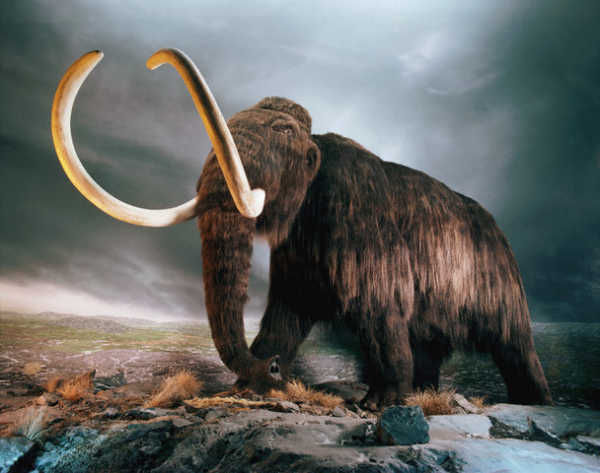
Just north of Siberia entire islands are formed of the bones of Pleistocene animals swept northward from the continent into the freezing Arctic Ocean. One estimate suggests that some ten million animals may be buried along the rivers of northern Siberia. Thousands upon thousands of tusks created a massive ivory trade for the master carvers of China, all from the frozen mammoths and mastodons of Siberia. The famous Beresovka mammoth first drew attention to the preserving properties of being quick-frozen when buttercups were found in its mouth.
What kind of terrible event overtook these millions of creatures in a single day? Well, the evidence suggests an enormous tsunami raging across the land, tumbling animals and vegetation together, to be finally quick-frozen for the next 12000 years.
These creatures didn't die because of the "gradual onset" of an ice age.
We come now to the movie "The Day After Tomorrow". The movie was inspired by The Coming Global Superstorm, a book written by Art Bell & Whitley Strieber which is synopsized as follows:
Global warming causes large areas of the Arctic ice shelf to break off and melt, meaning that the Atlantic ocean is diluted by large amounts of fresh water. This then disrupts the Gulf Stream causing an unnatural cooling of the northern hemisphere. This then triggers a series of anomalies, eventually leading up to a massive "global superstorm" system consisting of three gigantic hurricane-like superstorms, which result in an ice age for the northern hemisphere within days. One hurricane is over Canada, one over Scotland, and a third over Siberia. The movie follows Jack, a paleoclimatologist for NOAA; his son Sam, a high school student; and his wife Lucy, a doctor.Interesting, eh? It follows the science that seems to be based on valid observations and theories. And it does provide an explanation for how wooly mammoths could be flash frozen in mid-meal.
The film portrays the "eye" of the superstorms as having such a low pressure that extremely cold air (-150°F or -101°C) from the troposphere is sucked downward, instantly freezing to death all who are caught in the eye. A woman in NOAA argues that the freezing air would warm up and rise, such as in regular storms, but Jack simply states that the air is dropping too fast. The storm is headed to New York, where Sam is trapped, and which Jack is trying to reach in the hostile frozen environment with Arctic gear and his survival skills.
Throughout the movie, a subplot involves the refusal of the Vice President of the United States to accept the threat of global cooling - despite increasingly extreme weather conditions occurring throughout the world - insisting that measures to prevent it will do too much damage to the economy.
Shortly before and during the release of the movie, members of environmental groups and former Vice President Al Gore distributed pamphlets to movie-goers describing what they believe to be the possible effects of global warming, which generally did not agree with the film; some believe Gore looked too much into the film as what he may have thought to have been "a scientifically accurate movie". During the season when the film was in theaters, much criticism arose towards politicians concerning the Kyoto Protocol and climate change, and in the end the movie created quite the political stir.
© unknownA screenshot from the film "The Day After Tomorrow" showing massive cyclonic storms preceding the sudden onset of an ice age.
4 July 1998Remember what Bill Gray said in the article from June, 2006, quoted near the beginning? "In just three, five, maybe eight years, he says, the world will begin to cool again." I hope everyone has a pair of mukluks for the Day After Tomorrow...
Q: (A) I am trying to write down some things about a cosmology, and I have some questions mainly about the coming events. First there was the story of the sun's companion brown star which is apparently approaching the solar system, and I would like to know, if possible, details of its orbit; that is, how far it is, what is its speed, and when it will be first seen. Can we know it? Orbit: how close will it come?
A: Flat eliptical.
Q: (A) But how close will it come?
A: Distance depends upon other factors, such as intersecting orbit of locator of witness.
Q: (L) What is the closest it could come to earth... (A) Solar system... (L) Yes, but which part of the solar system? We have nine planets... which one? (A) I understand that this brown star will enter the Oort cloud... (L) I think they said it just brushes against it and the gravity disturbs it...
A: Passes through Oort cloud on orbital journey. Already has done this on its way "in."
Q: (A) You mean it has already entered the Oort cloud?
A: Has passed through.
Q: (A) So, it will not approach...
A: Oort cloud is located on outer perimeter orbital plane at distance of approximately averaged distance of 510,000,000,000 miles.
Q: (L) Well, 510 billion miles gives us some time! (A) Yes, but what I want to know... this Oort cloud is around the solar system, so this brown star, once it has passed through... (L) It must already be in the solar system? (A) No, it could have passed through and may not come closer. Is it coming closer or not? Is it coming closer all the time?
A: Solar system, in concert with "mother star," is revolving around companion star, a "brown" star.
Q: (A) So, that means that the mass of the companion star is much...
A: Less.
Q: (A) Less?
A: They are moving in tandem with one another along a flat, eliptical orbital plane. Outer reaches of solar system are breached by passage of brown companion, thus explaining anomalies recently discovered regarding outer planets and their moons.
Q: (A) But I understand that the distance between the sun and this brown star is changing with time. Eliptical orbit means there is perihelion and aphelion. I want to know what will be, or what was, or what is the closest distance between this brown star and the sun? What is perihelion? Can we know this, even approximately. Is it about one light year, or less or more?
A: Less, much less. Distance of closest passage roughly corresponds to the distance of the orbit of Pluto from Sun.
Q: (A) Okay. Now, this closest pass, is this something that is going to happen?
A: Yes.
Q: (A) And it is going to happen within the next 6 to 18 years?
A: 0 to 14.
Q: (A) Okay, that's it. I have some idea about this. Now, I understand that, either by chance or by accident, two things are going to happen at essentially the same time. That is the passing of this brown star, and this comet cluster. These are two different things?
A: Yes. Different, but related.
Q: (L) Is there a comet cluster that was knocked into some kind of orbit of its own, that continues to orbit...
A: Yes.
Q: (L) And in addition to that comet cluster, there are also additional comets that are going to get whacked into the solar system by the passing of this brown star?
A: Yes.
Q: (A) I understand that the main disaster is going to come from this comet cluster...
A: Disasters involve cycles in the human experiential cycle which corresponds to the passage of comet cluster.
Q: (A) I understant that this comet cluster is cyclic and comes every 3600 years. I want to know something about the shape of this comet cluster. I can hardly imagine...
A: Shape is variable. Effect depends on closeness of passage.
Q: (L) So, it could be spread out... (A) We were asking at some point where it will be coming from. The answer was that we were supposed to look at a spirograph.
A: Yes.
Q: (A) Now, spirograph suggests that these comets will not come from one direction, but from many directions at once. Is this correct?
A: Very good!!!
Q: (A) Okay, they will come from many directions...
A: But, initial visibility presents as single, solid body.
Q: (A) Do we know what is the distance to this body at present?
A: Suggest you keep your eyes open!
Q: (A) I am keeping my eyes open.
A: Did you catch the significance of the answer regarding time table of cluster and brown star? Human cycle mirrors cycle of catastrophe. Earth benefits in form of periodic cleansing. Time to start paying attention to the signs. They are escalating. They can even be "felt" by you and others, if you pay attention.
Q: (L) We have certainly been paying attention to the signs!
A: How so?
Q: (L) Well, the weather is completely bizarre. The fires, the heat...
A: Yes.
Q: (L) I notice that the tides are awfully high all the time with no ostensible explanation...
A: And low, too.
Q: (L) Yes. I have noticed that particularly. (F) I have too. Not too long ago I noticed that the tides were so incredibly low for this time of year. (L)
And also the signs in people - these kids killing their parents, all these people going berserk - you know...
A: Spike.
Q: (L) What do you mean spike?
A: On a graph...
Q: (L) Just spikes, not the biggie...
A: Spikes are big.
Q: (L) Well, from what you are saying about this - I mean how are we supposed to do all these things you say we are supposed to do? I mean, we won't have time!
A: Who says?
Q: (L) That is kind of what it is sounding like. Unless our lives and experiences escalate in concert with all these other events... (A) I have a last question which I have prepared. So, we have these two physical disasters or events, the coming brown star and the comet cluster, but we have been told that this time it is going to be different because this time it is accompanied by a plane convergence.
A: Yes. Magnetic field alteration.
Q: (A) This plane convergence, or this magnetic field alteration, it's supposed to be related to realms crossing or passing. A realm border.
A: Realm. What is root of "realm?"
Q: (L) Reality.
A: Yes. How does the magnetic field "plug in?" We want to stay on this general subject matter through this session, for your sake.
Q: (L) Okay, in terms of these signs, these things going on on the planet, these fires and so forth - you never said anything about all these fires in Florida. You said Arizona was going to burn, but you never said Florida was going to burn...
A: We did not say it would not.
Q: (L) I know. But, it is really oppressive. I have read a couple of signs in the last day or so that we are going to have a change in the weather, a break, is my little method of predicting...
A: Reverse extreme?!?
Q: (L) Oh! Floods again! Well, I guess floods are better than fires... but, maybe not!
A: Italy and Greece are burning too.
Q: (L) Yes, we noticed that in the paper today. Is there a relationship between Italy and Greece and where we are on the planet? Some kind of psychic link?
A: Just same current malady.
Q: (L) Okay, back to the comet cluster and realm border...
A: Not yet.
Q: (L) Well, which direction should we take right now?
A: Step by step.
Q: (L) Okay, you just said we are going to have a reversal in our weather. Are there any other conditions that we should be aware of at the present time?
A: Point is to watch, look, listen.
Q: (L) When we are watching, looking and listening, is there some particular thing we are supposed to be watching for that is to give us a clue about something?
A: All.
Q: (L) Is there something we are supposed to do at some point when we perceive a particular clue or event at some point?
A: What would you suggest?
Q: (L) I don't know that I would suggest anything except to keep a low profile and keep on working until we figure out the answer. It is like a race against time. We have to figure out the answer because, obviously, you are not going to tell us...
A: No. No race needed.
Q: (L) Well, I sometimes feel completely inadequate for all of this.
A: Stop thinking 3rd density!
Q: (L) Well, I don't want to just live in LaLa land and say, 'oh yes, I'm watching. I see the signs! I'm looking! I'm listening! And then count them off on my fingers and say: but I'm not gonna think about it because that's 3rd density!' See what I am saying here?
A: No, because you are still thinking 3rd density. Better to have a "front row seat," and enjoy!
Q: (L) But I feel like I am not supposed to be enjoying myself so much! I feel guilty!
A: Why not?
Q: (L) Well! I'm supposed to be DOING something!
A: You are.
Q: (A) When you watch, look and listen, you are getting some signals, and these signals cause a certain pattern of thinking which were not yet able to emerge, but now, after you receive certain signals, you start to think in a different way. So, you cannot now think in a different way, but when you learn this and this has happened, then you start to think in a different pattern. So, you cannot now do things, but you always have to be ready to change your thinking at any moment when you understand more, when you see more, when you notice more, when you put things together which are not yet together. Then, there may be a big change of perspective, a total change. And this we have to keep our minds and thinking patterns open and ready to change, and work and put the puzzle and mosaic together. And, this is all that counts. It is this work that we are now doing that counts, not some future big thing: oh! Now we go on a ship! No, it is only doing our best, and what is it? Our best? It will change. I believe so. That is the idea. So, everything depends on this.
A: Yes. You see, my dear, you cannot anticipate that which is not anticipatable.
Q: (L) Well, swell. Okay, you want to stay on this subject, so let us move another step.
A: We are glad you noticed this birth of the spike.
Q: (L) Is that a clue? Is this one of those obscure remarks? Yes, I noticed, the kids killing their parents, all the shooting going on, the weather... is this connected in some way to some other event?
A: 27 days of record heat out of 30, oh my oh my! Suggest you awaken your internet pals, as they are too busy chasing "goblins" to notice.
Q: (L) So, I should have something to say about this?
A: In Florida now, where to next? How about a shattering subduction quake in Pacific Northwest of U.S.? We estimate 10.4 on the Richter scale. We have warned of Ranier. Imagine a 150 meter high tsunami in Puget Sound...
Q: (L) Does this subduction quake have anything to do with that UFO that buried itself in the Pacific?
A: All are interconnected.
Q: (L) The information I got on that was that it was about 600 mile north and east of Hawaii. A couple of submersibles were sent down and disappeared or were destroyed or didn't come back... it is supposedly giving off a lot of energy. Any comment?
A: No.
Q: (L) Should I follow that direction?
A: All directions lead to lessons.
Q: (L) Now, you have mentioned this earthquake. I know that you don't usually give predictions, why have you done so now?
A: We do not give time tables.
Q: (L) Anything else other than a tsunami in Puget Sound and a big subduction quake... 10.4 on the Richter scale is almost inconceivable.
A: Ranier... caldera.
Q: (L) What about the caldera?
A: Expect one.
Q: (L) Other than floods, anything else for Florida upcoming?
A: All areas experience accelerating "freak weather patterns."
Q: (L) Okay, all of these freaky weather patterns and bizarre things going on on the planet, how does it relate to the comet cluster and the brown star? Is it related?
A: Human experiential cycle intersects.
Q: (L) Any specifice physical manifestation of either this brown star or this comet cluster or this realm border, that is related to these events on the planet?
A: Approach of wave stimulates precursor activity which in turn causes effects which in turn stimulates further "heating up" of activity...
Q: (L) I thought it was curious that you used the term 'birth of the spike.' Is there something or someone that was born at that particular time?
A: No. Spike is as on a graph...
Q: (L) Okay, is there anyway we could graph this ourselves, and if so, what types of events would we include to create the background data?
A: "El Nino, La Nina," etc...
Q: (L) Is this El Nino thing connected to sunspot cycles?
A: No.
Q: (L) It has its own cycle. I don't think it has been tracked for long enough to get...
A: Global warming, a part of the human experiential cycle.
Q: (L) I read where Edgar Cayce said that a slight increase in global temperature would make hurricanes something like 5 times stronger... given a baseline temperature. Does this mean we are going to have stronger and more frequent hurricanes?
A: Yes.
Q: (L) Will they hit land more frequently, or just spin out in the ocean?
A: Either, or.
18 March 2000
Q: You made a remark once that ice ages occur much, much faster than people ever thought...
A: Yes.
Q: Do we need to invest in some mukluks and snowshoes?
A: ??
Q: Well, what I am trying to get at is: should we start stockpiling firewood?
A: Maybe.
Q: So, it could be that fast?
A: Oh yes, and faster when in response to global "warming."
Q: When you put "warming" in quotes, you obviously mean warming in more than just an ordinary sense? Is that correct?
A: And/or not really "warm."
Q: Whitley Strieber and Art Bell have published a book about a "global superstorm." Is any of the information they have given in this book fairly accurate?
A: Derived from non-human sources known for stark accuracy, when convenient.
Q: What makes it convenient at the present time for them to be "starkly accurate?"
A: Fits into plans.
Q: Plans for what?
A: Do we not know already?
Q: In other words: world conquest and the takeover of humanity?
A: Not as simple.
Q: What would make my statement more accurate?
A: Call it amalgamation.
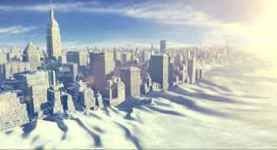
© unknownMukluks and Snowshoes required Day After Tomorrow.
- Hibben, Frank, The Lost Americans (New York: Thomas & Crowell Co. 1946).
- Sanderson, Ivan T., "Riddle of the Frozen Giants", Saturday Evening Post, No. 39, January 16, 1960.
- Simpson, George G., Horses, New York: Oxford University Press) 1961.

































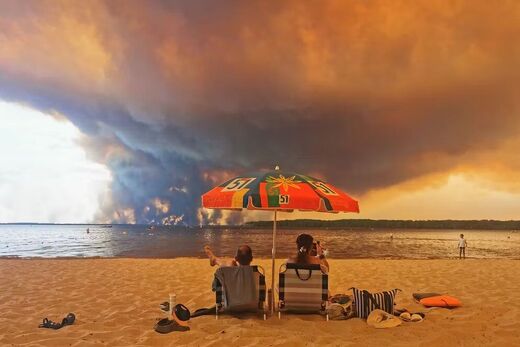
Unfortunately there is another way for the oceans to rise and that is by thermal expansion. Warmer oceans will take up more space than cold.
Apparently it takes about 3 decades for the surface layers of the oceans to absorb the heat in the atmosphere. Our oceans are still living in the 70's but the temperature trend is still going upwards.