
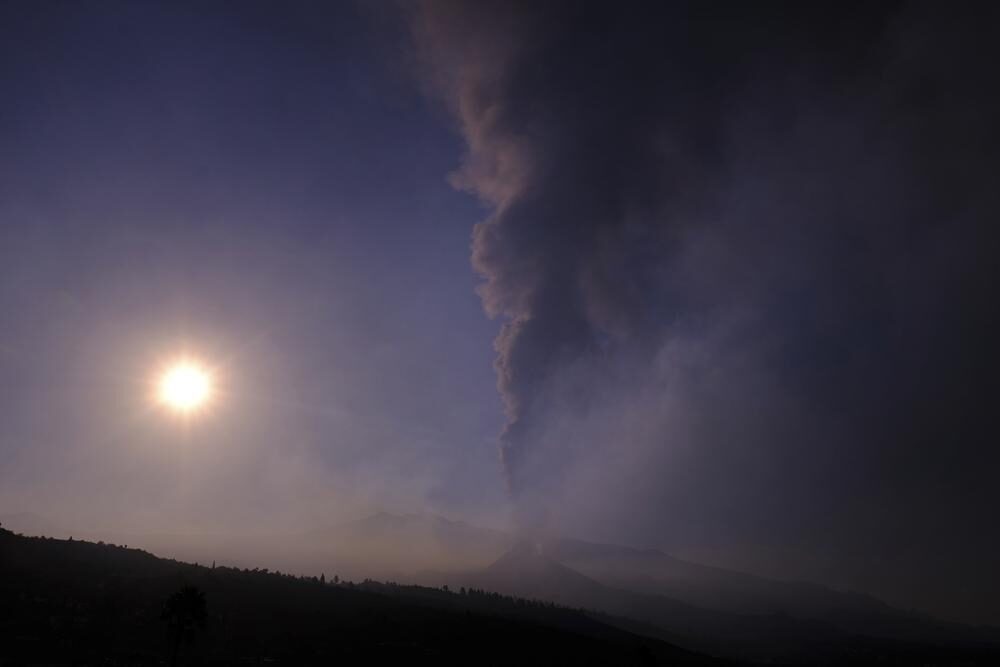
© AP Photo/Daniel RocaSmoke rises on the horizon as lava flows from a volcano on the Canary island of La Palma, Spain on Wednesday Oct. 6, 2021. A volcano that has destroyed nearly 1,000 buildings on a Spanish island increased its explosive power, roaring louder and spewing thicker lava flowing out of its main vent. The eruption started on Sept. 19 and has forced the evacuation of over 6,000 residents of the island of La Palma.
Scientists said the course of the eruption was unpredictable. It settled down in recent days, but the volcano in the Canary Islands continues to spew lava, and 16 earthquakes of up to magnitude 3.5 shook the area over the previous 24 hours, the National Geographic Institute said.
The lava has forced the evacuation of more than 6,000 people and destroyed more than 600 houses. The ash cloud temporarily closed La Palma Airport last month.
Officials said the molten rock from the crater is now flowing down a so-called lava tube beneath earlier, hardened lava, straight into the sea. That has eased fears it could spread wider and cause more destruction.
The German Research Center for Geosciences, which sent a team to La Palma, said the lava flow is 6,300 meters (6,900 yards) long, more than 1,000 meters (1,100 yards) wide at its broadest point, and up to 25 meters (82 feet) thick.
The center's volcano researcher, Thomas Walter, said the situation is still tense and unpredictable.
"It is still too early to say...how this eruption will develop," he said in a statement.
Prompt evacuations helped avoid casualties from the eruption, and most of the island of around 85,000 people is unaffected.
The volcanic Canary Islands lie off the northwest coast of Africa.





Comment: It's looking increasingly likely that this worldwide uptick in seismic and volcanic activity - amongst other extreme weather phenomena - isn't going to abate any time soon. Notably, it reflects the chaos bubbling under the surface on the global societal level:
- Earthquake swarm in Iceland continues - at least 1,100 shakes in 2 days
- Tokyo jolted by 6.1 quake, blackouts but no tsunami warning
- Shallow magnitude 5.9 earthquake hits southwestern Pakistan, kills at least 20
- La Palma volcano: Third fissure erupts after 8 new earthquakes
Also check out SOTT radio's: