
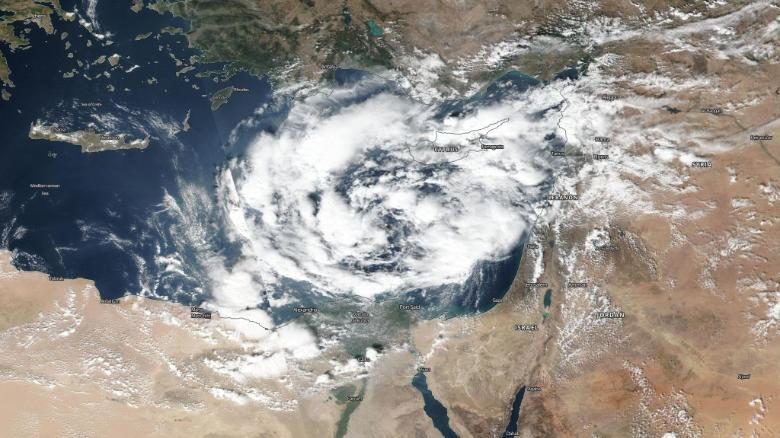
A rare hurricane-like storm in the Mediterranean threatens Egypt and Israel
Medicanes are named for a combination of "Mediterranean" and "hurricane" due to their blend of tropical and extratropical cyclone characteristics.
Up to 200 mm (nearly 8 inches) of rain is possible locally from Friday to late Saturday as the storm moves through the region, raising concerns for flash flooding.

Cars drive on a flooded street following rainfall that led to traffic jam in the Heliopolis district in the Egyptian capital Cairo on October 22, 2019.
Egypt's capital, Cairo, has experienced severe flooding from heavy rains already this past week from an unrelated storm system, killing at least 11 people.
Cairo may fortunately miss the worst of the rainfall as the system moves past the city to the east.Cars drive on a flooded street following rainfall that led to traffic jam in the Heliopolis district in the Egyptian capital Cairo on October 22, 2019.
Satellite imagery suggests current wind speeds upward of 20 mph at sea, and some models suggest that sustained wind speeds of 40 mph may be felt on shore early Saturday morning.
The UK Met Office says medicanes are incredibly rare this far east, and there are only one or two storms like this per year, according to a 2011 study.
They usually form during September and October when the waters in the Mediterranean Sea are warm. At the moment, temperatures in the Mediterranean are even warmer than normal, especially in the eastern waters, where the sea surface temperatures are currently 1-3 degrees Celsius above average.
A 2016 study warns that climate change is expected to increase the probability of medicanes in future years as temperatures in the Mediterranean Sea continue to warm.



Comment: Are medicanes becoming part of the new normal?
See also: