At least one person died and thousands were displaced after heavy rain caused flooding and landslides in the states of Alagoas and Pernambuco in northeast Brazil. Also in Pernambuco, a building collapsed in the capital Recife where at least 14 people have died or are missing. Local observers said the collapse may partly be a result of recent heavy rains.
In Alagoas, Federal Civil Defence said over 20,000 people across 37 cities and municipalities have been affected by heavy rains that began around 07 July 2023. As of 10 July a total of 3,578 people were displaced. Among tha hardest hit areas are Matriz de Camaragibe (3,548 people affected), Marechal Deodoro (3,004), São Miguel dos Milagres, (2,860), União dos Palmares (2,302), Rio Largo (2,108), Atalaia (1,624), Cajueiro (1,336), Murici (1,200) and Jacuípe (1040). One person died in flood waters in Joaquim Gomes.
Marine heatwaves off the coast of North America cause huge seabird die-offs, according to a study published in Marine Ecology Progress Series.
The study draws on data from four citizen science projects to examine coastal birds from central California, US, to Alaska, US, between 1993 and 2021.
"This is truly a global data set that asked a global-sized question: Does a warming world significantly impact marine birds, among the top predators in the nearshore marine environment?" says paper co-author Julia Parrish, a professor of aquatic and fishery sciences at the University of Washington, US.
"We find a dramatic delayed effect," she adds.
Comment: The data is showing that Earth isn't warming, it's cooling; but there are indeed marine heatwave events occurring, alongside a variety of other unusual and rare phenomena, that reveal our planet - and the solar system at large - is undergoing a significant, and potentially catastrophic, shift:
Christopher Lane II Oklahoman Tue, 11 Jul 2023 18:34 UTC
Hundreds of birds dead after OKC storm
After a week of storms and Saturday night's torrential rain and hail, residents across Oklahoma City woke up Sunday morning to hundreds of dead birds in the street.
WildCare Oklahoma, a nonprofit animal rehabilitation center in Noble, received numerous calls about hundreds or more purple martins downed from the storm and hail, including near the shopping area north of I-40 in Oklahoma City.
"Thanks to the public's support, we were able to save a small number of birds from the colony," said WildCare Oklahoma Executive Director Inger Giuffrida.
On Sunday, WildCare received 174 wildlife patients, with birds accounting for the majority of the cases. Among them were 121 purple martins, great-tailed grackles, doves, pigeons and European starlings, with many of the juveniles spending time on the ground with their injured parents.
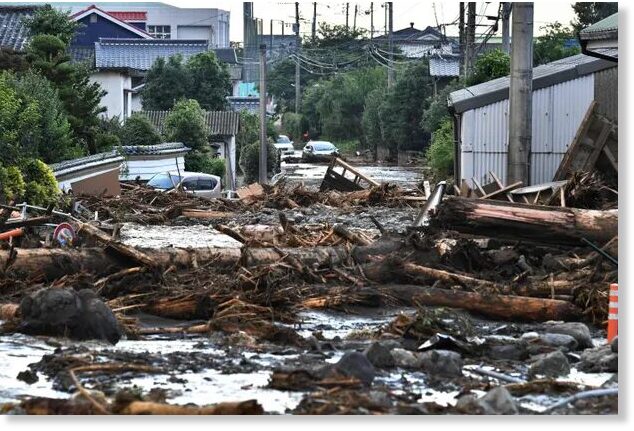
Six people died and three others were missing after the "heaviest rain ever" triggered floods and landslides in south-west Japan.
The Japan meteorological agency warned residents in Kyushu - one of the country's four main islands - to stay alert for more landslides, a common hazard in mountainous areas after heavy rainfall.
However, the agency on Tuesday downgraded an earlier special warning for heavy rain covering more than 1.7 million people in northern parts of the island.
Japan has been hit by unusually heavy rain and powerful typhoons in recent years, raising fears about its vulnerability to the climate crisis.
"This is the heaviest rain ever experienced" in the region, said Satoshi Sugimoto, a meteorological agency official. "The situation is such that lives are in danger and their safety must be secured."
Flash floods have struck several provinces in the Black Sea region, killing at least one person and triggering more than 1,000 landslides, with the Turkish State Meteorological Service once again issuing an "orange alert" for the region.
Following the bureau's "orange alert," which signifies a possibility of damage and loss in a dangerous weather situation on July 9, heavy rainfall paralyzed life in central and western parts of the Black Sea region. Several cities, notably Zonguldak and Bartın, experienced flooding in homes and businesses, with streets and roads turning into waterlogged areas.
The authorities urged citizens to heed the orange warning that would remain in effect till July 10, advising them to stay away from high-risk areas such as creek beds.
This Monday, the National Center for Disaster Prevention ( Cenapred ) indicates in its latest monitoring of the Popocatépetl volcano that 50 exhalations were detected accompanied by water vapor, volcanic gases and, on occasions, small amounts of ash.
In addition, 213 minutes of tremor (equivalent to 3.33 hours of high frequency, low to medium amplitude segments) were recorded , as well as 13 minutes of low amplitude harmonic tremor. A volcanotectonic earthquake registered yesterday at 22:45, with a magnitude of 1.4, was also reported.
While the volcano has been overall relatively calm during the past weeks, a sudden explosion occurred this morning from the southeast summit crater.
The eruption lasted about two minutes only and produced a dense brown ash plume that rose a few 100 meters and quickly dispersed to the southwest. No significant changes in volcanic tremor accompanied the event and there has been no official statement from the volcano observatory so far.
It is possible that the event did not involve any fresh magma and was driven purely by an internal phreatic explosion as trapped water can interact with hot rocks or residual magma inside the conduit.
A volcano has erupted about 19 miles (30km) from Iceland's capital, Reykjavik, the country's meteorological office has said, marking the third time in two years that lava has gushed out in the area.
"The eruption is taking place in a small depression just north of Litli Hrútur, from which smoke is escaping in a north-westerly direction," the office said.
Local media footage showed a massive cloud of smoke rising from the ground as well as a substantial flow of lava.
The smoke could be seen from the road connecting the capital to the international airport, with cars pulled over and people taking pictures.
A 6.6 magnitude earthquake struck Monday in the Atlantic Ocean near the northern Caribbean, causing some buildings to lightly sway in the region.
The quake struck at a shallow depth of six miles (10 kilometers), according to the U.S. Geological Survey. The epicenter was located about 170 miles (270 kilometers) north-northeast of Antigua and Barbuda.
The earthquake was felt on several islands, including Puerto Rico. No damage was immediately reported.
Comment: The data is showing that Earth isn't warming, it's cooling; but there are indeed marine heatwave events occurring, alongside a variety of other unusual and rare phenomena, that reveal our planet - and the solar system at large - is undergoing a significant, and potentially catastrophic, shift: