
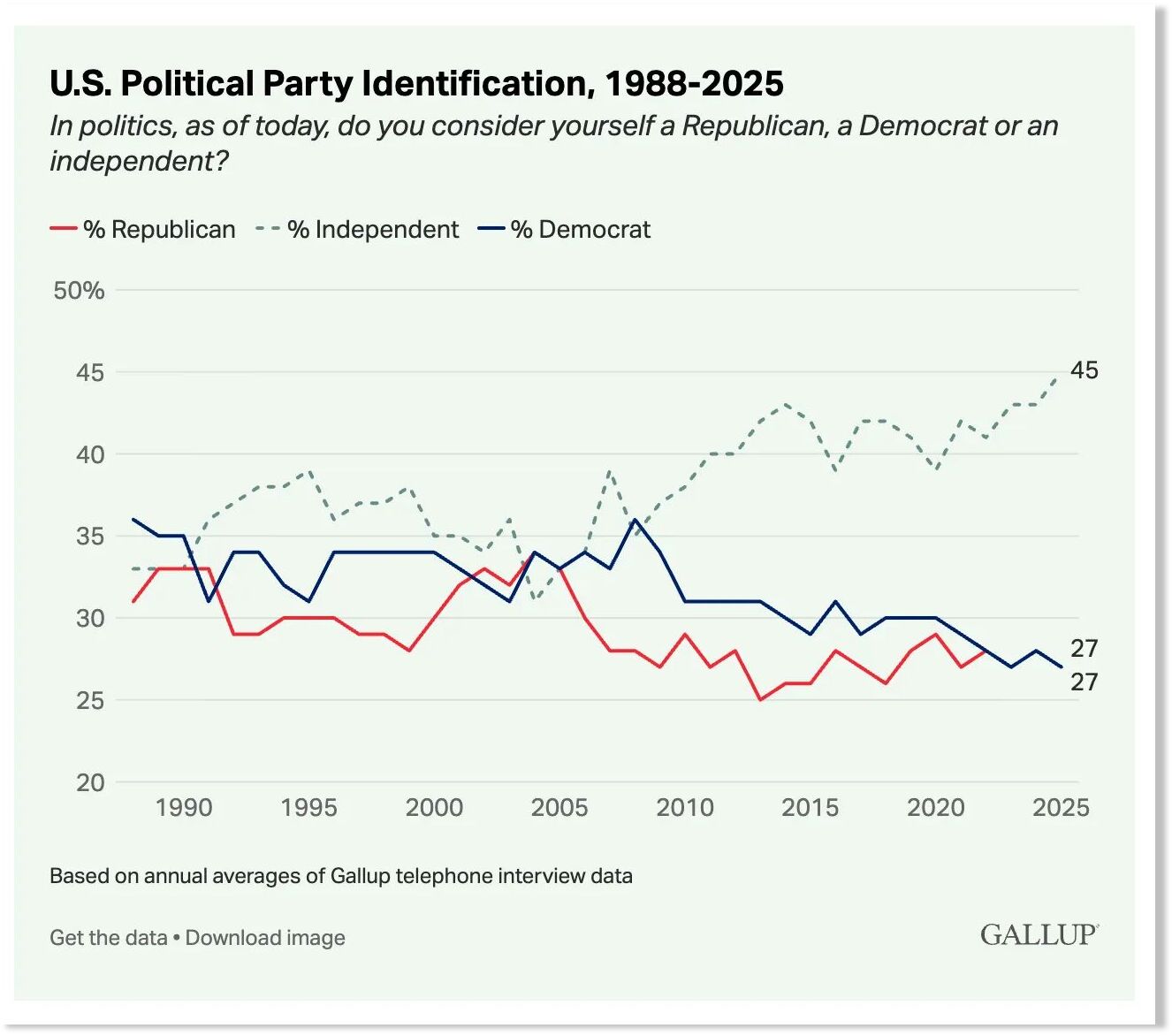
Every four years, independents are put in the position of either throwing their vote away for a third-party candidate who will get at most 3% of the popular vote, or choosing what they see as the lesser of two evils. (In the last 50 years, only Ross Perot came close, winning 19% in 1992.)
That's not to say independents are a homogeneous group. Slightly more independents lean Democrat than Republican (20% vs. 15%), with a core 10% who explicitly reject both parties. Given the choice (and an electoral system that would support it), their votes might be split among a handful of parties, as is the case in most democracies. The end result is that the largest segment of the American voting population does not have consistent political representation, at least on the federal level.











Comment: Local reporting: